 小影邮箱
邮件挽留怎么写?Keeping a Reader
Key Takeaways
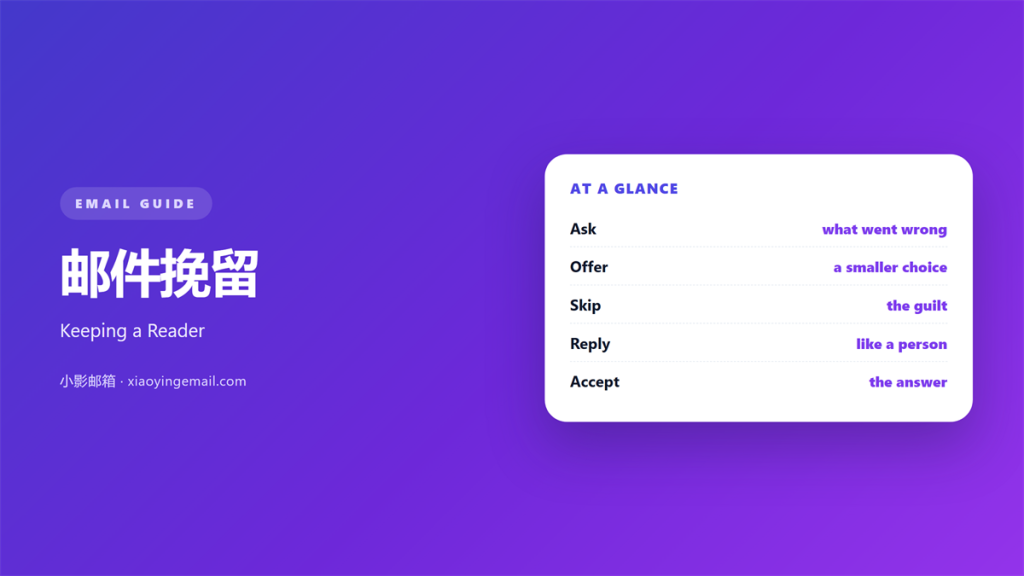
- 邮件挽留 is one honest note before a reader leaves.
- Ask what went wrong in a single question.
- Offer a smaller choice, such as fewer mails.
- Make the exit easy and the reason visible.
- Never trade a clean goodbye for a long fight.
What 邮件挽留 means
邮件挽留 is the moment a sender tries to keep a reader.
It happens when interest starts to fall.
The signs are quiet. Fewer opens, fewer clicks, no replies.
The reader may also reach the unsubscribe link.
That click is a message, not a mistake.
Retention starts by reading that message.
It ends with a clear choice, given freely.
Persuasion is fine. Pressure is not.
A good note says what will change.
It also says what will not.
One honest offer is usually enough.
Two offers begin to look like a trap.
Most exits are decided before the click.
The click only records a choice already made.
So the best time to ask is earlier.
Why 邮件挽留 matters
Getting a reader back costs less than finding a new one.
The old reader already knows the name.
That memory is an asset.
Retention is cheaper than acquisition.
It also protects the sender’s reputation.
Complaints fall when people can leave easily.
A clear exit reduces the urge to mark mail as spam.
Spam marks hurt every future message.
So retention and deliverability share one goal.
Make leaving simple, and staying likely.
The quiet cost of a lost reader
One reader leaves without a word.
The list shrinks by a number nobody notices.
Ten thousand quiet exits become a trend.
Each one took a reason with it.
邮件挽留 asks for that reason while it is still fresh.
A new reader takes months to trust a sender.
The old one already opened a hundred mails.
That history cannot be bought back.
Keep it while you can.
When 邮件挽留 helps
邮件挽留 helps when the reader still opens sometimes.
A single missed month is not a goodbye.
It helps when the problem is frequency.
Many readers want less mail, not none.
It also fits a change of interest.
A reader may want one topic and not the rest.
Use it when a subscription is about to renew.
A reminder is fair at that point.
And use it after a long silence.
One note can test whether the door is still open.
If there is no answer, close the file politely.
A reader who replies is telling you something useful.
Treat the reply as research, not a favour.
Then use it in the next campaign.
Signals worth watching
Opens are a weak signal.
Clicks are stronger.
Replies are strongest.
Watch the trend, not a single week.
Then act before the exit, not after it.
When 邮件挽留 hurts
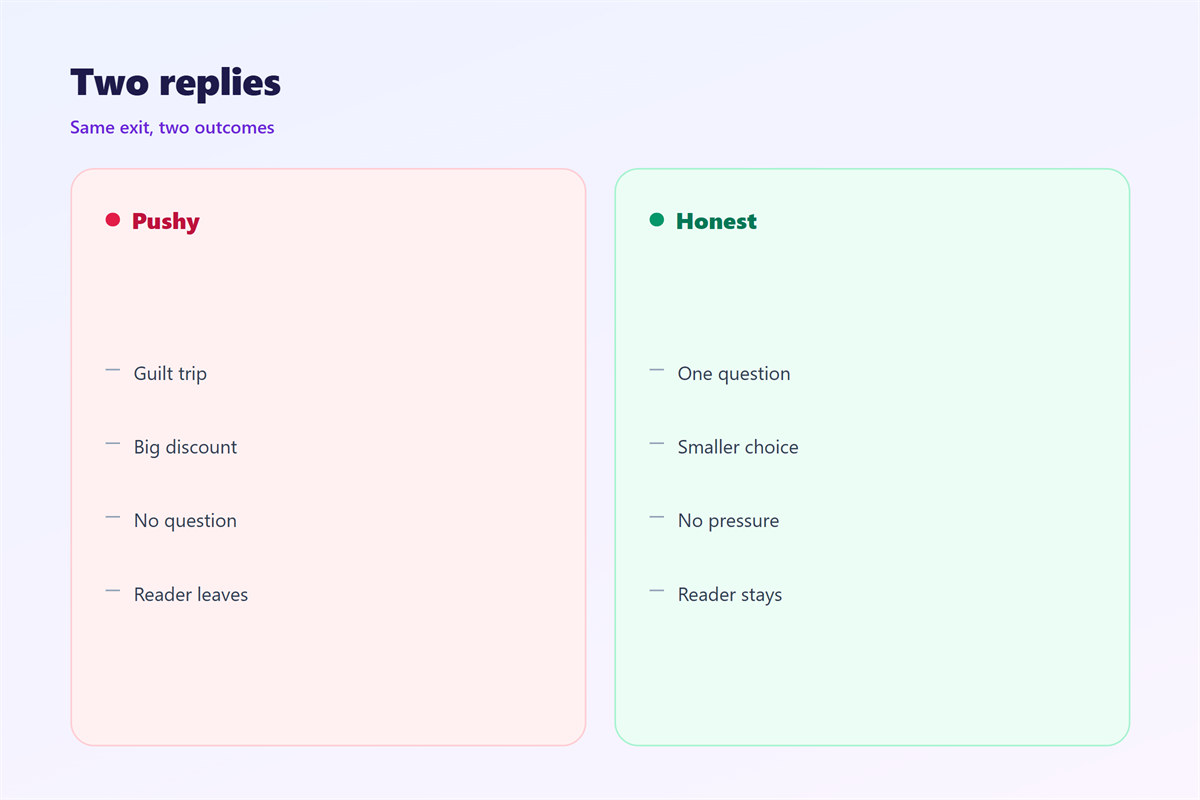
邮件挽留 hurts when it blocks the exit.
A hidden unsubscribe link is a dark pattern.
It hurts when the note arrives after every campaign.
Readers stop believing the concern.
It also hurts when the offer is only a discount.
A bribe answers a price question nobody asked.
And it hurts when the sender argues.
A reader who says no has already decided.
One reply, one honest sentence, then let go.
邮件挽留 that fights costs more than it saves.
Readers talk to each other about tricks.
A blocked exit becomes a public story.
That story outlives the campaign.
邮件挽留 and the exit
The exit is part of the product.
A slow page tells the reader what the sender thinks of them.
So keep the path short and visible.
One click should reach the choice.
No survey wall before the button.
No login screen in the middle.
Ask the reason after the exit, not before.
Test the page on a phone.
Most exits happen on a phone.
邮件挽留 works best when leaving stays simple.
Ask, then accept
Ask one question: what would you change?
Give four answers and a blank box.
Then accept the reply as it comes.
A defensive response closes the door for good.
How to use 邮件挽留 well
Write the note as a person, not a system.
Name the behaviour you noticed.
Say what you will change.
Offer one smaller option.
Keep the unsubscribe link in plain sight.
The note should fit on one screen.
Use a short subject that names the choice.
Send it once. Twice is pressure.
Then pass the reasons to the content team.
Fix the pattern behind the exits.
Read the note aloud before sending.
If it sounds like a form letter, rewrite it.
One sentence of plain language is enough.
This work is a question, not a campaign.
邮件挽留 in a sequence
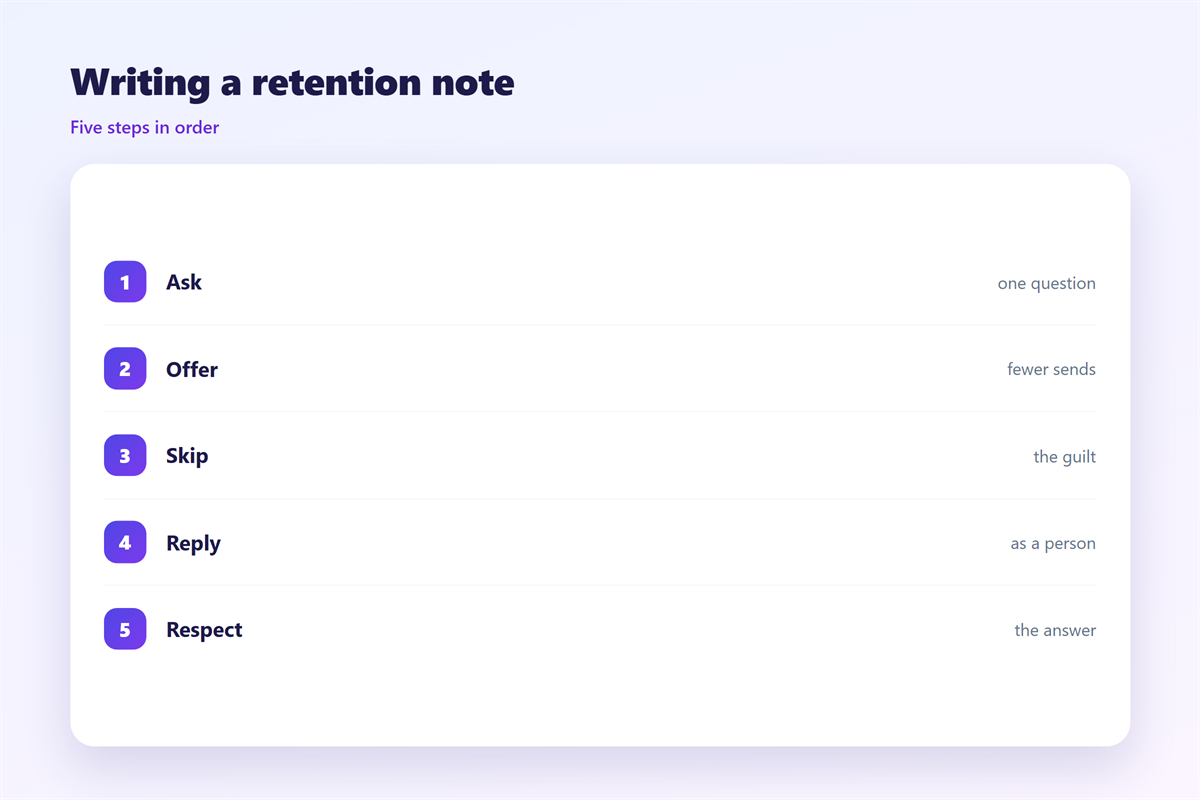
A retention sequence has three steps.
Step one notices the silence.
Step two offers a smaller choice.
Step three says goodbye with grace.
Space the steps by two weeks.
Stop the sequence after any reply.
Then set a quiet date for a later return.
One note a year is enough after that.
邮件挽留 in a sequence needs an owner.
Someone must read the answers.
Otherwise the questions are theatre.
Measure the replies, not the saves.
The reasons matter more than the count.
Keeping 邮件挽留 consistent
Consistency keeps the tone honest.
Use the same question everywhere.
The exit path is designed in 邮件退订页. The smaller choices live in 邮件偏好中心. Later returns are covered in 邮件唤醒. The wider habit sits in 邮件客户关怀.
Then write the steps into one playbook.
A team that follows it stops guessing.
FAQ
How often should a 邮件挽留 note go out?
Once per reader, then once a year at most.
Should I offer a discount to stay?
Only if price caused the silence. Ask first.
Can I stop the unsubscribe?
No. Blocking it breaks trust and often the law.
What if the reader replies with anger?
Thank them, fix what you can, and close the loop.
评论
还没有评论,来说两句吧。
评论功能已关闭。