 小影邮箱
邮件逻辑怎么理?Logic That Holds Together
Key Takeaways
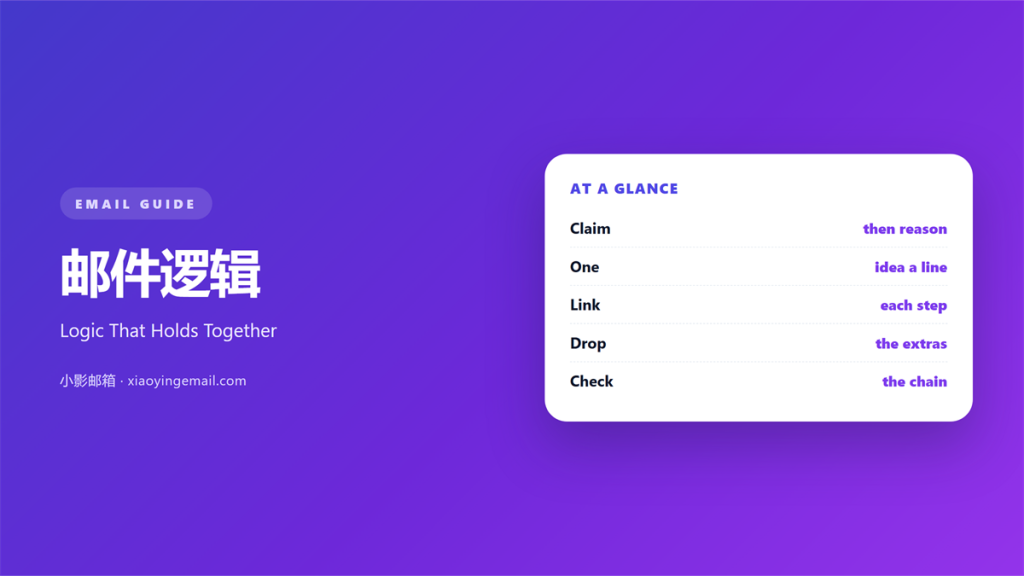
- 邮件逻辑 is the chain that links each line to the next.
- State the claim before you give the reason.
- One paragraph should carry one claim.
- Remove any point that does not support the ask.
- Read the chain backwards to test it.
What 邮件逻辑 means
邮件逻辑 is the chain that links each line to the next.
Each sentence should follow from the one before it.
The reader should never ask why a line is there.
Logic is not the same as length.
A short note can be tightly reasoned.
A long note can wander in circles.
The test is simple. Remove a line and see what breaks.
If nothing breaks, the line was not needed.
Good 邮件逻辑 feels obvious once it is read.
That ease comes from careful order, not luck.
Most writers build the chain after the first draft.
That is normal, and it is safe.
The first draft finds the ideas. The second draft orders them.
A clear order also makes the note shorter.
Why 邮件逻辑 matters
A reader follows a chain of reasons.
One weak link stops the whole argument.
The reader then asks a question you did not answer.
That question costs a reply.
Clear logic keeps the thread short.
It also makes the decision easier to defend.
A manager can forward a logical note without edits.
A loose note needs a second explanation.
That second explanation is where delays start.
Teams remember the writer who makes sense.
That memory earns more trust than a clever line.
That trust grows with every clear note.
The because test
Put the word because after each claim.
If you cannot finish the sentence, the claim is weak.
Either find the reason or cut the claim.
That single test fixes most drafts.
When 邮件逻辑 helps
Logic helps most in a proposal.
The reader needs to see why the plan will work.
It helps in a complaint or a correction.
Facts must come before any judgment.
It also helps when several people must agree.
A shared chain gives them one path to follow.
Then the debate moves to the facts, not the tone.
That shift alone can end a long argument.
A simple chain is easy to check later.
One claim at a time
Give each claim its own short block.
Add the reason under it.
Then add the evidence that supports the reason.
Do not stack two claims in one paragraph.
Readers lose the thread when you do.
When 邮件逻辑 hurts
邮件逻辑 hurts when it turns into a lecture.
A perfect chain can still sound cold.
Some writers prove too much.
The reader wanted an answer, not a case.
It also hurts when the chain hides the ask.
A long proof can bury the request.
Put the ask first and the proof after.
Stop proving once the reader is convinced.
More reasons rarely change a settled mind.
They only add length to the note.
邮件逻辑 and evidence
Every reason needs a fact behind it.
A number, a date, or a quote will do.
Vague words weaken a strong chain.
Write “three late shipments” instead of “some issues”.
Then link the fact to the claim in one line.
The link is the logic the reader needs.
Here the craft of logic meets plain evidence.
Name the gap
If a step is missing, name it.
A visible gap is better than a hidden one.
Write what you know and what you still need.
Then ask for the missing piece.
That keeps the chain honest and short.
How to use 邮件逻辑 well
Plan the chain before you write.
List the claim, the reason, and the evidence.
Put them in the order a reader needs.
Then write one short paragraph for each step.
Use a link word when the jump is large.
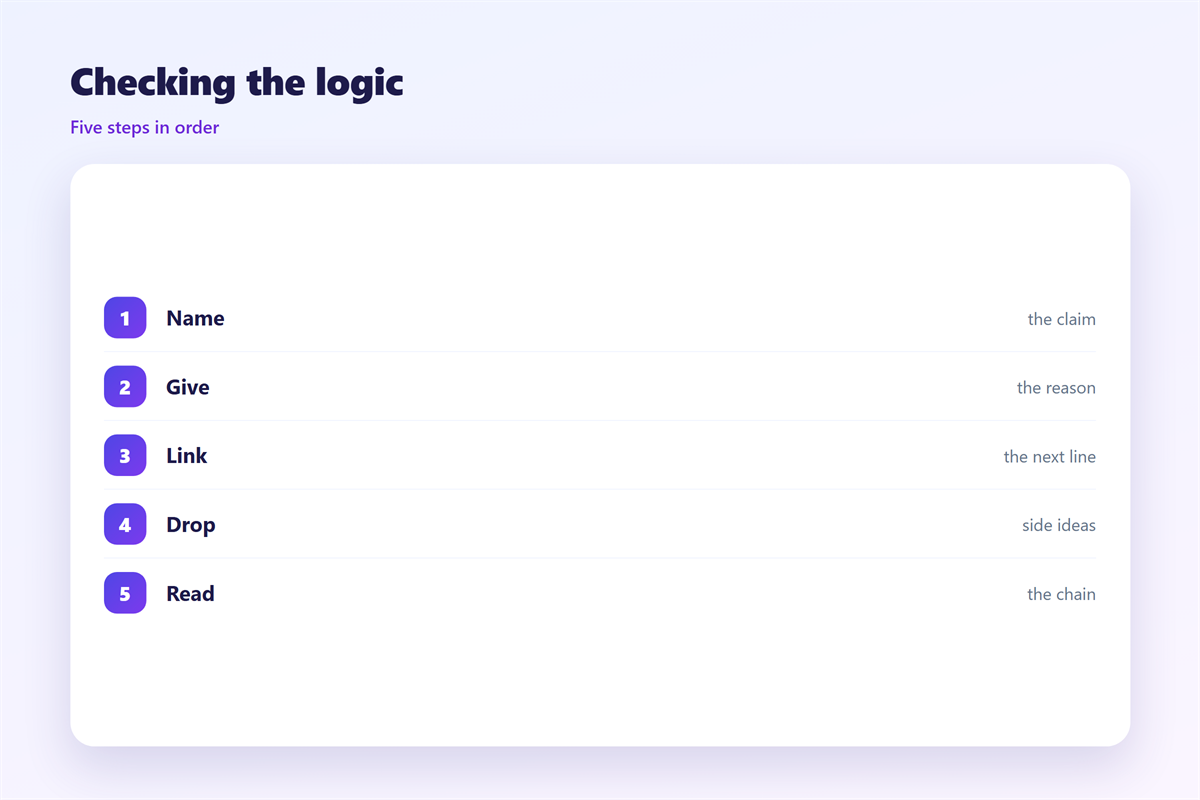
Read the draft backwards, line by line.
Ask what each line proves.
Then cut any step the reader can infer.
Good order also saves the writer time.
Good 邮件逻辑 survives that reverse read.
A short logic pass
After the draft, mark every claim.
Draw a line to its reason.
Any claim without a line should go.
Any reason without a fact should go too.
邮件逻辑 in a reply chain
Long threads lose their logic first.
Each reply answers the last one, not the question.
Restate the open question at the top.
Then answer it in two lines.
Quote the point you are replying to.
That keeps both sides on the same page.
A clear 邮件逻辑 ends a thread faster.
It also stops the same question from returning.
Short replies keep the chain easy to follow.
One open question per note is enough.
Keeping 邮件逻辑 consistent
Logic should not change with the reader.
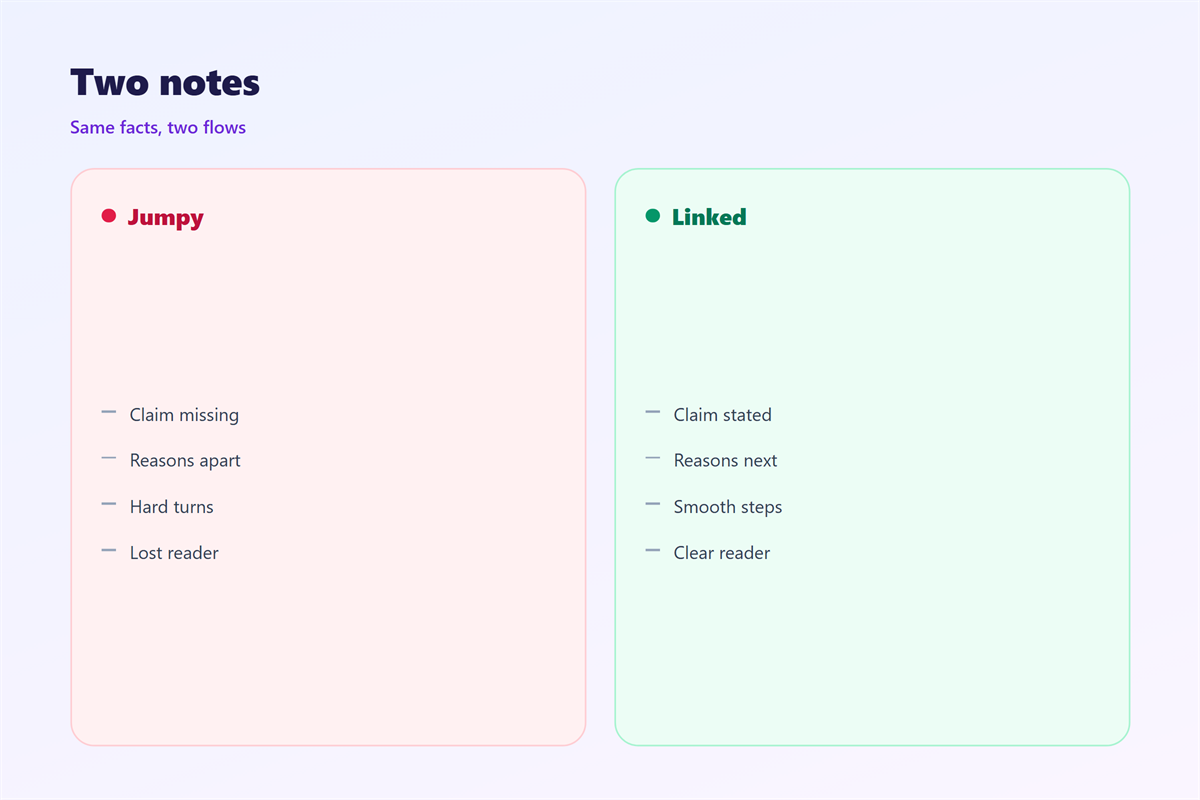
The same facts should lead to the same claim.
Agree on how reasons are written.
The connecting words are covered in 邮件过渡.
The short summary sits in 邮件要点.
The planning step appears in 邮件提纲.
The drafting basics are in 邮件撰写.
Then check a few sent notes against the chain.
Fix the pattern, not just the single draft.
A short chain is easier to defend.
Consistent 邮件逻辑 makes a team easier to trust.
It also makes every new note faster to write.
FAQ
What makes an email logical?
A clear claim, a reason, and a fact. Each line should follow from the one before it.
How do I check 邮件逻辑?
Read it backwards. Ask what each line proves. Cut any line that proves nothing.
Does 邮件逻辑 need formal words?
No. Plain words carry logic better. Formal phrases often hide a missing reason.
Can logic make a note too cold?
Yes, if you skip the human line. Add one warm sentence at the close. Then keep the chain intact.
评论
还没有评论,来说两句吧。
评论功能已关闭。