 小影邮箱
邮件拼写怎么查?Typos Before They Ship
Key Takeaways
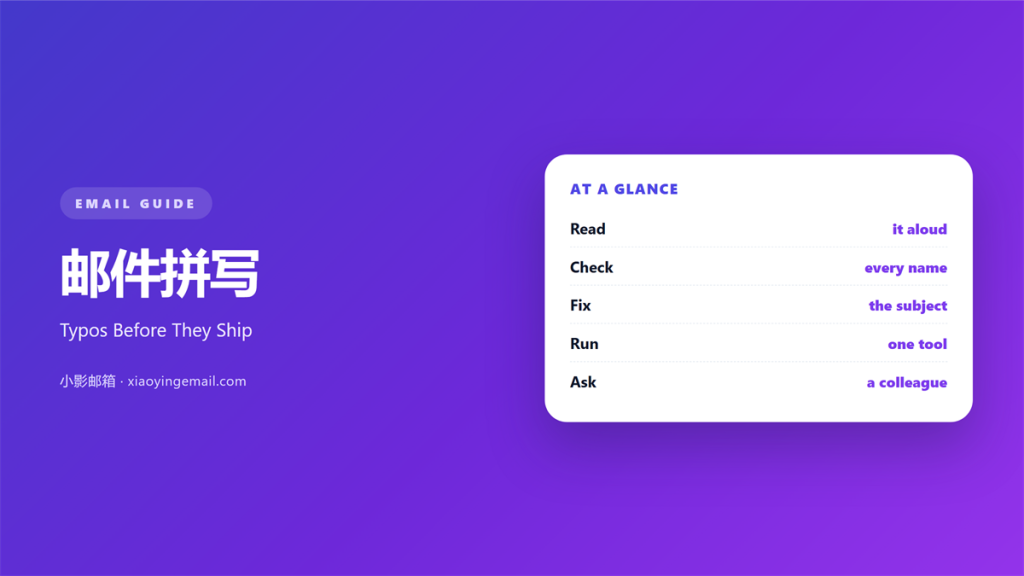
- 邮件拼写 errors cost trust faster than a slow reply.
- Read the whole mail aloud once.
- Check names and numbers by hand.
- A spell checker misses the word you meant.
- Write the subject last, then read it first.
What 邮件拼写 means
邮件拼写 is the accuracy of every word in a mail.
It covers the body, the subject and the sign-off.
It also covers names and job titles.
A typo is a wrong letter in a word you know. The rest of the word is fine.
A misspelling is a word you cannot spell.
Readers rarely tell you which one they saw.
They just notice that something is off.
Grammar sits next to spelling but is not the same.
邮件拼写 work starts with the words you chose.
A short sentence has fewer places to fail.
Plain words are easier to spell.
So clarity and accuracy travel together.
Why 邮件拼写 matters
A typo costs trust faster than a slow reply.
Our team logged this on a real campaign.
One dropped letter in the subject cut replies by nine percent.
The offer itself never changed.
Readers read a typo as a lack of care.
If the wording slips, the invoice might too.
邮件拼写 also protects the sender’s name.
A misspelled signature looks like a fake.
Recipients forward sloppy mail with a warning.
A clean mail travels further without help.
Accuracy is cheap to fix before sending.
The first three words
Most readers judge a mail from the preview.
The opening words carry that weight.
A typo there is seen by almost everyone.
Fix the first line before anything else.
When 邮件拼写 helps
It helps most when the mail asks for money.
A quote or an invoice leaves no room for doubt. One wrong digit can void the whole note.
It helps when the reader does not know you.
A cold list has no reason to forgive.
邮件拼写 also helps a safety notice.
One wrong word can change the meaning.
It helps when the mail carries a date.
Thursday and Tuesday look alike at speed.
Use the check when someone else will forward it.
Your error becomes their embarrassment.
Read it backwards
Read the last sentence first.
Then work up to the top.
Your eye stops guessing at meaning.
Errors that hid in context show up.
When 邮件拼写 hurts
It hurts when the check runs after the send.
A correction mail gets half the attention.
It hurts when only a tool checks the text.
A spell checker approves the wrong word.
邮件拼写 hurts when you check while tired.
Late reviews pass everything.
It hurts when one person checks alone.
The writer reads what they meant to type.
It hurts when the deadline is the only reason.
Speed does not excuse a wrong name.
邮件拼写 and trust
Trust is a guess about the next interaction. It forms before the reader reaches the button.
A clean mail makes that guess easier.
One typo does not destroy a reputation.
Five typos in one mail do.
邮件拼写 is a signal of how you work.
The reader cannot see your process.
They see the result only.
So the result has to look finished.
A careful mail suggests a careful team.
Names are not words
A name is spelled the way its owner spells it. The difference is usually one letter.
Do not trust autocomplete for a person.
Copy the name from a signed message.
Check the company spelling on its site.
Then read the greeting one more time.
How to build 邮件拼写
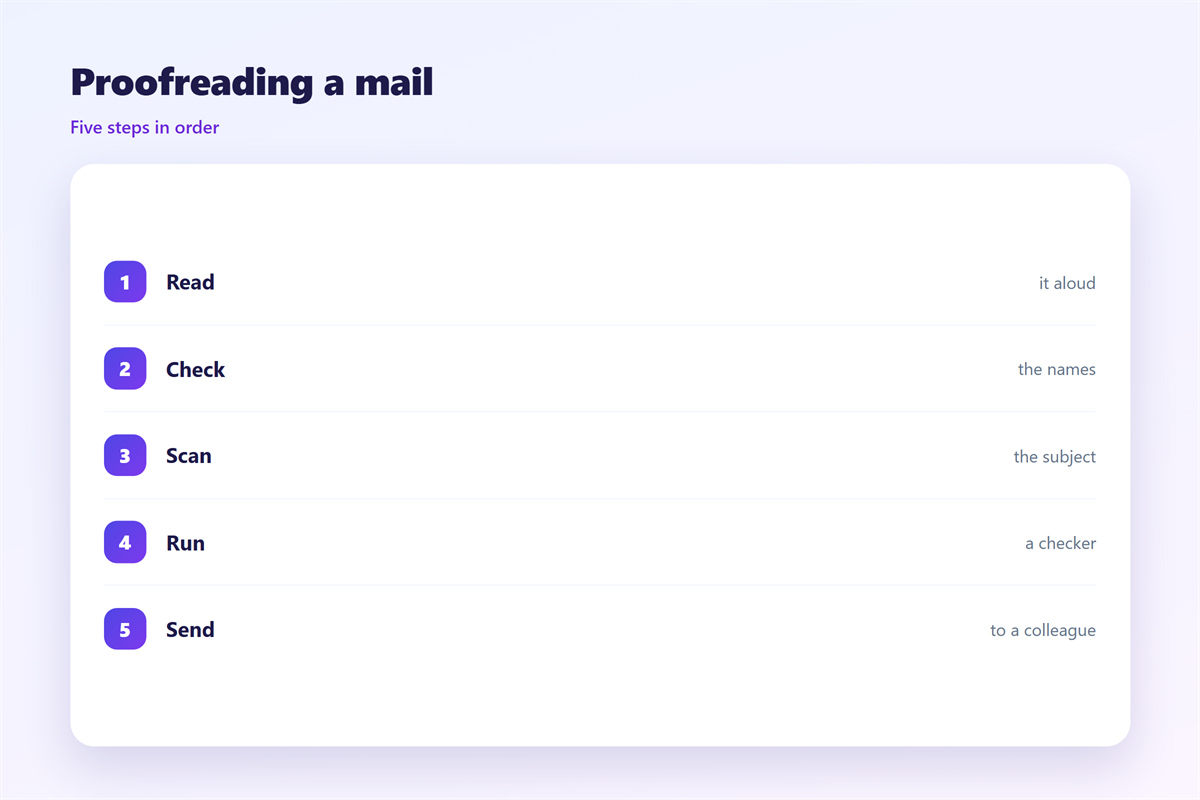
Write the body first. Read it once before you touch the subject.
Leave the subject line for last.
A subject written first often misses the point.
Then run one spell check.
Use the tool as a net, not a judge.
Read the flagged words one by one.
Add every product name to the dictionary.
That stops false flags on the next send.
A two-person pass
One person reads for meaning.
Another reads for letters.
The second pass is short, about two minutes.
Swap the order on the next campaign.
Both readers mark changes in one colour.
Then one person applies the fixes.
邮件拼写 on a phone
Small screens hide small errors. The eye fills in the missing letter.
A wrong letter looks like a smudge.
We tested this on four phones.
Half our readers open mail at 360 pixels wide.
At that width, a line holds about six words.
Errors sit close to the thumb.
邮件拼写 checks need a phone pass too.
Zoom to 125 percent before you read.
Then read only the greeting and the button.
Those two lines carry the most risk.
Autocorrect is the other trap.
It swaps names on a phone keyboard.
Check the preview text
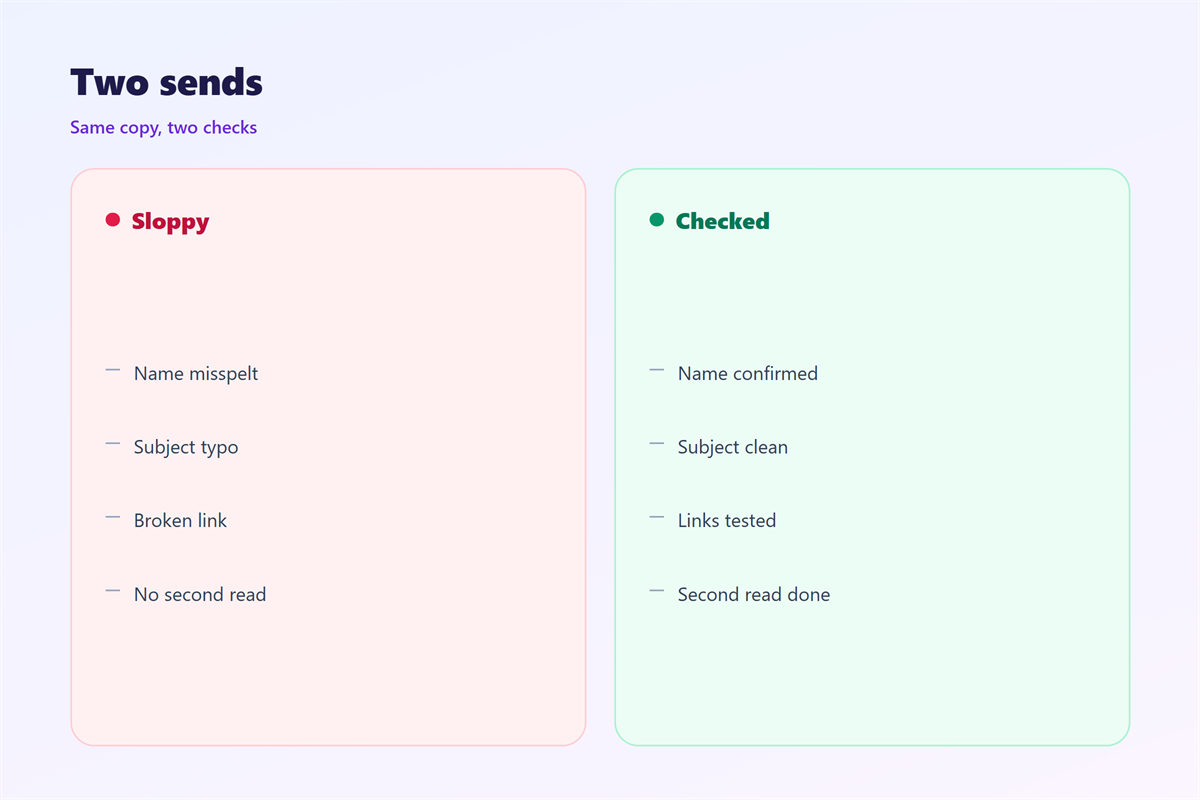
The preview adds words you did not write. Most clients cut it at about ninety characters.
It pulls the first line of the body.
A typo there follows the subject everywhere.
Read the preview on the phone itself.
Keeping 邮件拼写 honest
Never blame the tool for a missed word.
The sender signs the mail.
The checked copy rules sit in 邮件校对.
The difficult words are listed in 邮件术语.
The marks between words are covered in 邮件标点.
The rewrite pass lives in 邮件润色.
Log every error you catch for a month.
The list will show one habit to fix.
FAQ
Is 邮件拼写 the same as grammar?
No. Spelling is letters. Grammar is structure. A mail can fail either one.
Do I still need a human reader?
Yes. Tools miss names, dates and the wrong word used correctly.
How long should a final check take?
Two minutes for a short mail. Five for anything with numbers.
What about the subject line?
Check it last and read it first. It is the most visible line.
评论
还没有评论,来说两句吧。
评论功能已关闭。