 小影邮箱
邮件分众怎么做?Splitting a List Well
Key Takeaways
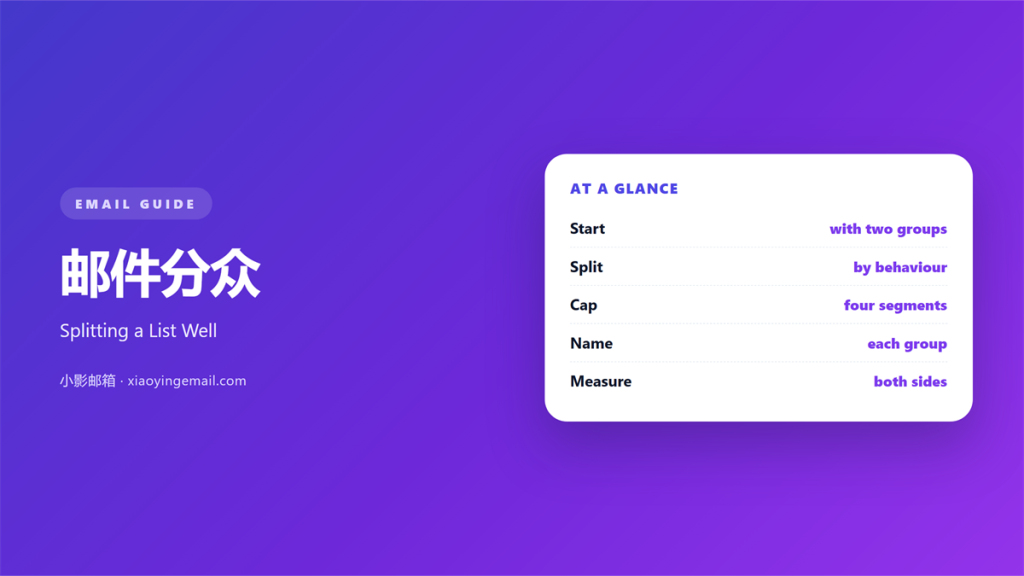
- 邮件分众 splits a list by what people actually did.
- Two groups beat six for a first test.
- Size matters less than a clear rule.
- Name each segment after its rule.
- Check both groups after the send.
What 邮件分众 means
邮件分众 means sending different mails to different slices of one list.
The whole list stays in one place.
Only the send changes.
A slice can be small or large.
What matters is the rule behind it. A good rule survives a new campaign.
Most rules use a fact you already store.
A purchase, a click or a signup date will do.
A 邮件分众 rule must be repeatable.
Anyone on the team should get the same slice. That test keeps the rule honest.
So write the rule down as a sentence.
“Bought once, no order in ninety days” is a rule.
“Good customers” is not.
Why 邮件分众 matters
One message cannot fit every reader.
A first-time buyer and a regular need different words.
A split lets one send serve both.
Our team ran that test on a list of 22,000.
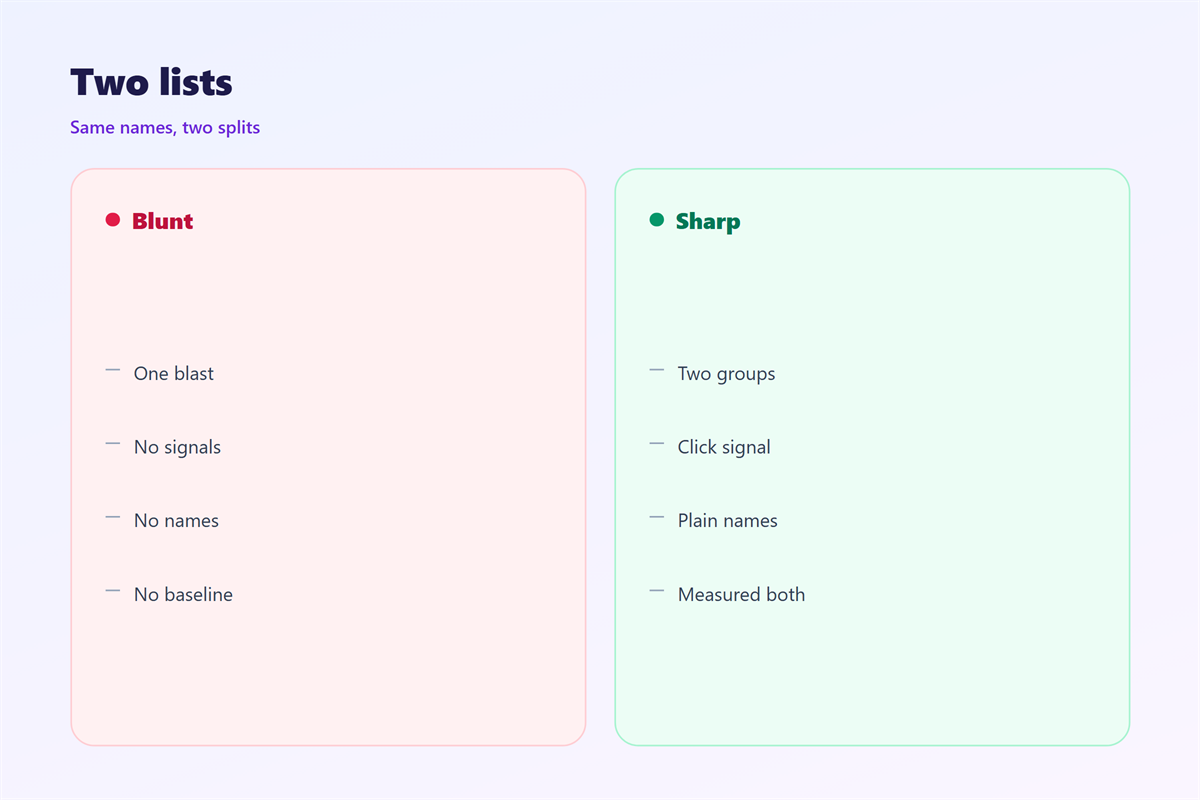
The split raised clicks by 31 percent over one blast. The subject line never changed.
That gain came from relevance, not volume.
Splitting also protects the list.
Fewer irrelevant sends means fewer unsubscribes. Our complaint rate fell by half.
A matched group reads the whole mail.
As a result, the reply rate climbs.
A well-built segment also repeats.
One rule per segment
A segment is defined by one condition.
Two conditions make it harder to explain.
Hard rules hide errors.
Keep the first version simple.
When 邮件分众 helps
It helps when behaviour differs inside one list.
New readers and repeat buyers behave differently.
It helps when a mail has two versions of the offer. The cheaper plan suits the newer reader.
One version can mention the last order.
A 邮件分众 also helps a win-back note.
The quiet group gets a different nudge.
It helps around a launch or a price change.
Existing buyers need a different note than prospects.
Use it when the rule is stable for a month.
A rule that changes weekly is a guess.
Start with two groups
Split the list into two.
Send the same body with one changed line.
Compare clicks after three days.
Then split again if the gap holds.
When 邮件分众 hurts
It hurts when the segments are too small. A thin group hides its own result.
A group of forty cannot prove anything.
It hurts when the rule is a guess.
“People who like us” is not a condition.
A split built on names looks like profiling.
It hurts when nobody documents the rule.
Two senders then build two different lists.
It hurts when the split becomes a maze.
Twelve segments mean twelve mails to maintain.
Also, a hidden segment can receive nothing for a year. Then one morning they ask why the mail stopped.
邮件分众 and behaviour
Behaviour beats demographics for most lists.
A click is a signal you can trust.
A job title is often out of date.
So build the first rule from the last action.
Recency matters more than totals.
Someone who clicked last week is warm.
Someone who clicked last year is not.
Our team ranks recency above lifetime value.
That order fixed our worst segment.
Keeping a segment clean
Every segment needs an exit rule. Without one, the group grows forever.
A buyer should leave the prospect group.
Otherwise they get two offers at once.
Check the exit rule every month.
A stale 邮件分众 sends the wrong note.
How to build 邮件分众
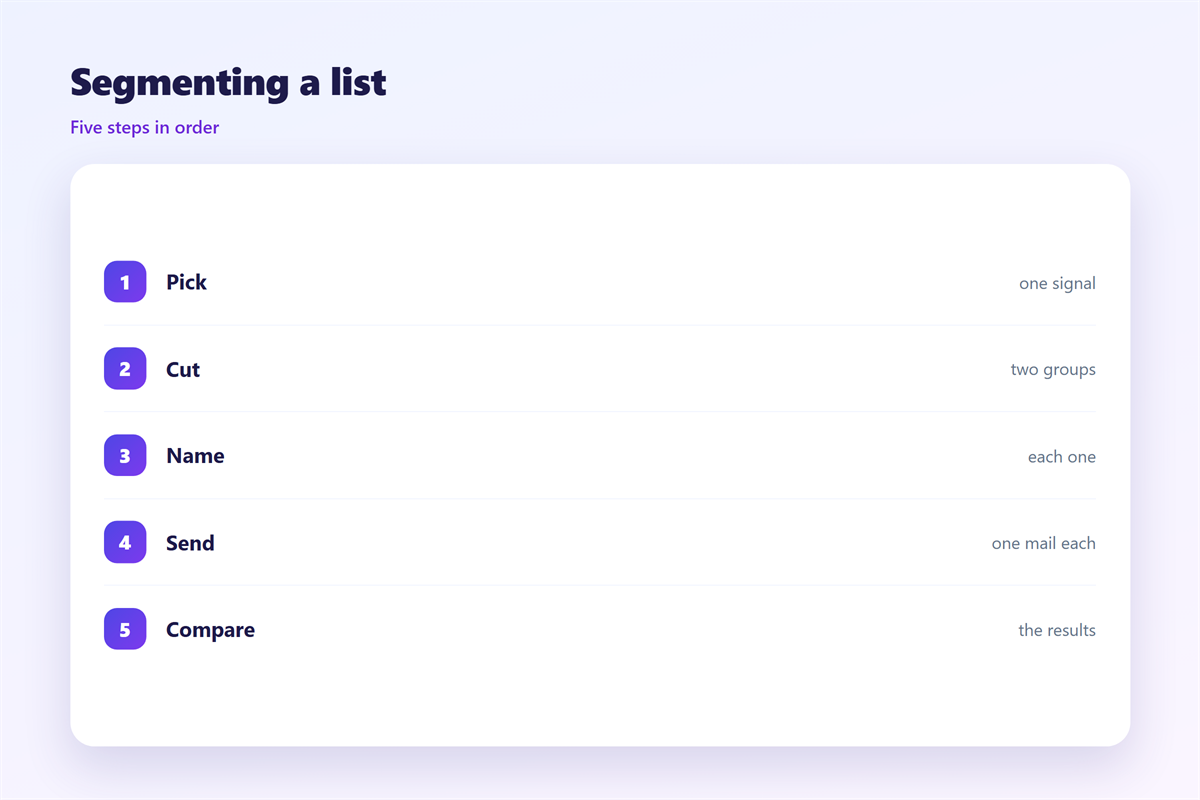
Export the list with its activity columns.
Pick the one action that predicts a reply.
Write the rule as a single sentence. Then read it back the next morning.
Translate that sentence into one filter.
Test the filter against ten known records.
Fix the mismatch before you send.
Give the segment a plain name.
Store the rule next to the name.
Measure one thing
Pick one number to compare.
Click rate is the easiest start.
Keep the subject line the same.
Change only the line you are testing.
Then wait a full week.
A one-day gap is mostly noise.
邮件分众 on a phone
A phone shows one message at a time. There is no room for a second offer.
So a mismatched mail is easy to delete.
A 邮件分众 that fits the reader survives that glance.
Keep the mobile version short for every group.
Test the longest segment first.
Its members carry the most detail.
Check that the offer still makes sense on a phone.
A wide table will not fit at 360 pixels.
Keep the segment name out of the mail body.
Readers should not see the label you gave them.
“You have not ordered since March” is fine.
“Segment B” is not.
Check the label
Read the mail as a reader would.
A label can sound like a verdict.
Keep the tone factual.
Then send it to the smallest group first.
Keeping 邮件分众 honest
The simple grouping rules sit in 邮件分组.
The address handling is covered in 邮件列表.
The inbox sorting effect appears in 邮件标签页.
The follow-up pattern lives in 邮件再营销.
A 邮件分众 should never punish a reader.
Do not shrink a group just to lift a rate.
Check the group size before you celebrate.
Then write the rule into the shared notes.
FAQ
Can 邮件分众 work on a small list?
Yes. Two groups of a few hundred still show a gap.
How often should a rule change?
Rarely. Fix the rule, then change the offer instead.
Do segments cost more to send?
No. A segment is a filter, not a second list.
What if both groups perform the same?
Keep the simpler mail. The split earned nothing.
评论
还没有评论,来说两句吧。
评论功能已关闭。