 小影邮箱
邮件空行怎么留?Space That Helps
Key Takeaways
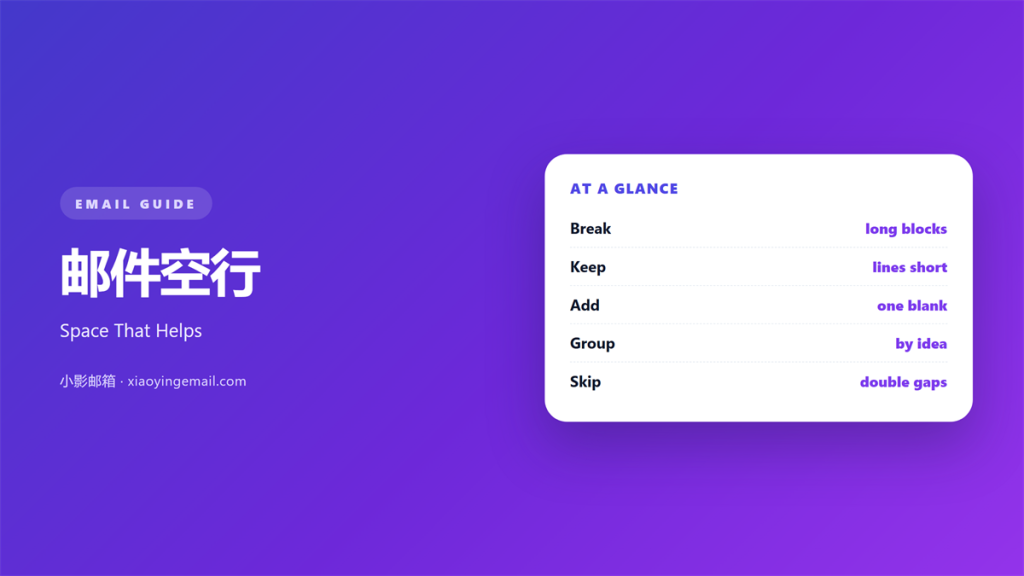
- 邮件空行 gives a reader a moment to pause.
- Use one blank line to split two blocks of text.
- Keep the gap steady and never random.
- Too many gaps make a note feel scattered.
- Space is cheap and it clearly helps.
What 邮件空行 means
邮件空行 is a blank line between two blocks of text.
It is not a decoration. It is a pause.
The pause tells the reader that one idea has ended.
And that the next idea is about to start.
Most editors create it when you press enter twice.
So the skill is knowing where the pause belongs.
Think of 邮件空行 as a breath between sentences.
A breath keeps a long speech easy to follow.
Without a breath, the speech runs out of air.
A short pause also gives the reader time to think.
So space is a tool, not just empty room.
Why 邮件空行 matters
A wall of text is hard to read.
The eye loses its place in a long block.
A single 邮件空行 breaks the wall apart.
It gives the eye a clear place to rest.
It also shows where one idea ends.
That helps the reader follow your thinking.
A clear page also looks friendlier.
And a friendly page gets read more often.
A block of text can also hide the main point.
Space helps the point rise to the top.
What a blank line cannot do
It cannot fix a message with no clear point.
It cannot hide a paragraph that is too long.
So cut weak words first, then add space.
When 邮件空行 helps
A blank line earns its place in a few clear cases.
Use it to split two separate ideas.
Use it before and after a short list.
Use it to set off a single closing line.
And stop there. A few gaps are plenty.
Each gap should mark a real change.
If two lines feel joined, a gap can separate them.
A well-placed gap is easy to miss.
Between blocks
Put one blank line between two paragraphs.
Two is fine for a big shift in topic.
Three is a sign the message needs an edit.
Around a list
A list reads better with space above and below.
The gap tells the reader a list has started.
It also stops the list from blending into the text.
When 邮件空行 hurts
Too many blank lines make a note feel jumpy.
The eye keeps stopping and starting again.
A page of tiny blocks is tiring to read.
Blank lines can also hide weak structure.
A weak note cannot be rescued by space.
So count your gaps before you send.
A simple count takes ten seconds.
Then remove any gap that adds no meaning.
A fewer, steadier set of gaps reads best.
The steady-gap rule
Keep the gap between blocks the same size.
A steady gap looks calm and tidy.
A random gap looks careless and rushed.
How to use 邮件空行 well
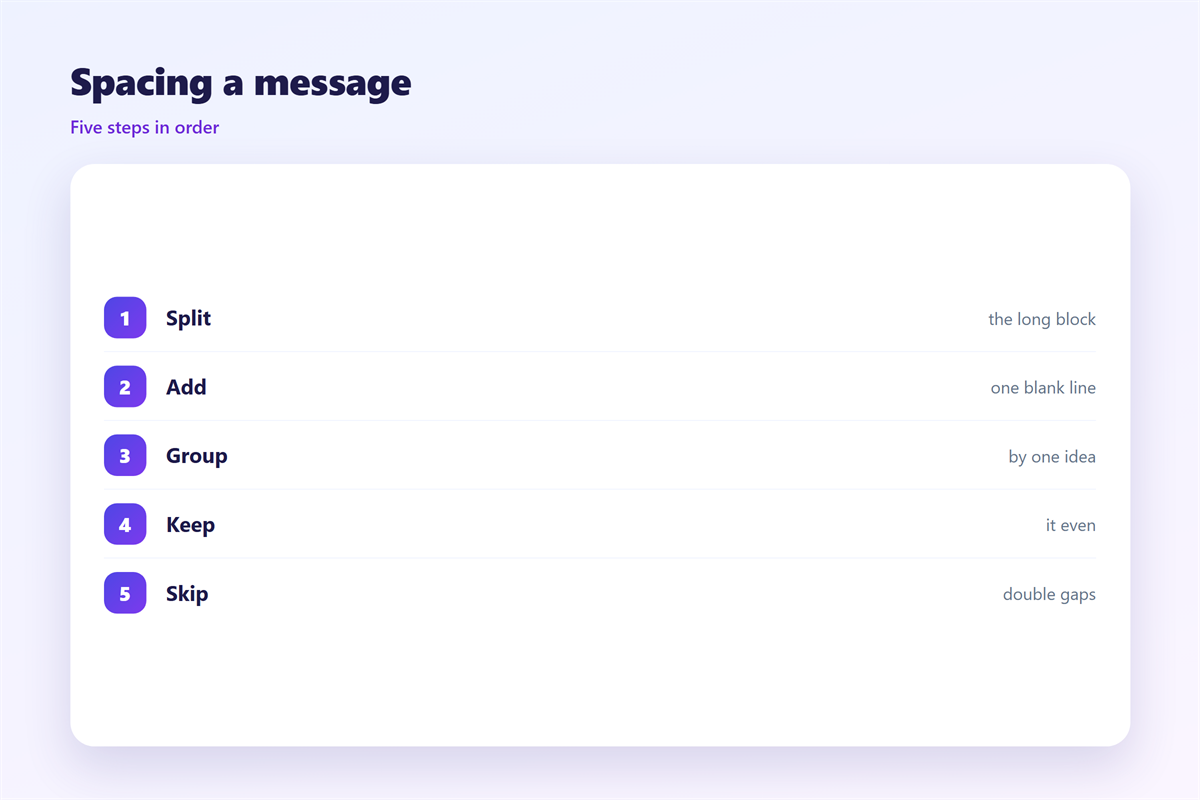
Start by cutting the text into clear blocks.
Each block should hold one idea.
Then add one blank line between the blocks.
Keep the gap the same through the whole note.
Then read the message on a small screen.
Good 邮件空行 is easy to miss in the best way.
The reader just moves down the page with ease.
Next, check the whole page at a glance.
Run your thumb down the gaps on the screen.
If the gaps feel uneven, tidy them up.
Then send a test copy to yourself.
Read it on a phone before you send it on.
邮件空行 and accessibility
Some readers use a screen reader to listen.
A screen reader may skip a blank line.
So never let a gap carry meaning on its own.
Use clear words to mark each new idea.
A heading can also signal a fresh block.
That keeps the note clear for everyone.
Test with a screen reader if you can.
A clear heading helps more than an empty gap.
A proper heading also helps a reader who scans.
It marks the start of each new idea.
邮件空行 across clients
Blank lines behave differently from one app to the next.
Some clients keep the gap as you set it.
Others remove the gap and join the lines.
In plain text, the gaps may vanish.
So plan for the plain version too.
A message that reads well without 邮件空行 is safest.
Write the plain version first. Then add the gaps.
Test the note in two or three apps.
Note where the gaps survive and where they close.
A simple note often keeps its shape best.
Keeping 邮件空行 consistent
Consistency turns a small rule into a habit.
Pick a house style and hold it across the team.
The space around the text is covered in 邮件留白.
The wider layout behind good spacing is covered in 邮件排版.
The way blocks form a message appears in 邮件段落.
The structure of the message body appears in 邮件正文.
Agree on how many blank lines a note may use.
Keep that rule for every message you send.
Then review the rule after a few weeks.
A short check keeps the habit from slipping.
A team that agrees on 邮件空行 writes cleaner mail.
FAQ
How many blank lines should I use?
Use one between blocks and two for a big shift.
Is 邮件空行 the same as a new paragraph?
Yes. One blank line usually starts a new paragraph.
It also gives the reader a clear pause.
Should I use a blank line after the greeting?
Yes. Keep one clear line after the greeting.
Do blank lines work in every mail app?
No. Some clients remove them, so test first.
A plain text version should still read well.
评论
还没有评论,来说两句吧。
评论功能已关闭。