 小影邮箱
邮件缩写怎么用?Short Forms Done Right
Key Takeaways
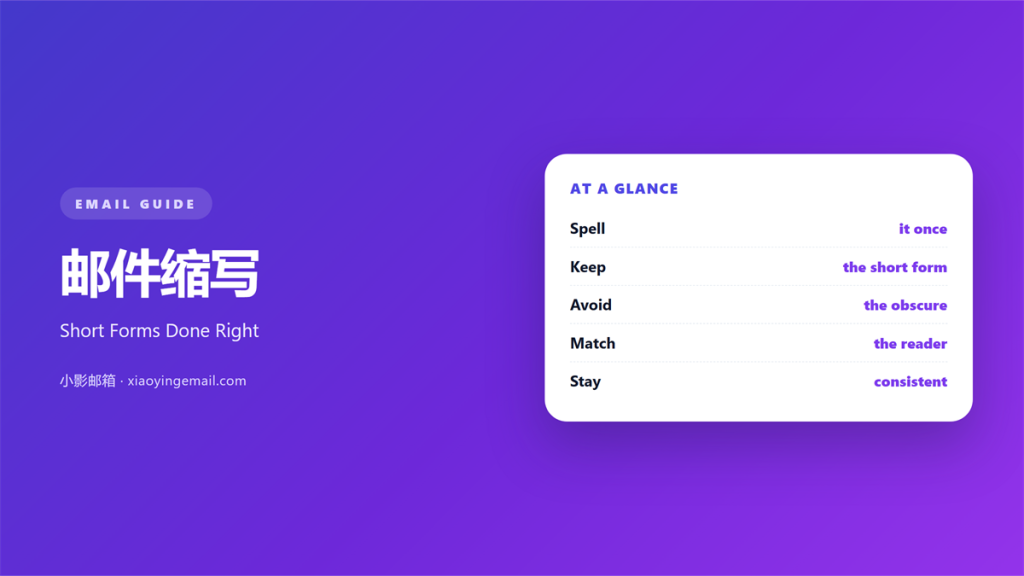
- 邮件缩写 saves time when the reader knows the short form.
- Spell the full term once before you shorten it.
- Standard short forms travel well between teams.
- Invented short forms confuse more than they help.
- Match the short form to the reader, not your habit.
What 邮件缩写 means
邮件缩写 is a shortened form of a longer word or phrase.
It saves space in a message that has to stay short.
Common ones include FYI, ASAP and EOD.
Most readers meet these on their first day at work.
The same term can also mean a shorter spelling.
For example, “approx.” stands in for “approximately”.
Some short forms come from Latin, like “e.g.” for example.
Others come from radio codes or early chat rooms.
New ones still appear every year in busy offices.
A short form is a tool, not a sign of laziness.
It simply packs a known idea into fewer letters.
The meaning stays the same for a reader who knows it.
The idea is simple. Fewer letters, same meaning.
The risk is real. A short form can hide a fact.
Why 邮件缩写 matters
A short form trades clarity for speed.
That trade is fine when both sides know the code.
It saves time in a busy thread.
Yet a reader outside your team may not know it.
Then 邮件缩写 becomes a small puzzle to solve.
Puzzles slow people down and invite mistakes.
Clear 邮件缩写 keeps everyone moving at the same pace.
A shared code also builds a shared identity.
It marks who belongs and who is still learning.
That sense of belonging can help a new team bond.
But a code that excludes a reader does real harm.
So use it to include, never to shut a door.
Common 邮件缩写 in the workplace
Some short forms appear in nearly every inbox.
Learn the ones your team uses most.
Do not learn every term at once.
Pick the five you see each day.
Time and tasks
EOD means end of day. COB means close of business.
ASAP means as soon as possible. It carries a sense of hurry.
TBD means to be decided, and it leaves a gap.
EOW means end of week. EOM means end of month.
People and roles
CC means carbon copy. BCC means blind carbon copy.
OOO means out of office. It tells people you are away.
POC means point of contact. It names the right person.
DM means direct message. It points to a private thread.
Everyday notes
FYI means for your information. It asks for no action.
NRN means no reply needed. It lowers the pressure.
TY and THX both mean thank you, with a softer tone.
BTW means by the way. It adds a small aside.
This list grows with each new project. Keep it short.
When 邮件缩写 helps and hurts
A short form helps when it is widely known.
It hurts when it hides a number or a name.
Never shorten a client’s name on a first email.
Never shorten a legal term in a contract note.
If the reader might pause, spell it out.
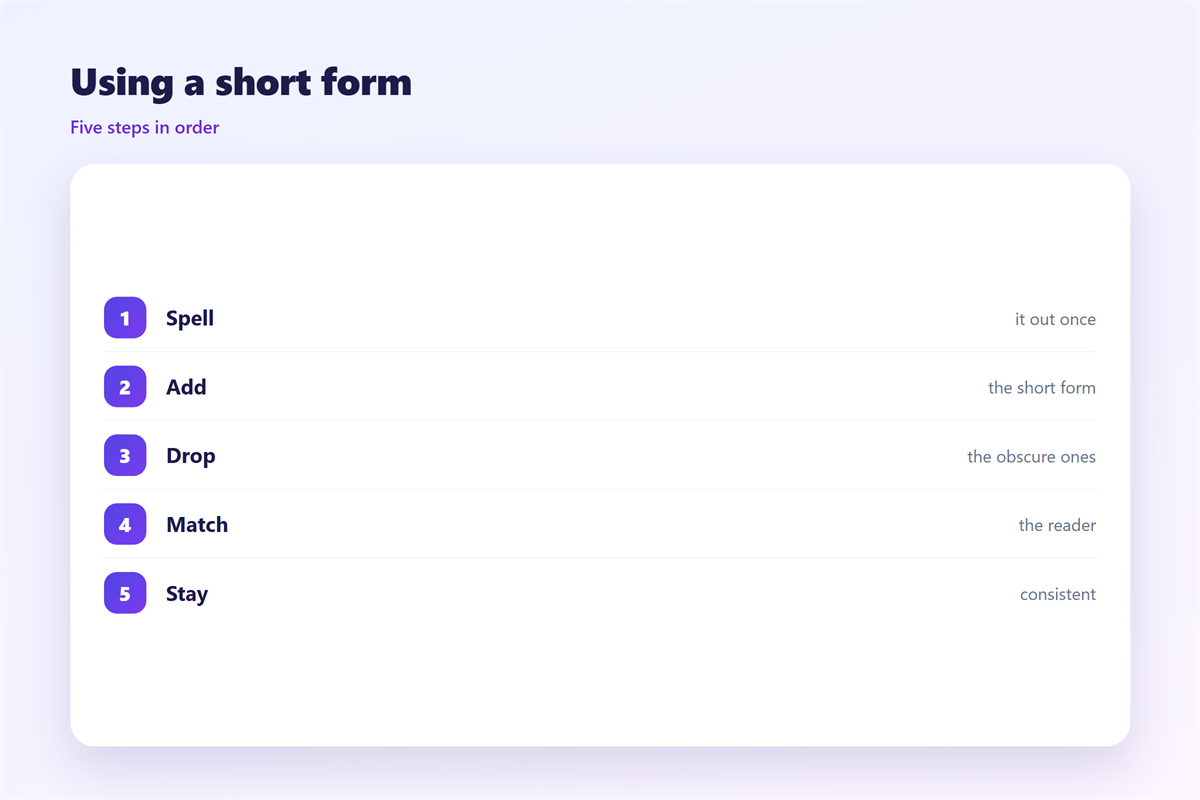
Write the full term once, then the short form in brackets.
After that, the 邮件缩写 is safe to reuse.
A bracket costs three seconds and saves a reply.
That is a cheap trade in any busy week.
So prefer the clear option when the stakes are high.
Spell these out
A deadline or a price deserves the full word.
A greeting or a signature can keep the short form.
Clarity first, speed second, every time.
邮件缩写 in greetings and sign-offs
Greetings set the tone before the first idea.
A plain “Hi” beats a coded short form here.
Sign-offs can carry a short form, but keep it mild.
“Best” and “Thanks” are short forms that always work.
Avoid stacking three short forms in one line.
For a formal note, spell everything out in full.
A greeting is not the place to save a syllable.
The reader forms a first impression there.
Keep it plain and let the body do the work.
A short sign-off can still sound warm.
The key is to match the reader’s own habit.
Write the closing the way you would say it aloud.
Fixing 邮件缩写 before you send
Read the draft as a stranger would read it.
Mark every short form you used.
Ask if each one is truly clear.
Check the reader knows each short form.
Check the same term means one thing only.
Check the tone still sounds friendly.
Spell out the ones that touch money or dates.
Keep a short glossary in your notes for next time.
Then send with confidence, not hope.
A quick check
Full term first. Short form in brackets. Reuse after that.
One clear rule beats a long list of exceptions.
A final read takes a minute and saves a correction.
A slow send beats a fast apology.
邮件缩写 across cultures and clients
Short forms do not travel perfectly between regions.
FYI is safe. Others are less so.
Some clients read a short form as too casual.
Others read a full phrase as too slow.
Time words vary most across regions.
Numbers and dates can shift their order too.
Write the full word when a slip could cost.
When unsure, mirror the style of the other side.
Keep your own short forms plain and few.
A client who never uses codes may dislike them.
Follow the other side and you will rarely offend.
A quiet note rarely causes trouble.
Keeping 邮件缩写 clear across teams
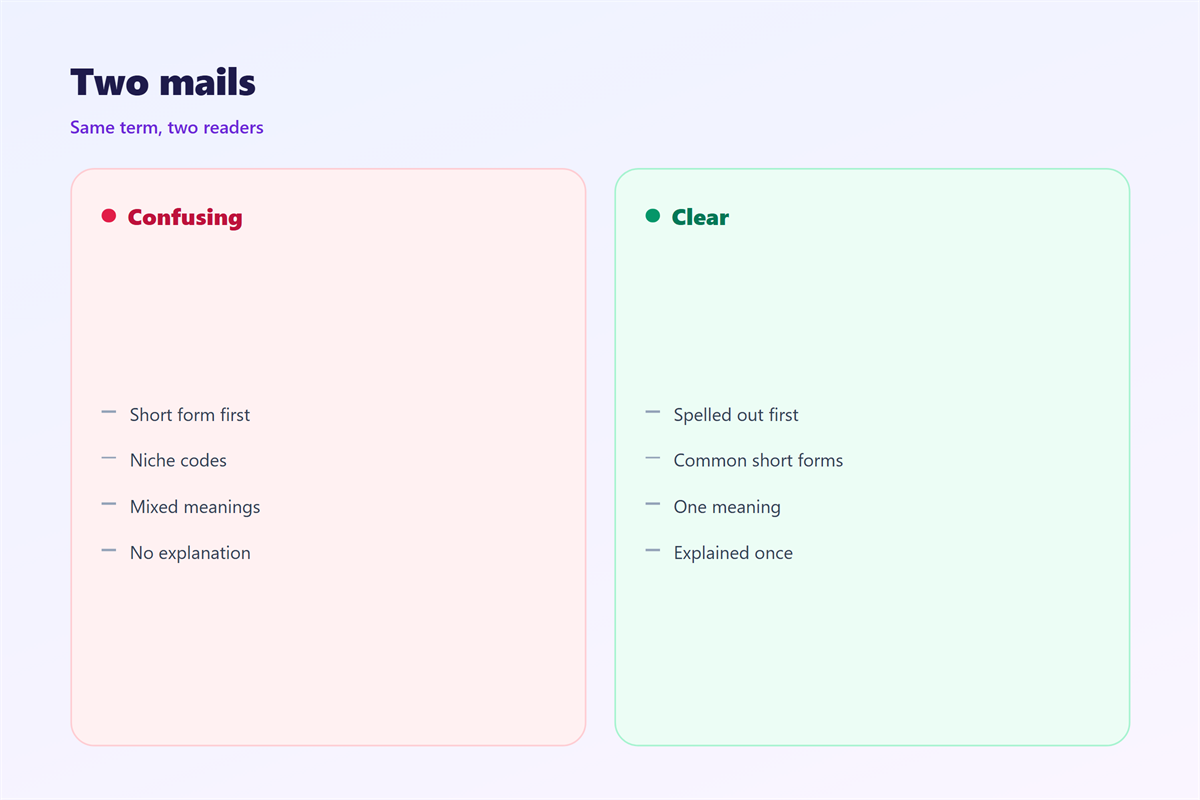
Consistency lets a reader trust every short form.
Write a short list of the terms your group uses.
The habits behind a clean first draft are set out in 邮件撰写.
The way a note sounds is covered in 邮件语气.
How you open a message is explained in 邮件称呼.
The small rules of good form appear in 邮件礼仪.
A shared style means fewer questions for everyone.
Keep the list short enough to remember.
Review it whenever a new member joins.
A printed page on the wall can help a busy team.
Update the list when a term changes meaning.
Teams that agree on 邮件缩写 write faster and read better.
FAQ
Is 邮件缩写 rude in a work email?
No, if the reader knows the short form. A clear one saves time.
What does FYI mean?
It means for your information. It asks the reader to take no action.
Should I shorten a client’s name?
No. Spell it in full until the client shortens it first.
How many short forms can I use per line?
One or two. More than that starts to look like code.
评论
还没有评论,来说两句吧。
评论功能已关闭。