 小影邮箱
邮件软退信怎么办?Temporary Failures Explained
Key Takeaways
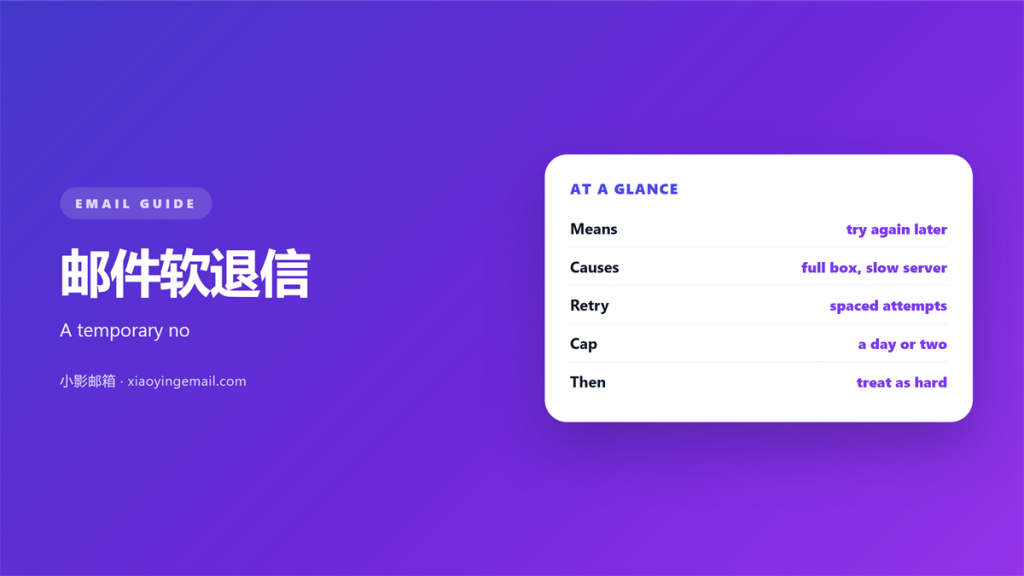
- A 邮件软退信 means the server deferred the message, not refused it.
- Full mailboxes and busy servers cause most of them.
- The 4xx code tells you whether a retry makes sense.
- Space retries out, then stop after a few days.
- Endless retries of dead mailboxes can hurt your sender score.
What 邮件软退信 really means
A 邮件软退信 is a temporary delivery failure. The receiving server accepted the connection but declined the message for now.
That word “now” carries the whole meaning. The address still exists, and the mailbox is simply not ready.
Compare it with a hard bounce. A hard bounce means the address is gone for good.
A 邮件软退信 says the opposite. The message could be delivered if you try again later.
The server answers with a numeric code. Codes in the 400 range signal a soft failure.
Codes in the 500 range point to a hard failure instead. That single digit changes your whole response.
This is why mail software separates the two kinds. One needs a retry, and the other needs the address removed.
Mix them up and you either drop good mail or keep mailing dead addresses.
Most senders never read the code. They react to the word “bounce” and guess.
A 邮件软退信 is normal traffic, not an emergency. Healthy lists produce some every single day.
Why 邮件软退信 happens so often
Most soft failures come from a short list of causes. Few of them say anything about your content.
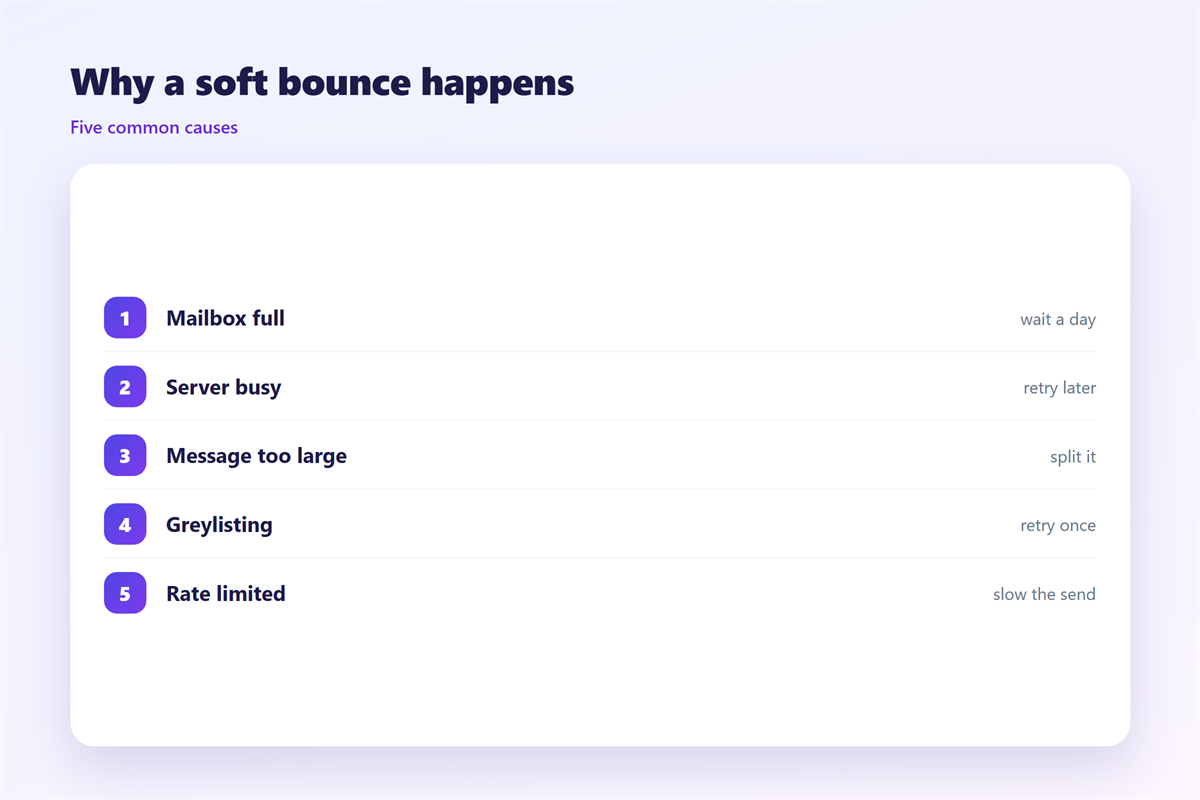
A full mailbox is the usual one. The user ran out of space, so the server postpones delivery.
A busy server is another. It is rate limiting you and asks you to return in a few minutes.
Greylisting is a deliberate version of this. A new sender must retry once before mail is accepted.
Large messages fail more often too. A heavy attachment may exceed the limit the server accepts.
A DNS problem can also produce a 邮件软退信. The receiving side cannot resolve a name right now.
A temporary block appears when traffic spikes. The server cools you down instead of saying no.
None of these causes are about your subject line. A 邮件软退信 is a timing problem, not a verdict.
That is good news for senders. Timing problems are shorter and cheaper than reputation problems.
Reading the 邮件软退信 code
Every bounce message carries a status code. Read it before you decide anything at all.
421 means the service is unavailable. Retrying in a few minutes often works.
450 means the mailbox is busy or blocked for now. A later attempt is reasonable.
451 means the server hit a local error. This is usually a passing glitch on their side.
452 means the mailbox is over quota. Retrying will fail until the user frees space.
Treat these four codes as your retry list. A 邮件软退信 in this group deserves another attempt.
Other 4xx codes need a closer look. Some describe policy limits that a retry will not fix.
Watch how often you retry one address. Ten attempts look like a broken list, not patience.
Most providers send a final bounce after a few days. It tells you the soft failure never cleared.
Retrying a 邮件软退信 safely
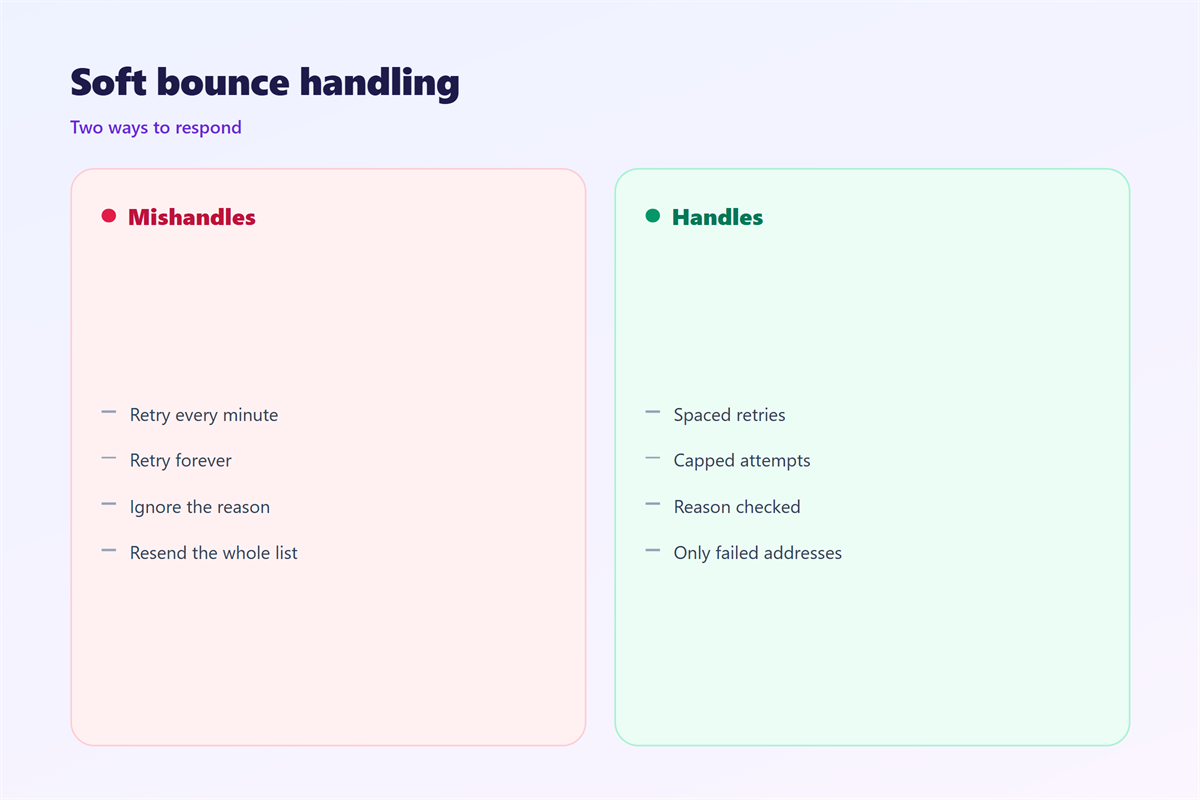
A retry needs a schedule, not hope. Space the attempts out instead of hammering the server.
Start with a short delay. Try again in fifteen minutes, then again after an hour.
Stretch the gaps each time. A common pattern is fifteen minutes, one hour, four hours, then a day.
This is called a backoff. It lowers the load on the receiver and improves your odds.
Cap the total window. After about seventy-two hours, stop and record the failure.
Never retry a hard bounce at all. That only wastes quota and annoys the receiving server.
Keep a separate queue for the 邮件软退信. A clean queue makes the whole window easy to see.
Track which addresses keep failing. Three failed windows in a row is a pattern worth acting on.
Log every attempt with a timestamp. The log turns a guess into a real decision.
Do not retry during a domain-wide block. Wait for the block to lift before you resume mail.
When to stop retrying
Some soft failures never clear. A mailbox that stays full for two weeks is effectively dead.
Look for a rising failure count over time. A steady climb means the address is not recovering.
Check whether the whole domain is failing. That points to a server problem, not a person.
If one domain blocks you, pause it. Do not let a single bad domain slow the rest of the queue.
After the retry window closes, move the address out of rotation. Log it as a 邮件软退信 and stop.
Tell the original sender when a message finally fails. Silence is the worst outcome for everyone.
A 邮件软退信 that clears on the first retry tells you the mailbox was just full.
That is the normal case, and it needs no further action.
Our notes on 邮件退信 explain the full split between hard and soft. The waiting room is described under 邮件队列. Timing sits in 邮件重试, and late arrivals are covered under 邮件延迟.
FAQ
Is a 邮件软退信 the same as spam blocking?
No. A soft bounce is about timing or capacity. Spam blocking tends to return a hard failure or a policy code.
How many times should I retry?
Four to six attempts over two or three days is typical. More than that rarely helps.
Should I delete a soft-bounced address right away?
Not at once. Let the retry window close first. Remove it only if the failures keep repeating.
Can a soft bounce hurt my sender score?
It can when the volume is high. Receivers notice lists that keep retrying dead mailboxes.
References
- IETF RFC 5321: Simple Mail Transfer Protocol
- IETF RFC 3463: Enhanced Mail System Status Codes
- Google Workspace: SMTP errors
评论
还没有评论,来说两句吧。
评论功能已关闭。