 小影邮箱
邮件附言怎么用?The Line After the Sign-Off
Key Takeaways
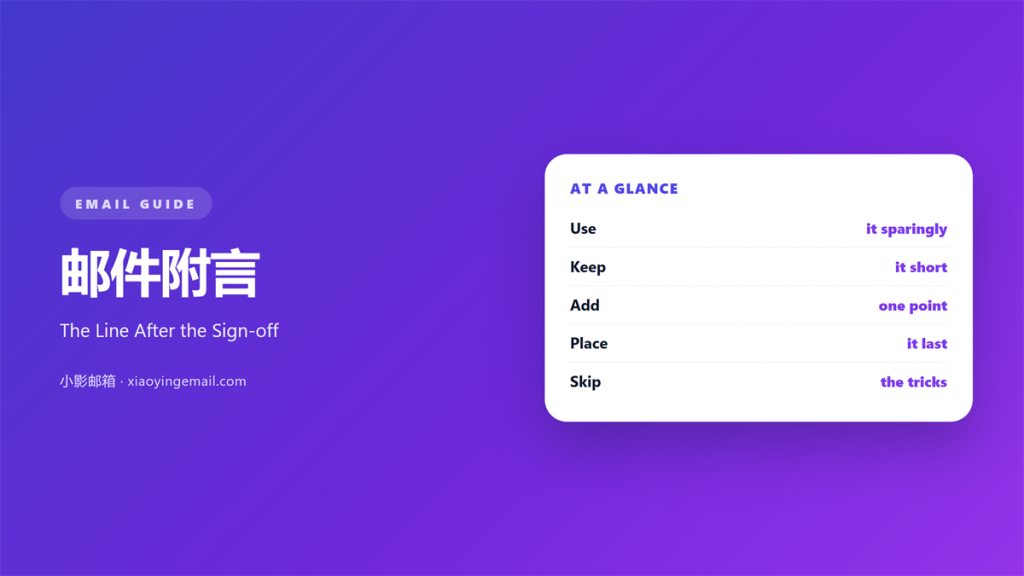
- 邮件附言 is the short line after your sign-off.
- It carries one idea that the body could not hold.
- A single sentence usually beats a short paragraph.
- Never bury a key request at the very end.
- Keep the tone light and the length brief.
What 邮件附言 means
邮件附言 is the note that follows your closing line.
You know it better as the letters P.S.
It sits after “Best regards” and your name.
In the past, people added one after finishing a letter.
They signed the note and then remembered one more thing.
Today the same habit works in email.
A good 邮件附言 feels like a natural last thought.
It never feels like a second message bolted on.
It is a small courtesy that costs nothing.
People have used it for more than a century.
Where it sits
It comes after the closing and the name.
Sometimes a second P.P.S. follows the first.
Keep it to one line most of the time.
Two lines already feel like a habit.
Why 邮件附言 matters
The last line of a message is easy to remember.
Readers often scan down and stop near the bottom.
So a short 邮件附言 can carry real weight.
It can add warmth, a reminder, or a small piece of news.
It can also rescue a message that rambled too long.
But the same slot can work against you.
A buried request may get missed down there.
So 邮件附言 is a tool to use with care.
It can soften a request that feels abrupt.
A friendly goodbye leaves a warm memory.
It shows you were thinking of the reader.
Small touches like this are easy to skip.
Yet they are the ones people remember.
It turns a formal note into a warmer one.
The pull of the last line
People skim. Their eyes drift to the end of a note.
A clear final line catches that drifting gaze.
That gives the extra line unusual power for its size.
Use it well and one short line does real work.
When to use a 邮件附言
Reach for it when the message is already complete.
Use it to add a small human touch.
Use it for a light reminder that is not urgent.
Use it to share one useful link or tip.
Use it to connect back to an earlier conversation.
Do not use it for anything that must be seen.
If it matters, put it in the body instead.
A 邮件附言 is a bonus, never the main point.
One idea per 邮件附言
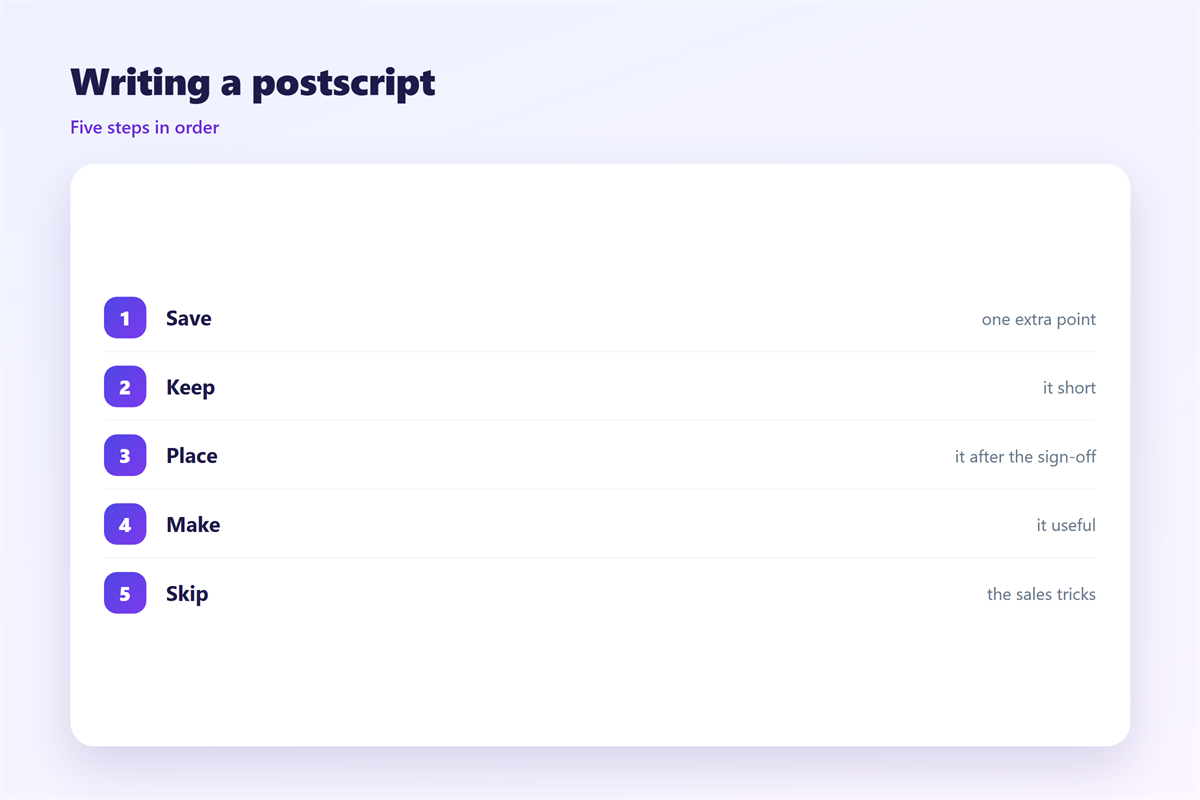
Keep each one to a single thought.
Two notes turn the extra into extra clutter.
If you need two, move one into the body.
Then the closing stays clean and calm.
Match the reader
Write a warm postscript for a friendly contact.
Keep it plain and factual for a formal one.
Mirror the tone the person used with you.
That small choice keeps the note at the right level.
Good uses in practice
Thank a reader for a recent favor.
Mention a related article they may enjoy.
Offer a small tip that saves them time.
Confirm a detail you almost forgot to add.
When to skip it
Skip it when the body already says everything.
Skip it when the message is urgent and short.
Skip it when the reader dislikes informal notes.
邮件附言 styles to avoid
Some postscripts do more harm than good.
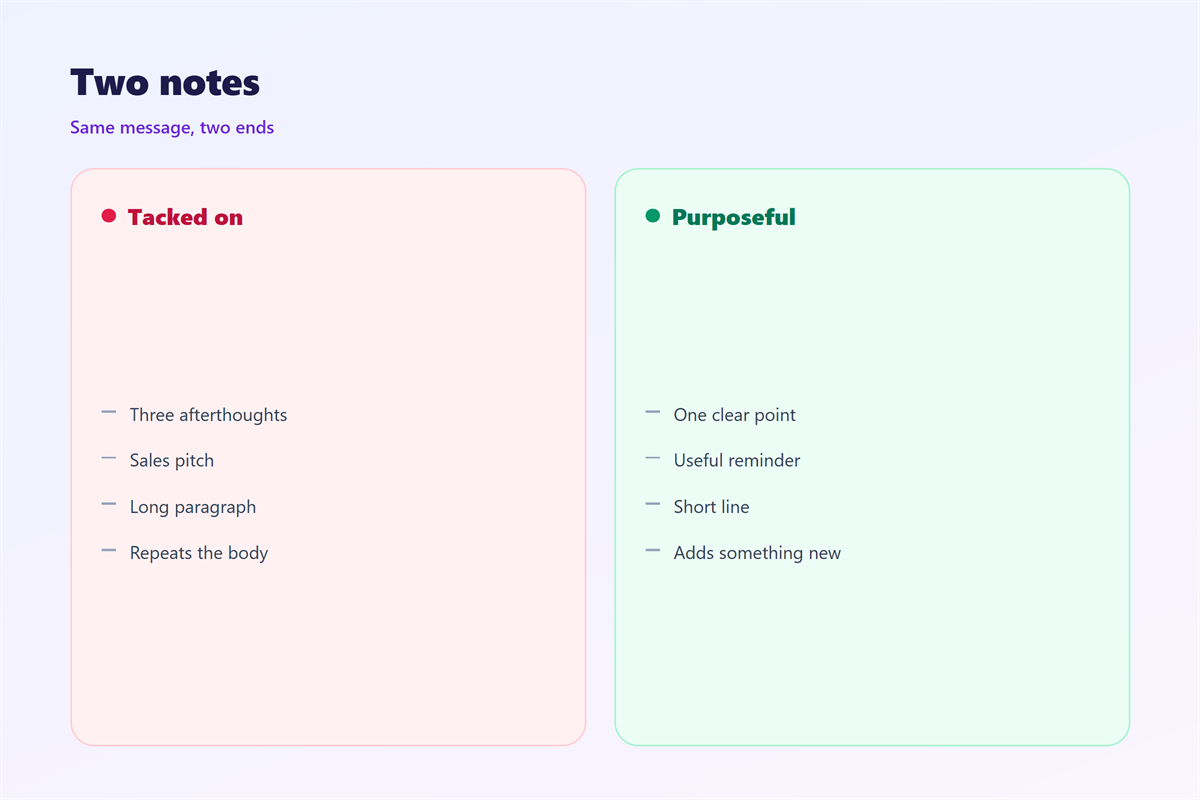
A passive demand can read as pressure.
A joke can fall flat without a face or a voice.
A second call to action splits the reader’s focus.
A long 邮件附言 stops feeling like an aside.
Also avoid repeating what you already wrote above.
Redundancy makes the reader wonder why you repeated it.
So keep the extra line fresh and short.
A postscript in every message loses its charm.
Save it for the times it truly adds value.
A vague postscript wastes a good chance.
邮件附言 across cultures and clients
Not every reader likes the same style.
Some inboxes treat a postscript as old-fashioned.
Others find it charming and personal.
When you write across borders, keep it plain.
Choose the safest wording and stay consistent.
Also check how it renders in a plain-text view.
Some clients strip formatting and move the line around.
A simple postscript survives every client.
Keep the length modest so nothing gets cut.
Keep the abbreviations simple for a global reader.
Explain any short form the first time you use it.
Keeping 邮件附言 consistent
Consistency makes a small habit feel intentional.
Pick one rule for when the extra line appears.
See how messages end in 邮件结尾.
Keep contact details steady with 邮件签名.
Give each idea its own block in 邮件正文.
Keep the tone polite through 邮件礼仪.
Then the whole team writes the same way.
Over time, a tidy 邮件附言 becomes part of your voice.
Readers learn what to expect at the end of your mail.
Write a short note about when to use it.
Store the example in the team handbook.
Checking your 邮件附言 before sending
A last read catches most slips.
Read the message from the greeting to the final line.
Ask if the extra note belongs there at all.
Move anything important back into the body.
Trim the line until only one idea remains.
Check the names and the links once more.
Then send it and move on.
Clean 邮件附言 takes a moment and saves a follow-up.
Delete the line if it adds nothing new.
A short aside should feel effortless to read.
FAQ
What is a 邮件附言?
It is a short line after your sign-off, often marked P.S.
Is it fine to use one at work?
Yes, if it stays short and light.
Should I put a request in it?
No. Put anything important in the main body.
How long should it be?
One sentence is usually best. Two is the limit.
评论
还没有评论,来说两句吧。
评论功能已关闭。