 小影邮箱
邮件诈骗怎么识别?Invoice and Boss Fraud
Key Takeaways
- 邮件诈骗 usually arrives as ordinary business mail: an invoice, a payment reminder, or a short request from someone senior.
- The two costliest patterns are the fake invoice and the impersonated manager.
- A display name proves nothing. The address behind it does.
- Any change of bank details needs confirming through a second channel before money moves.
- Urgency and secrecy are the feelings every 邮件诈骗 tries to create.
What 邮件诈骗 looks like in a normal inbox
邮件诈骗 rarely announces itself. It arrives looking like the mail you already handle every day: a supplier invoice with updated account details, a note from a manager asking for a quick transfer, a courier notice with an attachment. The message is usually short and cleanly written, with none of the clumsy spelling people still expect from criminals.
The giveaway is almost never the wording. It is the mismatch between what the message claims to be and what the account behind it really is. A sender who signs as your finance director but writes from a domain registered three weeks ago is not your finance director, however fluent the email reads.
That is why 邮件诈骗 is better understood as a process problem than a technical one. Nothing has to be hacked. The attacker needs one person busy enough to skip a single phone call before a payment goes out.
Why 邮件诈骗 works on busy people
Invoices are boring and plentiful, which is exactly why they work. A finance team processing forty payments a week cannot examine all of them with equal care, so the attacker only has to blend into the queue. A single 邮件诈骗 does not need to convince everyone, just the one person who is behind schedule on a Friday afternoon.
Authority supplies the second lever. A request that appears to come from a chief executive or a long-standing supplier is hard to question without seeming obstructive, and few people want to be the one who delays an important deal over a routine formality.
Time pressure closes the loop. When the message insists the transfer must clear today, checking appears more expensive than complying. Reversing that assumption is most of the defence.
The two patterns behind most 邮件诈骗
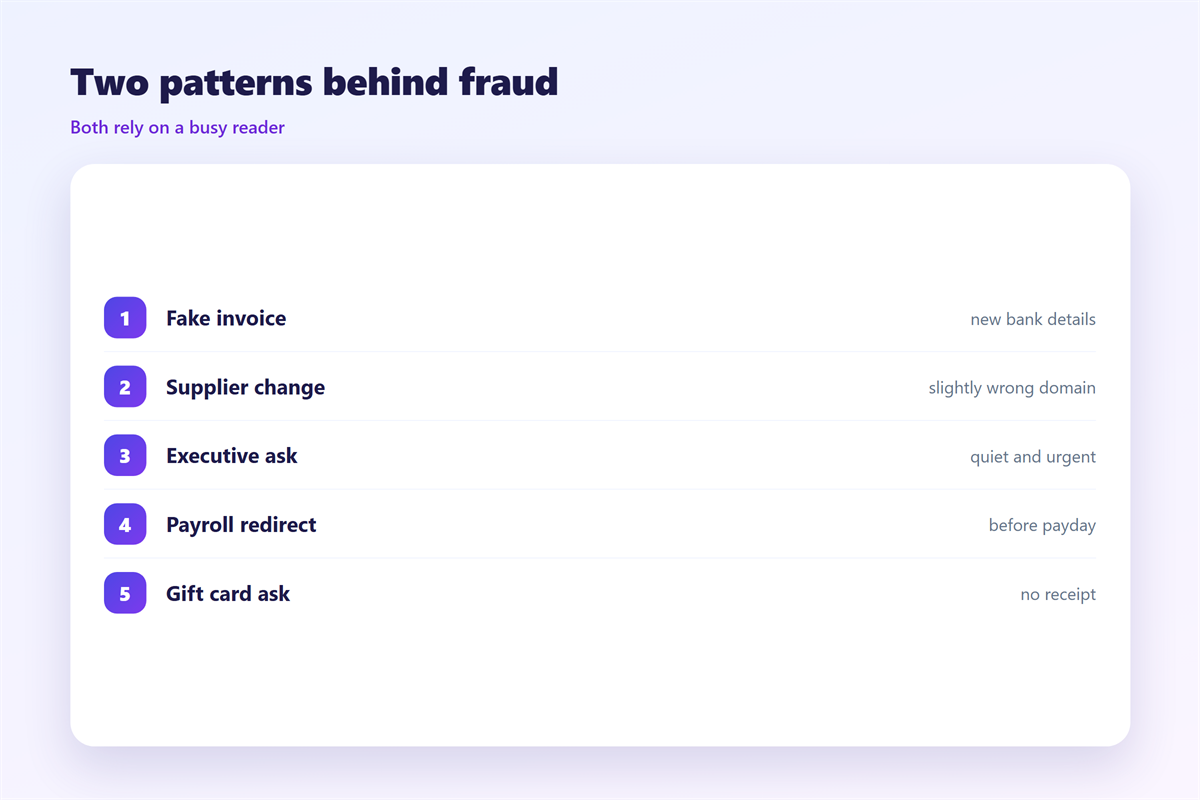
Nearly every case of 邮件诈骗 reduces to one of two shapes, and both are worth rehearsing before they arrive in your own inbox.
The fake invoice
A familiar supplier sends a genuine-looking invoice, or a message that reads like a routine update to payment details. The amount is plausible, the formatting is right, and the only change is an account number buried near the foot of the document.
The urgent transfer
A senior colleague asks for a confidential payment, often while travelling, and asks that it be kept quiet. The secrecy is the point: it removes the colleagues who would otherwise raise an objection before the money leaves.
Signals that a message is 邮件诈骗
No single clue settles the question, but a cluster of them usually does. The reply-to address differs from the sender address. The domain uses a near-miss spelling. The message arrives outside business hours and asks for action before the day ends.
Attachments deserve their own suspicion. A file that asks you to enable editing or sign in before it will open is behaving unlike a real invoice, which is a document you simply read. Our notes on 钓鱼邮件 walk through reading message headers for exactly this kind of mismatch.
Forged sender addresses are their own subject, and 邮件冒充 explains how to tell a real domain from a convincing copy. Extortion messages that threaten rather than ask are handled under 邮件勒索, and if credentials have already leaked, the response steps in 邮箱泄露 matter more than anything else.
How to verify a payment before you send it
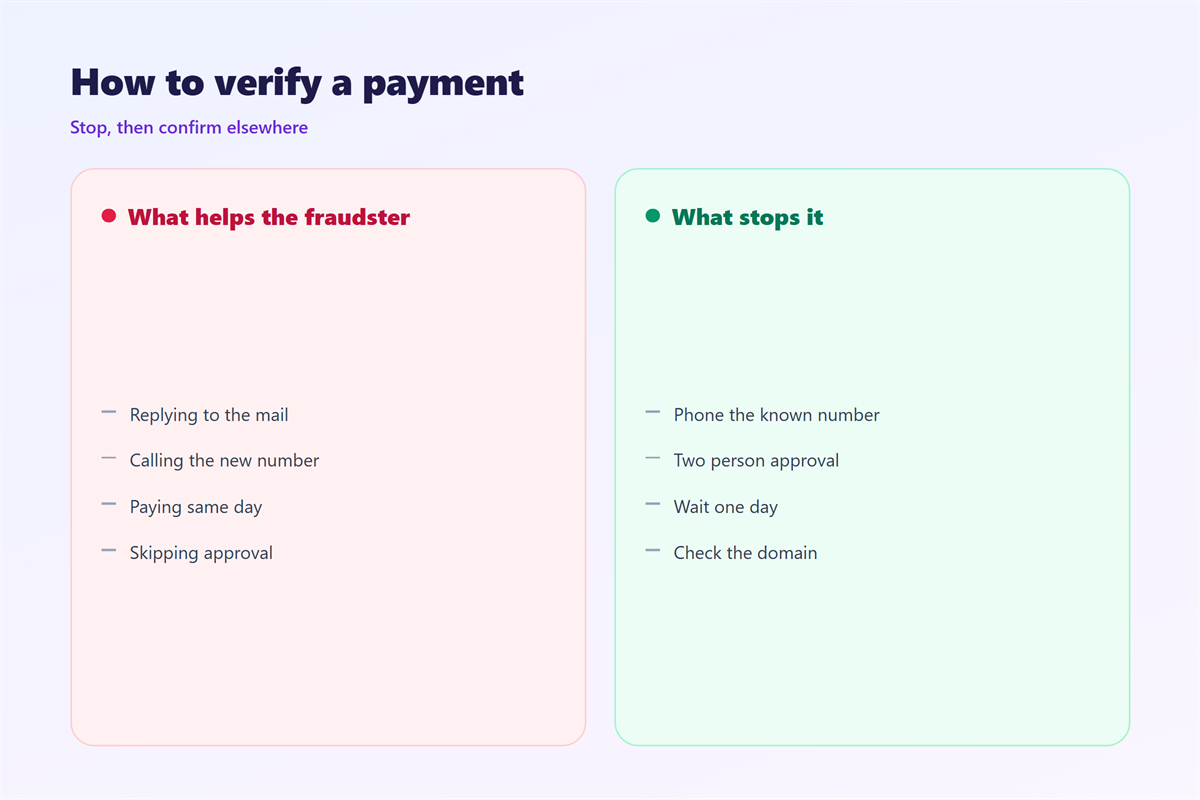
The check takes two minutes and defeats nearly every 邮件诈骗. Take the contact details from a source you already trust, never from the message itself, and confirm the request by voice or in person.
Use a second channel
Reply to nothing and call the number in your own records instead. A supplier who genuinely changed banks will expect the call and will not mind it. An impersonator will invent a reason why a call is difficult today, which is itself the answer.
Separate the approval from the request
Whoever receives a payment request should not be the only person who approves it. A second signature turns one moment of inattention into a short conversation, and that conversation is usually enough.
It also helps to have a standing rule that everyone already knows. A short written policy, saying that bank details are never changed by email alone and that a verbal confirmation is required for anything above a set amount, removes the decision from the moment it matters most.
FAQ
Does 邮件诈骗 always ask for money?
No. Some messages want credentials, a password reset, or a reply that confirms a working address for a later stage. Payment fraud is simply the variant with the clearest damage attached.
Can a 邮件诈骗 come from a real address?
Yes. A compromised mailbox belongs to a real person and sends real mail from the correct domain, which is why behaviour matters as much as the address itself.
What should I do after a 邮件诈骗 payment?
Call your bank immediately and ask whether the transfer can be recalled, then tell your security team so the same message can be blocked for everyone. Speed decides how much comes back.
Do spam filters stop 邮件诈骗?
Partly. Filters catch bulk campaigns well and targeted messages poorly, because a short email with no links is nearly indistinguishable from ordinary correspondence.
References
- FBI Internet Crime Complaint Center
- Wikipedia: Business email compromise
- IETF RFC 5322: Internet Message Format
评论
还没有评论,来说两句吧。
评论功能已关闭。