 小影邮箱
邮件步骤条怎么排?Steps in a Row
Key Takeaways
- 邮件步骤条 shows a reader where they sit in a process.
- Number each stage and keep the labels short.
- Highlight the current stage, not three at once.
- Five stages is a sensible ceiling.
- On mobile, turn the bar into a vertical list.
What 邮件步骤条 means
邮件步骤条 is a row of labelled stages inside a mail.
Each stage marks one point in a process.
The reader sees the whole path at a glance.
One stage is filled, and the rest stay quiet.
This bar usually appears near the top.
It suits orders, onboarding, and reviews.
It is built from text and simple shapes.
No scripts are needed, so it renders broadly.
The labels carry more weight than the arrows.
A reader should take in the bar in one pass.
It answers two questions: where am I, what next?
That pair of answers is the whole job.
Why 邮件步骤条 matters
邮件步骤条 matters because waiting feels longer without a map.
A customer who sees stage three relaxes.
A customer who sees nothing writes to support.
The bar lowers that kind of mail.
It also sets expectations for the next step.
Readers stop checking their account every hour.
Support teams answer fewer status questions.
The same bar works for internal processes.
New hires follow an onboarding path without asking.
Reviewers know whether their turn has arrived.
One bar, one process
Use a bar for a single defined process.
Do not mix approval and shipping stages.
Each stage needs a clear finish line.
If a stage has no end, split it.
When 邮件步骤条 helps
邮件步骤条 helps when the process has clear stages.
Order tracking is the classic case.
It helps during onboarding, where week one feels vague.
A review queue also benefits from a visible position.
Use it when the reader must act next.
The bar then points at the pending task.
It helps when a delay is normal and expected.
Naming the wait reduces the worry.
A bar also helps when two teams hand work over.
When a plain sentence is enough
A two-step process needs no bar.
Write the sentence instead: we received your form.
Save the bar for three stages or more.
Below that, the graphics cost more than they give.
When 邮件步骤条 hurts
邮件步骤条 hurts when the stages are invented.
A bar with eight steps reads as bureaucracy.
It hurts when the current stage is unclear.
Two filled stages confuse the reader.
It hurts when the labels are nouns only.
Received, processing, done tells nobody anything.
Use verbs that describe the actual work.
It hurts when the bar never updates.
A fixed image cannot show progress.
It also hurts when the bar repeats one word.
Send a fresh mail at every real stage change.
邮件步骤条 and checklists
A step bar and a checklist look similar.
The bar shows position, while a list shows tasks.
A checklist tells the reader what to do.
A bar tells them how far the process has come.
Some mails need both, in that order.
Put the bar at the top and the list below.
Keep the numbering style the same in both.
Readers link the two blocks by their numbers.
That link saves a sentence of explanation.
Shared numbers, shared order
If the bar starts at two, the list starts at two.
Never renumber the list from one.
Keep stage names identical across both blocks.
Copy the exact words, not a paraphrase.
Then the reader never has to translate.
How to build 邮件步骤条
Build 邮件步骤条 after you map the process.
Write the stages on paper first.
Cut any stage that has no visible outcome.
Aim for three to five stages.
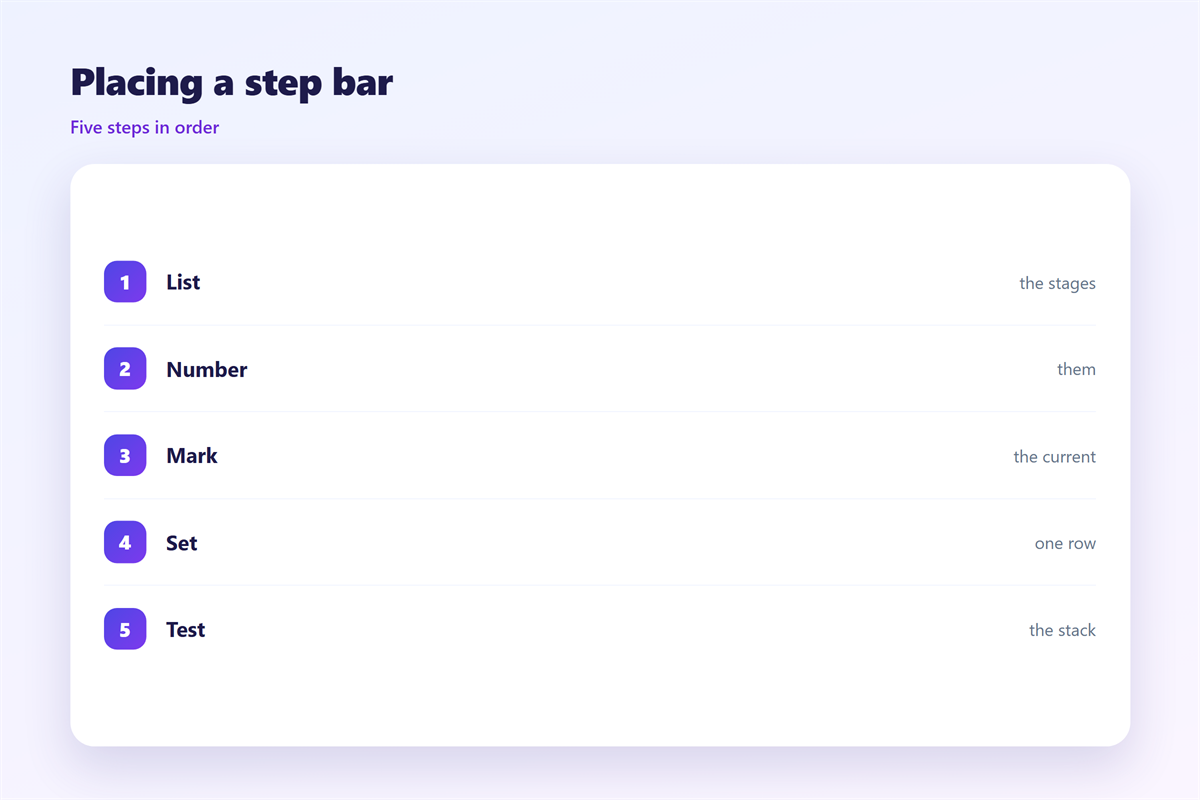
Number them from one and keep that order.
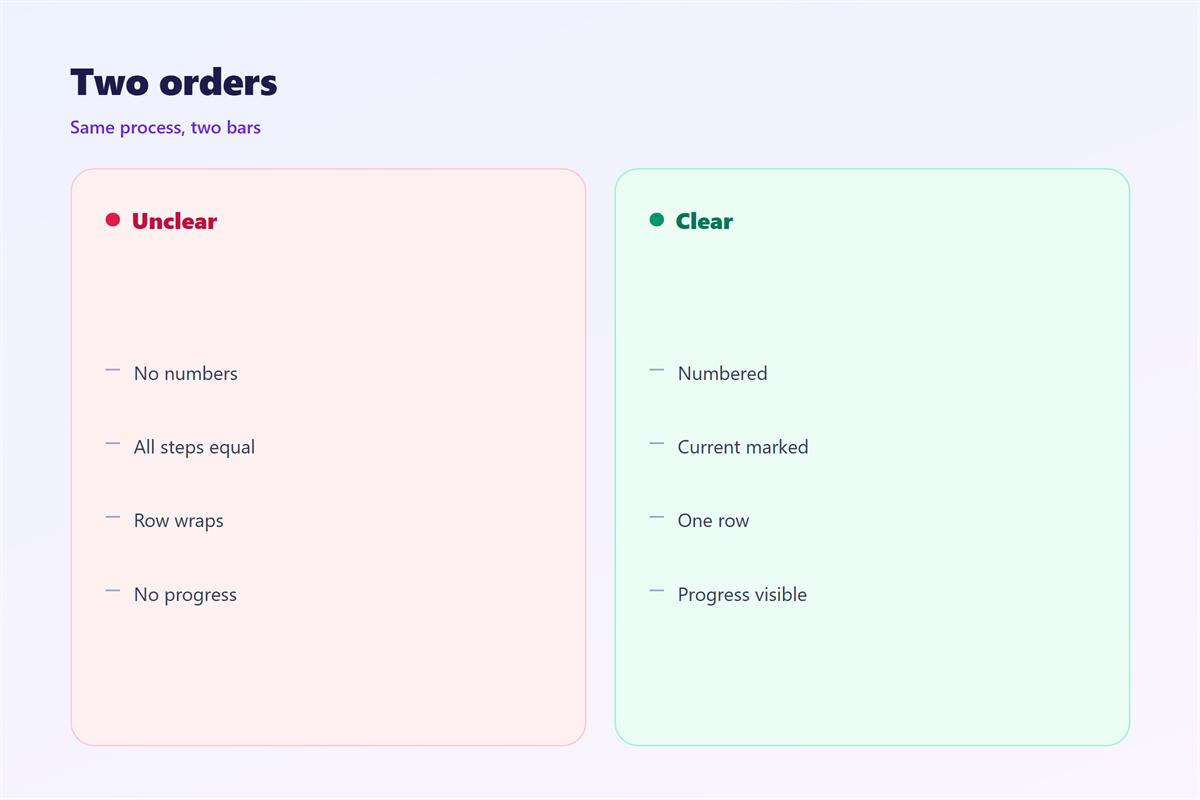
Fill only the stages already finished.
Use one accent colour for the current step.
Keep the rest in a light grey.
Text first, shapes second
Write each label in two or three words.
Set every label in the same size.
Use a line or a dot, not both.
Leave a gap between the number and the label.
Then check the bar in a plain text client.
Test it again on a plain white background.
邮件步骤条 on a phone
邮件步骤条 on a phone cannot stay horizontal.
Four columns squeeze into unreadable slivers.
Stack the stages into a short vertical list.
Keep the numbers in a narrow left column.
Place each label on the same line as its number.
Show the current stage in bold.
Grey out the stages not reached yet.
Keep the line between stages thin.
Test the list at 320 pixels wide.
If it runs past one screen, cut a stage.
Keep the current stage at the top of the stack.
The bar must not push the button
A tall bar hides the action below.
Keep the stack under 120 pixels.
Place it under the headline, not above it.
Then the button stays near the first screen.
Keeping 邮件步骤条 honest
Keeping 邮件步骤条 honest means showing real progress.
Never fill a stage before it happens.
A filled dot is a promise about the work.
Update the bar only when the status changes.
The list pattern sits in 邮件清单.
The column rules live in 邮件排版.
The spacing advice sits in 邮件对齐.
The margins are covered in 邮件留白.
Keep one bar design across every process mail.
Readers learn it once and read it faster.
Consistency is the quiet part of trust.
Check the wording with the team that runs the process.
FAQ
How many steps fit in a 邮件步骤条?
Five at most. Three reads best in a short mail.
Should finished steps be ticked?
Yes. A tick separates done from pending at a glance.
Can the bar use icons?
Only if the icon is obvious. Words are safer.
What if a step repeats?
Say so in the label. A review can happen twice.
评论
还没有评论,来说两句吧。
评论功能已关闭。