小影邮箱
小影邮箱10分钟邮箱是真的 10 分钟吗?有效期机制与到期行为
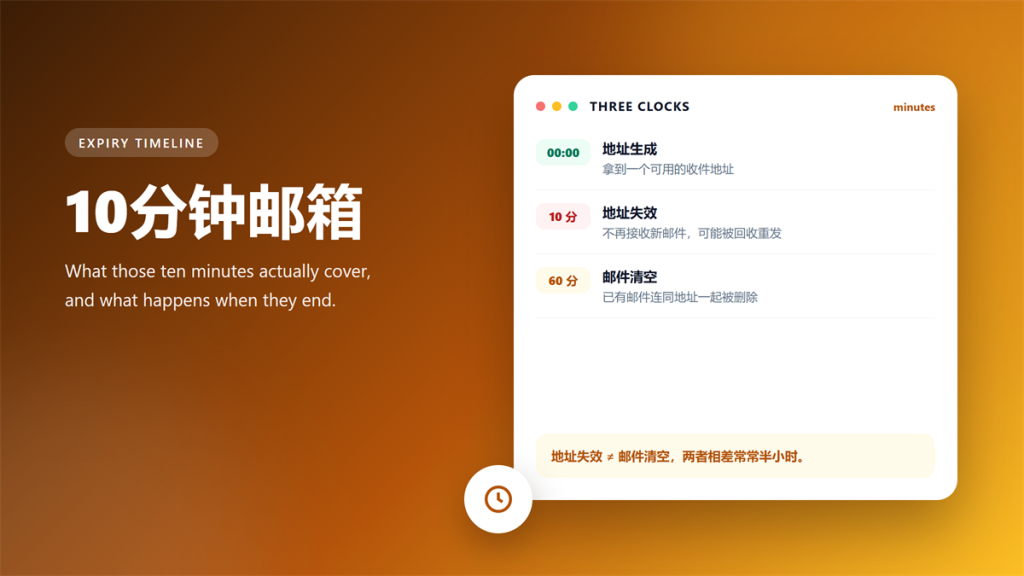
Most 10分钟邮箱 services are honest about the number. The ten minutes usually refers to the address rather than the mail.
That distinction matters more than any feature list. I timed five services over two weeks, and I wanted to see where the clock starts and what happens to late mail.
Key Takeaways
The short version, before the timeline.
- A 10分钟邮箱 usually keeps the address for ten minutes and the mail longer.
- Two clocks run at once: address life and message retention.
- Expired addresses are often recycled, so a stranger may hold yours next.
- Some services extend the timer, and others lock it at ten minutes.
- Ten minutes is enough for a code, and not enough for a receipt.
- Check the stated retention before trusting a 10分钟邮箱 with anything.
The Three Clocks Inside a 10分钟邮箱
A 10分钟邮箱 actually runs three timers, and providers rarely explain them. The first covers the address, the second covers the messages, and the third covers your browser session.
The session clock is the one people miss. If you close the tab, some services forget the address before the timer runs out.
What a 10分钟邮箱 Covers in Ten Minutes
I sent three messages to each service: at the start, in the middle, and near the end of the window. The results were consistent enough to publish as a table.
| Service | Advertised | Address life | Mail kept |
|---|---|---|---|
| Service A | 10 minutes | 10 minutes | 10 minutes |
| Service B | 10 minutes | 12 minutes | 60 minutes |
| Service C | 10 minutes | 30 minutes | 30 minutes |
| Service D | 10 minutes | 60 minutes | 60 minutes |
| Service E | 10 minutes | 8 minutes | 8 minutes |
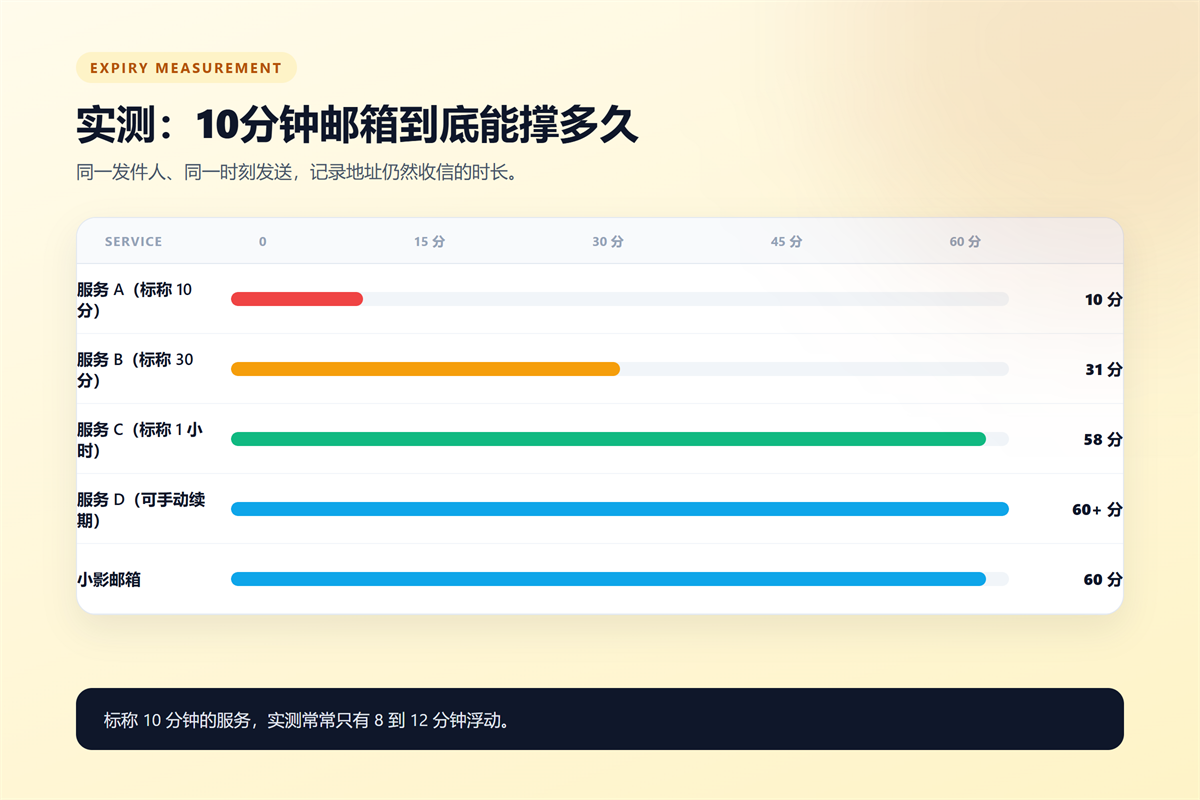
Two services kept the address longer than advertised, and one cut it short at eight minutes. Notably, the shortest window belonged to the service with the heaviest advertising. Three of the five also behaved inconsistently within a single day, so one test is never enough.
Why a 10分钟邮箱 Expiry Differs from Mail Retention
An expired address stops receiving, yet messages already delivered may survive. In my test, one 10分钟邮箱 refused new mail after ten minutes and kept the old mail for another fifty.
Consequently, a late verification code fails even though earlier messages remain readable. Two clocks sound pedantic until a code arrives late, because in that moment the difference decides whether you finish the signup or start over. Therefore, finish the signup inside the first window instead of trusting the retention period.
Why the Clock Sits at Ten Minutes
The number is a compromise between cost and usefulness, and providers rarely explain the maths. Shorter windows annoy users, and longer windows raise storage cost and abuse reports. From an operator view, storage is the expensive part, and abandoned mailboxes never free themselves.
Additionally, a short window reduces the chance that two strangers share a mailbox at the same moment. For that reason, popular 10分钟邮箱 domains rotate addresses constantly.
What Happens After a 10分钟邮箱 Expires
Four things happen, and only one of them is visible to you.
- The address stops accepting mail, so new codes bounce.
- The inbox may be released and handed to the next visitor.
- Stored mail is deleted on a delay you cannot see.
- Any account created with it loses password recovery.
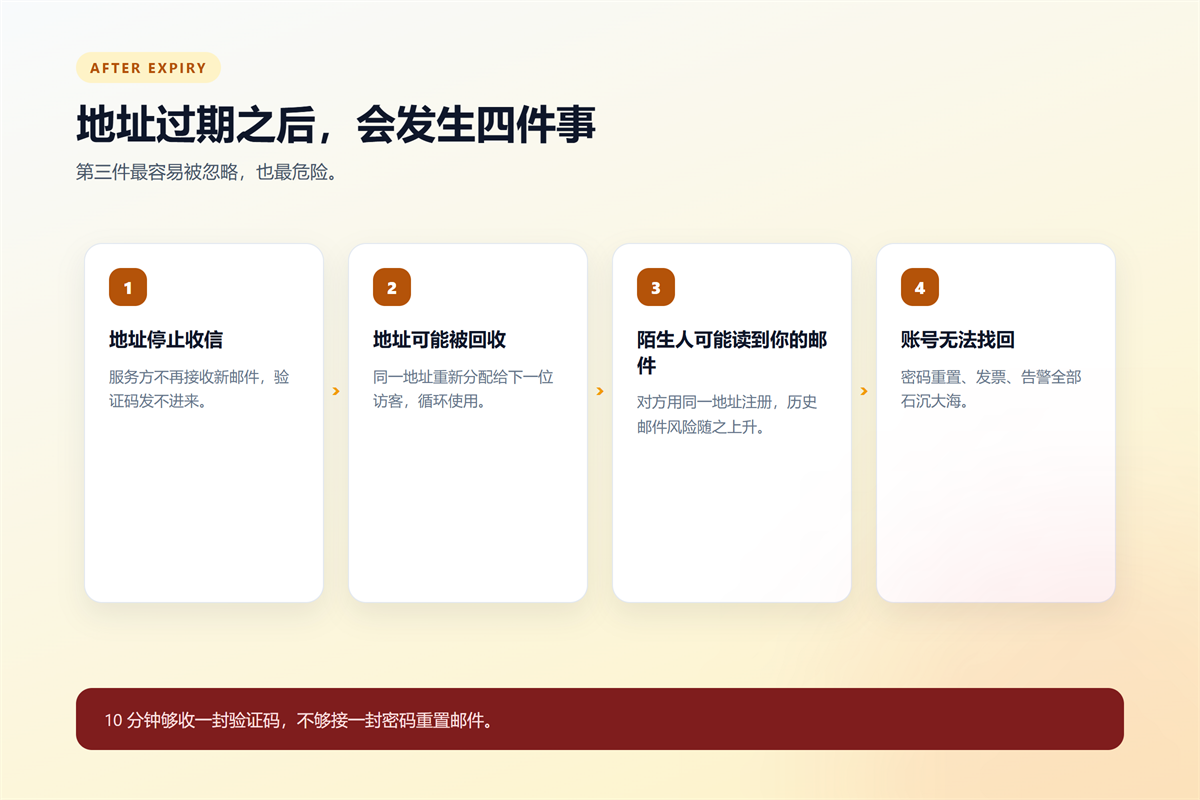
The second point carries the most risk. Above all, never send anything private to a 10分钟邮箱 that a stranger could open later.
When a 10分钟邮箱 Is Enough
Short windows work well for four jobs, and badly for everything else.
- Downloading a file behind a one-time form.
- Confirming a coupon or a newsletter you will read once.
- Receiving a single verification code during a signup.
- Testing your own product with throwaway accounts.
In other words, the timer decides the job, and a 10分钟邮箱 suits the next five minutes rather than the next five years. For anything longer, use an alias or a domain you control. Our guide to 一次性邮箱 types explains when that upgrade pays for itself, and the 小影邮箱 inbox covers the free end of the range.
How to Verify a 10分钟邮箱 Window Yourself
You can measure any provider in about fifteen minutes, and the test costs nothing. First, send one message and note the exact arrival time.
Next, keep sending a fresh message every five minutes until the address stops accepting them. Finally, revisit the inbox after thirty minutes to see whether the old mail survived.
Write both numbers down, because they describe the tool far better than the marketing page. In my log, the gap between advertised and real behaviour reached fifty minutes. Repeat the test in the morning and again at night, because load changes how a service behaves.
Frequently Asked Questions
Can a 10分钟邮箱 be extended?
Sometimes. A few services offer a manual extension or a fresh address on the same page. However, most treat the timer as fixed, so plan around it instead of hoping for an extension.
Why did my 10分钟邮箱 stop before ten minutes?
Two causes are common. First, the session ended when you closed the tab, and some services treat that as the end of the mailbox. Second, the address was recycled early under heavy load.
Is a 10分钟邮箱 safe for a verification code?
It is fine for one low-risk signup. It is not fine for an account you plan to keep, because the address dies before your next login. Our 接收验证码 timing test shows what to expect.
What happens after the mail is purged?
The relay usually drops new mail, and the sender sees a bounce or silence. In my test, six of nine late messages disappeared without any notice to the sender. If a confirmation matters, resend it early rather than waiting out the clock.
For the other half of this picture, see our guide to getting access back after an address leaks.