 小影邮箱
邮件日期怎么写?Dates People Understand
Key Takeaways
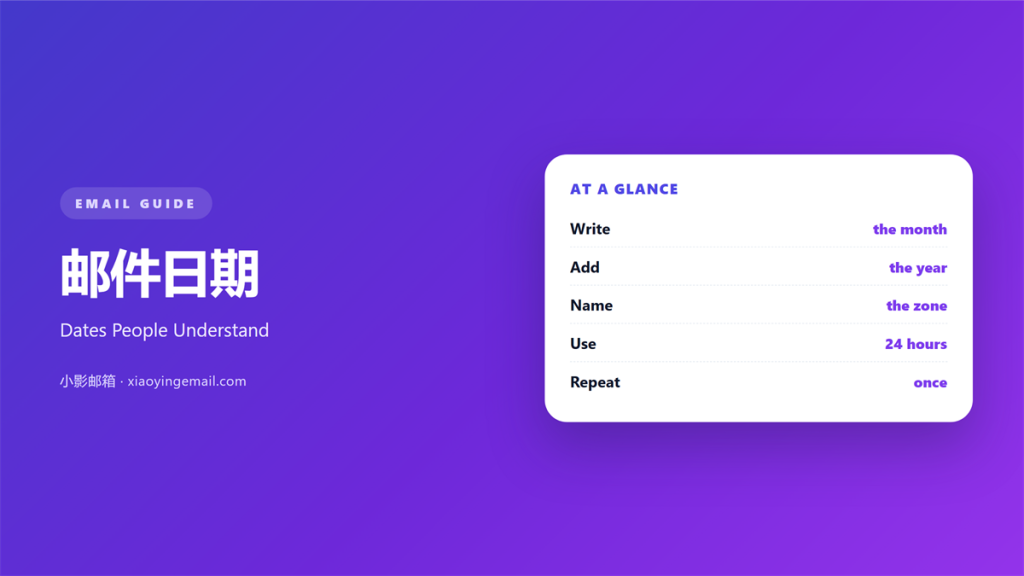
- 邮件日期 tells the reader exactly which day you mean.
- Spell the month as a word, not a bare number.
- Put the year first in files and long records.
- Add the time zone to every planned hour.
- Repeat an unclear 邮件日期 once, in plain words.
What 邮件日期 means
邮件日期 is the way a message states a day or a time.
It can sit in the greeting, the body or the closing line.
A single wrong digit can send a reader to the wrong week.
Most people write dates on autopilot. They never check them.
Yet a clear date removes a whole round of questions.
Think about two short forms. “03/04” is a coin toss.
That could mean March the fourth or the third of April.
Now write “4 March 2026”. Nobody has to guess.
Good 邮件日期 is plain, ordered and complete. It never makes the reader think.
Why 邮件日期 matters
A date is a quiet promise about when something happens.
A meeting, a deadline or a payment all rest on it.
When the date is unclear, trust slowly drops.
The reader wonders whether you checked anything at all.
Clear 邮件日期 protects both sides of a deal.
It also saves time, because a guessed date invites a reply.
That reply costs two people a few minutes each.
Multiply it across a team and the loss grows.
The cost of a missed date
A missed date is rarely a disaster by itself.
But it starts a chain. A call moves and a plan slips.
Someone explains the slip in yet another email.
Each extra message spends attention that real work needs.
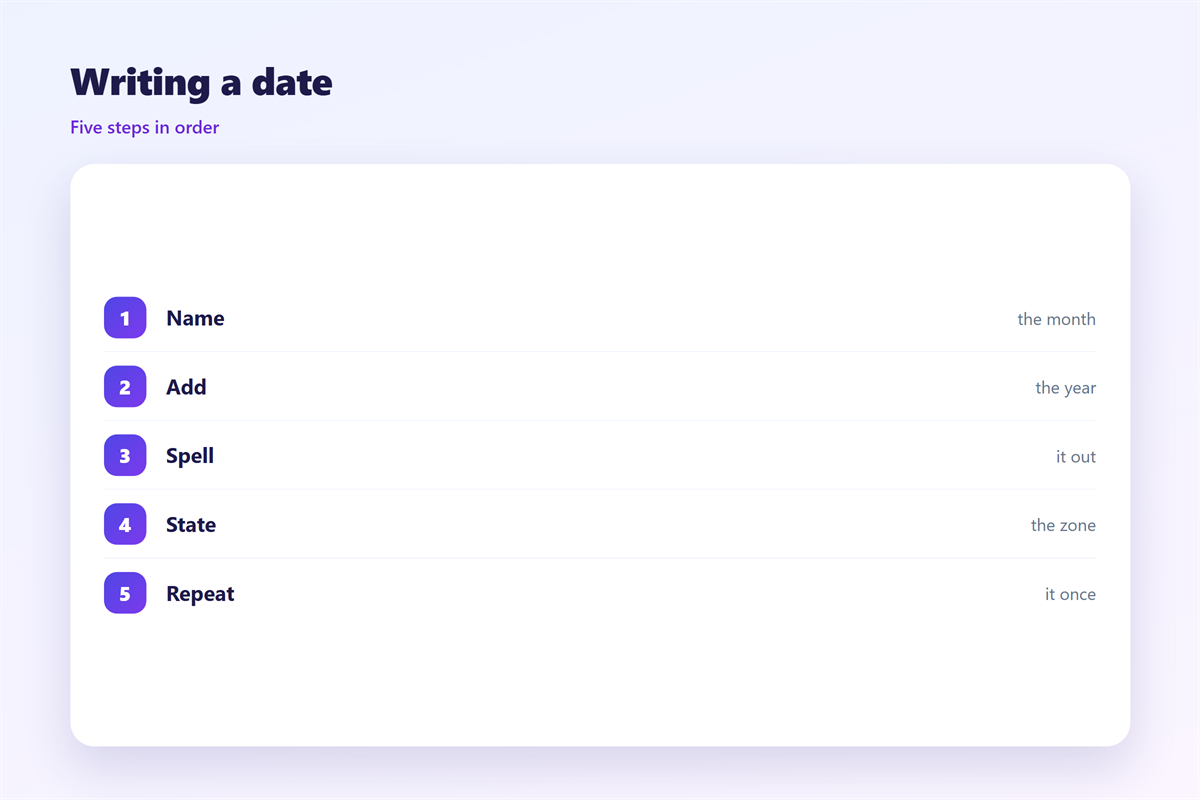
A calm writer names the day, the hour and the zone.
Formats that travel well
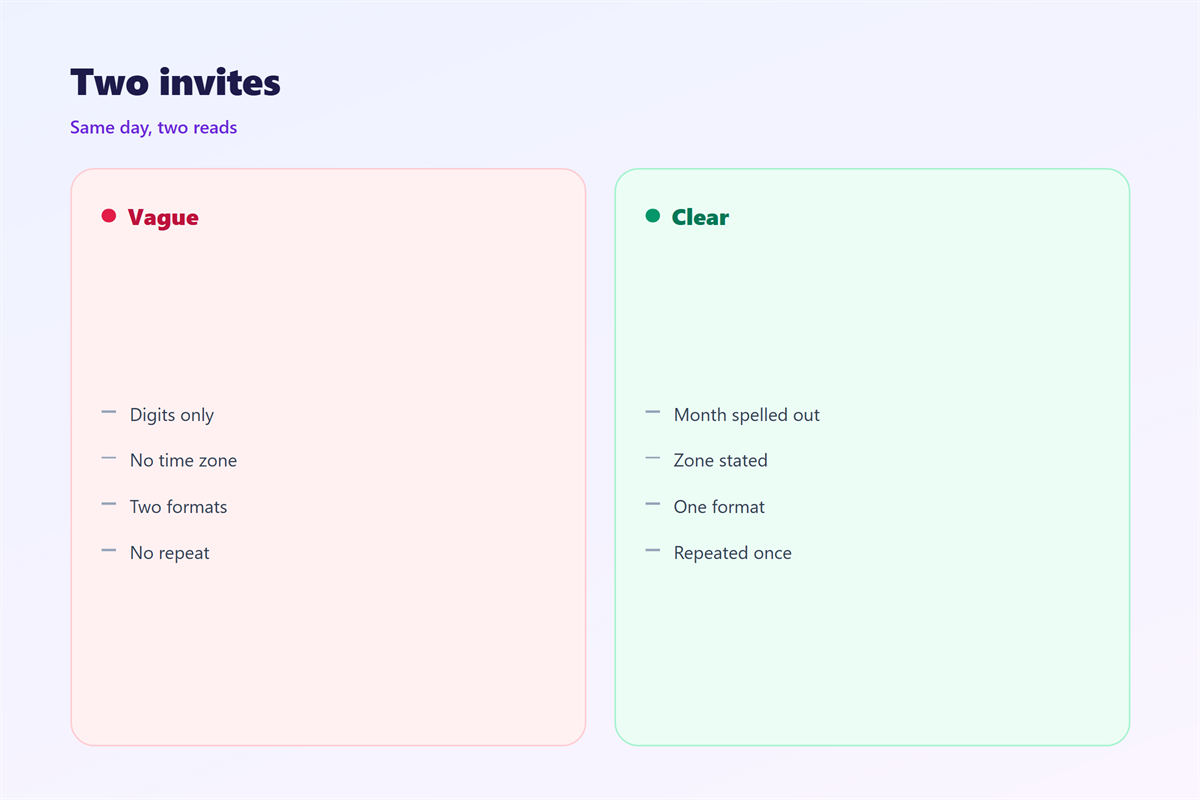
Pick one date form and use it in every message.
The safest order is day, then month, then year.
Write “4 March 2026” instead of “4/3/2026”.
A spelled month cannot be read two different ways.
For files and logs, prefer the long year-first shape.
That form looks like “2026-03-04” in plain numerals.
It sorts itself and never flips between regions.
One format removes the daily debate. Decide the rules once for the whole team.
Writing the month in full
Short month names save space but add doubt.
“Mar” and “May” are fine, yet a bare “03” is not.
Spell the month when the meaning must be certain.
Most guides drop the comma in the day-first form.
Keep the same choice in every note you send.
Saying 邮件日期 with the time
A date without an hour is only half the message.
Add the time and the zone, then repeat them clearly.
“Tuesday at 10:00 Beijing time” leaves nothing open.
Never assume the reader shares your clock or your day.
Two cities can be a whole calendar day apart.
Name the city when a zone is common. Then the reader can convert the hour alone.
Morning, noon and night
“Morning” means a different hour to every reader.
Prefer a real clock time over a vague word like “soon”.
If you must stay loose, give a range of hours.
Then confirm the exact minute in a follow-up note.
邮件日期 in scheduling
Scheduling is where a loose date hurts the most.
Two people in two places must agree on one moment.
Write the full 邮件日期 in the invitation and the reply.
Then set a reminder so the hour is not forgotten.
A calm invitation lists the day, the hour and the zone.
Invite, confirm and remind
Three small messages keep any plan on track.
The invitation sets the date and the reply confirms it.
The reminder arrives just before the chosen hour.
Each message repeats the 邮件日期 in plain words.
Saying the year clearly
The year is the part people drop when they are busy.
They write “next Friday” and hope the reader agrees.
Add the year whenever a plan crosses into the next one.
December and January are the danger months for this.
A written year also helps anyone who reads the note later.
An archived note without a year can confuse a new colleague.
Write the year in full as four digits. Short forms invite doubt.
Fixing 邮件日期 before you send
A quick read will catch most date slips.
Start with the day of the week. Does it match the number?
Then check the month and the year.
Read the time aloud and picture two different cities.
Break any sentence that runs past twenty words.
Finally, check the numbers twice. Digits are easy to swap.
Clean 邮件日期 is the last check before sending.
One calm pass saves a correction later.
Read the whole date back to yourself. Your ear spots a swap.
Keeping 邮件日期 consistent
Consistency matters more than any single rule.
Pick one style and hold it across every message.
The habit behind a clear first draft is set out in 邮件预约.
Reading across many zones is explained in 邮件时区.
Choosing a slot in a busy week is covered in 邮件日程.
A gentle nudge before the hour is described in 邮件提醒.
Then keep a short house style for the whole team.
A team that agrees on 邮件日期 writes faster and reads better.
FAQ
Is 邮件日期 really that important?
Yes. A single wrong digit can move a meeting by a week.
Should I write the day or the month first?
Write the day first in prose. Nobody will misread a spelled month.
Do I need to add the time zone?
Add it whenever two people may sit in different places.
How do I write the year in a file name?
Put the year first, as “2026-03-04”, so the list sorts on its own.
评论
还没有评论,来说两句吧。
评论功能已关闭。