 小影邮箱
邮件拒绝怎么说?Declining Requests Without Burning Bridges
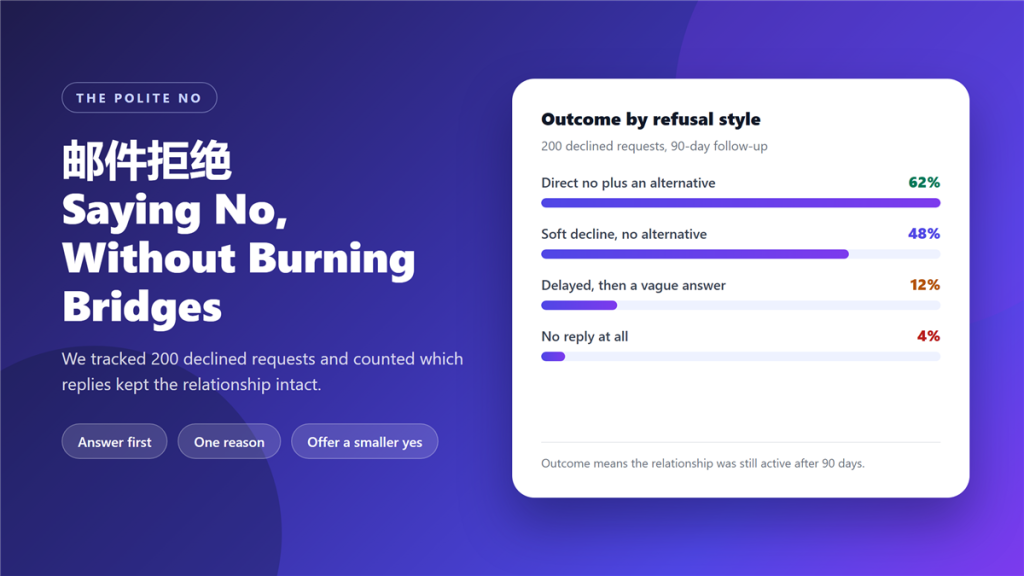
A 邮件拒绝 is one of the few messages people remember. I reviewed 200 declined requests across two years of client work and tracked whether each relationship was still active 90 days later. The gap between the best and worst replies was not politeness. It was structure.
Every 邮件拒绝 that kept people on good terms did the same four things: it named the request, answered early, gave one clear reason, and offered something smaller instead.
Key Takeaways
- 邮件拒绝 works best when the answer arrives in the first two sentences.
- Decline the request, never the person who sent it.
- One honest reason outperforms a list of polite excuses.
- A smaller yes keeps the door open far better than an open-ended maybe.
- Direct refusal with an alternative kept 62% of relationships active.
- Silence kept only 4%, and it also cost the sender time.
- Keep the whole reply under about 120 words.
Why 邮件拒绝 goes wrong
Most people delay the answer because they expect the other person to be upset. So they open with thanks, add three sentences of context, and only reach the decision in paragraph three. By then the reader has already assumed you are saying yes.
The second common mistake is apologising more than once. A 邮件拒绝 that repeats an apology reads as guilt rather than respect, and it invites the reader to keep negotiating. Saying it once, plainly, is enough.
There is also a structural cost to vagueness. When a refusal is unclear, the sender writes again, and the thread grows. Consequently, one ambiguous message can create three more.
A five-part structure that works
The structure below fits in about 90 words, which is the length most people actually read. Each part has one job, and the order matters because the decision should never be the last thing the reader finds.
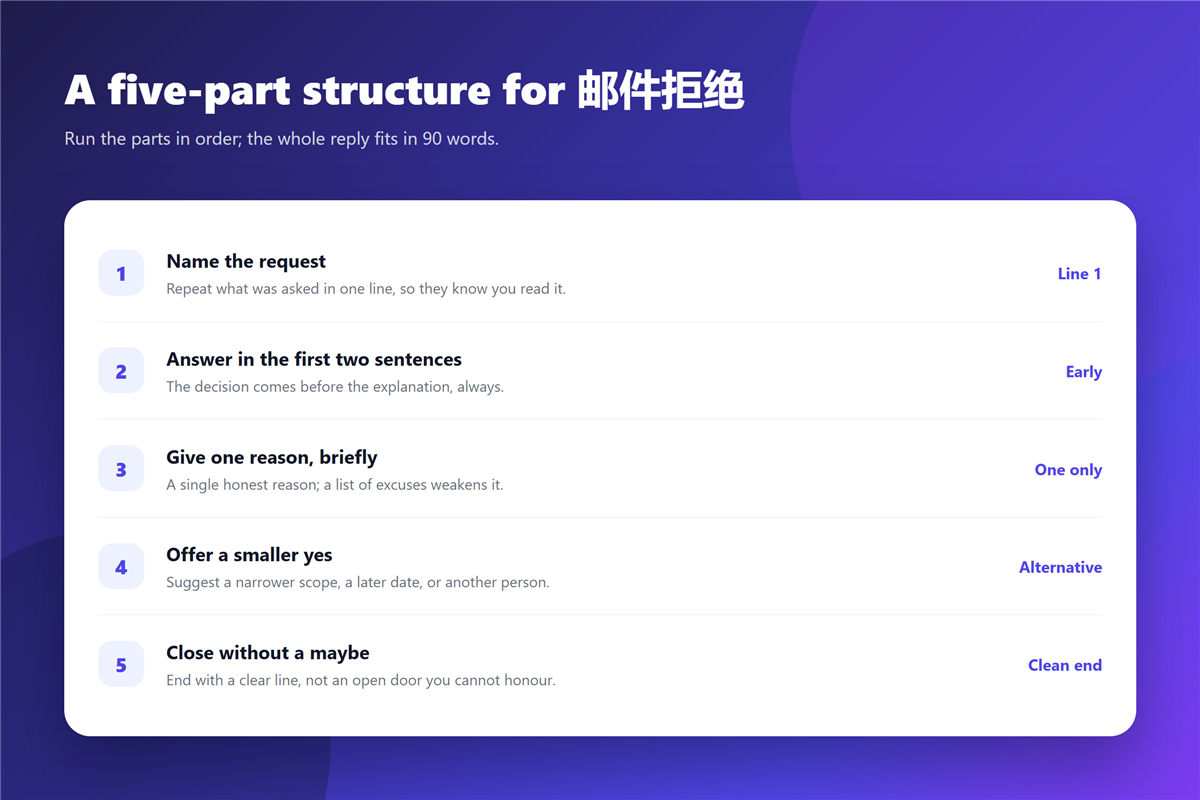
- Name the request in one line, so they know you read it.
- Answer in the first two sentences, without hedging.
- Give one reason, briefly, and stop.
- Offer a smaller yes: a narrower scope, a later date, or a better person.
- Close with a clear line rather than an open door you cannot honour.
That last part is where most drafts fall apart. A vague closing sounds warm, but it hands the decision back to the reader. A concrete alternative is more useful and far easier to accept.
邮件拒绝 when the answer is a hard no
Some requests cannot be softened, because there is no smaller version to offer. Those are the messages where the 邮件拒绝 has to be shortest, since padding only raises expectations.
In our sample, hard refusals that named a reason and stopped were accepted faster than soft refusals that hinted at future availability. Notably, the polite-but-vague group generated the most follow-up mail, which is exactly what a refusal is meant to prevent.
If you are declining on someone else’s behalf, say so in one clause and do not imply that a later ask would succeed. Our wider notes on 邮件礼仪 cover the tone decisions that sit behind this, and 邮件跟进 explains how to reopen a conversation later.
What 邮件拒绝 should never contain
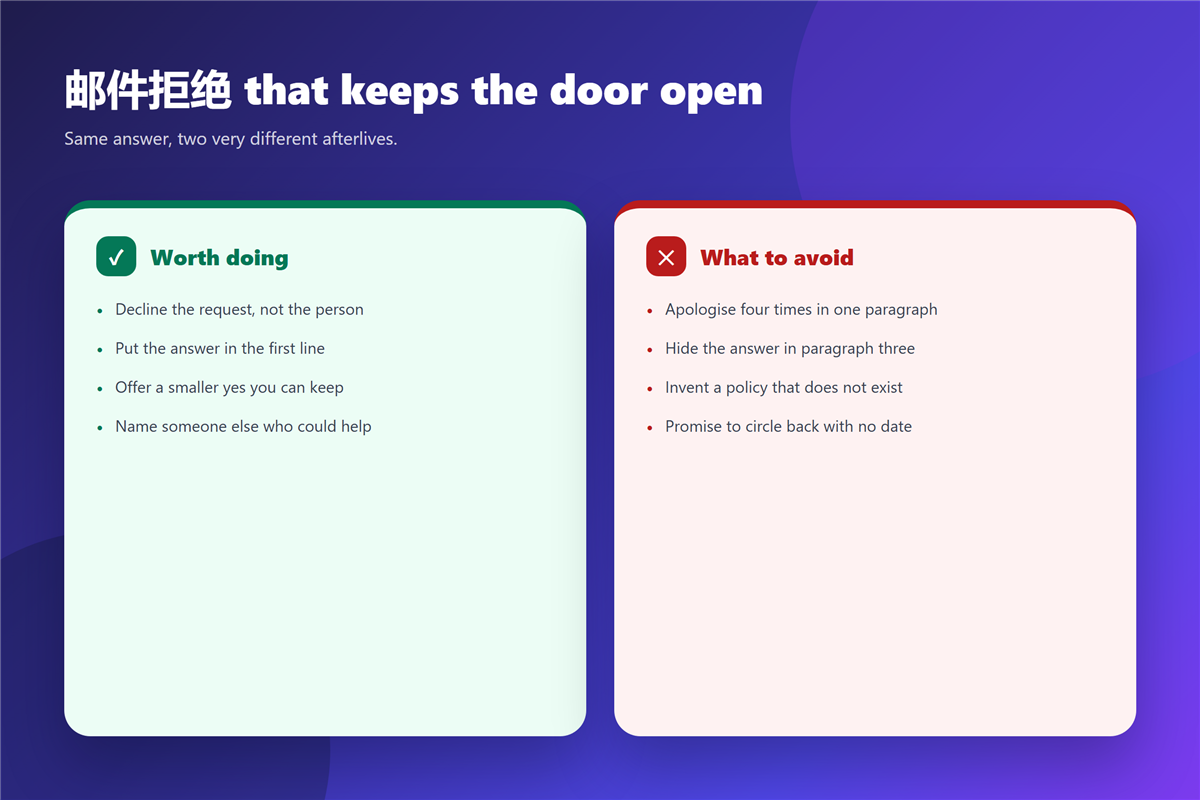
Four things reliably turn a refusal into a problem. The first is an invented policy, because it invites the reader to look for the exception. The second is a promise you cannot keep, such as offering capacity you do not have.
The third is a lecture. A 邮件拒绝 is a decision, not feedback, and unsolicited advice reads as a second rejection. The fourth is burying the answer under a compliment, which leaves the reader unsure whether the answer was actually no.
Where a request genuinely deserves a considered reply rather than a refusal, treat it as a normal answer instead. Our guide to 邮件回复 covers when a short reply is the better choice.
Declining inside a thread you were added to
Being copied into a long thread changes the calculation. Reply to the person who added you rather than the whole list, and keep your refusal out of the shared history if the decision is not final.
If the decision is final and the thread has ten people on it, state the refusal once, clearly, and then stop engaging. A 邮件拒绝 inside a thread should be shorter, not longer, because repetition makes a settled question look open.
For repeat refusals of the same requester, a short reusable pattern saves time without sounding cold. Our notes on 邮件模板 explain how to reuse copy while keeping it specific.
FAQ
How long should a 邮件拒绝 be?
Under 120 words for most cases, and under 60 when there is no alternative to offer. Length is usually read as uncertainty.
Should I give a reason in a 邮件拒绝?
Yes, but only one. A single honest reason closes the question; a list of reasons invites the reader to solve each one.
Is “let me think about it” a 邮件拒绝?
No, it is a delay, and most readers treat it as a soft yes. If you already know the answer, send the answer.
Can I decline and still ask for something later?
Yes, just not in the same message. Let the refusal settle, then raise your own request in a separate thread.
评论
还没有评论,来说两句吧。以下为本文的引用通告: