 小影邮箱
邮件写作怎么写?Writing Mail That Gets Read
Key Takeaways
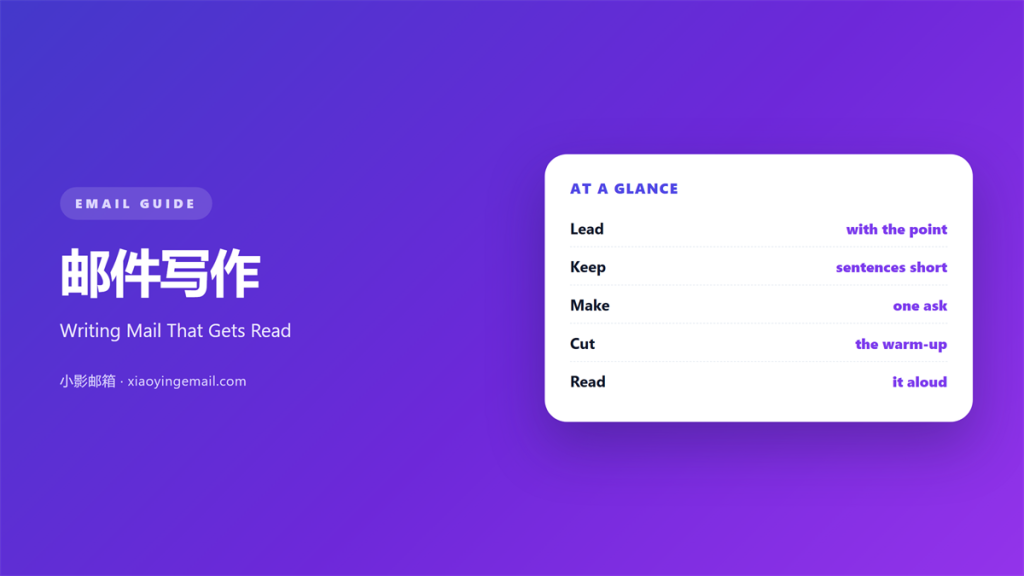
- 邮件写作 is the craft of putting a request into writing.
- Lead with the point and put the detail after it.
- One message should carry one clear ask.
- Short sentences beat clever ones every time.
- Read the draft aloud before you press send.
What 邮件写作 means
邮件写作 is the work of turning a thought into a message. The reader should be able to act on it once.
It covers the subject line, the opening, the body, and the close.
It is not about sounding formal. It is about being understood.
Many people confuse good writing with long writing.
The two are not the same. Length often hides a missing point.
A clear note can be short and still feel warm.
The best test is simple. Can a stranger reply after one read?
If not, the draft is not finished yet.
A note that needs a second read has already failed.
Readers rarely give a draft that courtesy.
They move on to the next message instead.
Why 邮件写作 matters
Readers give a new message only a few seconds.
They scan the first line and decide whether to continue.
Good 邮件写作 respects that moment.
It puts the reason for writing at the top.
That single habit saves a reply and often a day.
Poor writing costs more than time. It costs trust.
A vague note makes the sender look careless.
A tight note makes the sender look organised.
That impression follows you across every thread.
Every extra round trip costs two people time.
Multiply that across a week and the loss shows.
The cost of one unclear line
One unclear line can start a chain of five messages.
Each reply adds a question and a delay.
The fix is cheaper than the thread. Rewrite the line first.
When 邮件写作 helps
邮件写作 helps in three common cases.
First, when you ask for a decision.
Second, when you hand off work to someone else.
Third, when you write to a stranger.
Each case has the same risk. The reader may guess wrong.
So state the ask and the deadline in plain words.
A short note with both is hard to misread.
The three-line test
Write the draft in three lines.
Line one says why you are writing.
Line two gives the detail that matters.
Line three states the next step.
If the draft needs more, the request may be too broad.
When 邮件写作 hurts
邮件写作 hurts when it becomes polishing.
Some writers rewrite a short note for an hour.
The extra time rarely improves the message.
It also hurts when a call would be faster.
A tense topic can grow colder in writing.
Pick the channel before you pick the words.
And never write when you are angry.
Wait an hour. The draft usually shrinks.
Heat is a poor editor and a worse sender.
Write it, save it, and return when calm.
邮件写作 and tone
Tone is not decoration. It carries the meaning.
The same sentence can read as help or as blame.
Small choices decide which one the reader hears.
Use plain words first. Then check the verbs.
Active verbs sound warmer than passive ones.
They also make the sentence shorter.
Plain words, warm tone
Replace formal phrases with everyday ones.
Write “we can” instead of “it is possible”.
Write “I need” instead of “it is required”.
Then add one human line at the close.
A simple thank you is enough.
Read the draft as if a stranger sent it to you.
Ask whether you would answer it kindly.
How to use 邮件写作 well
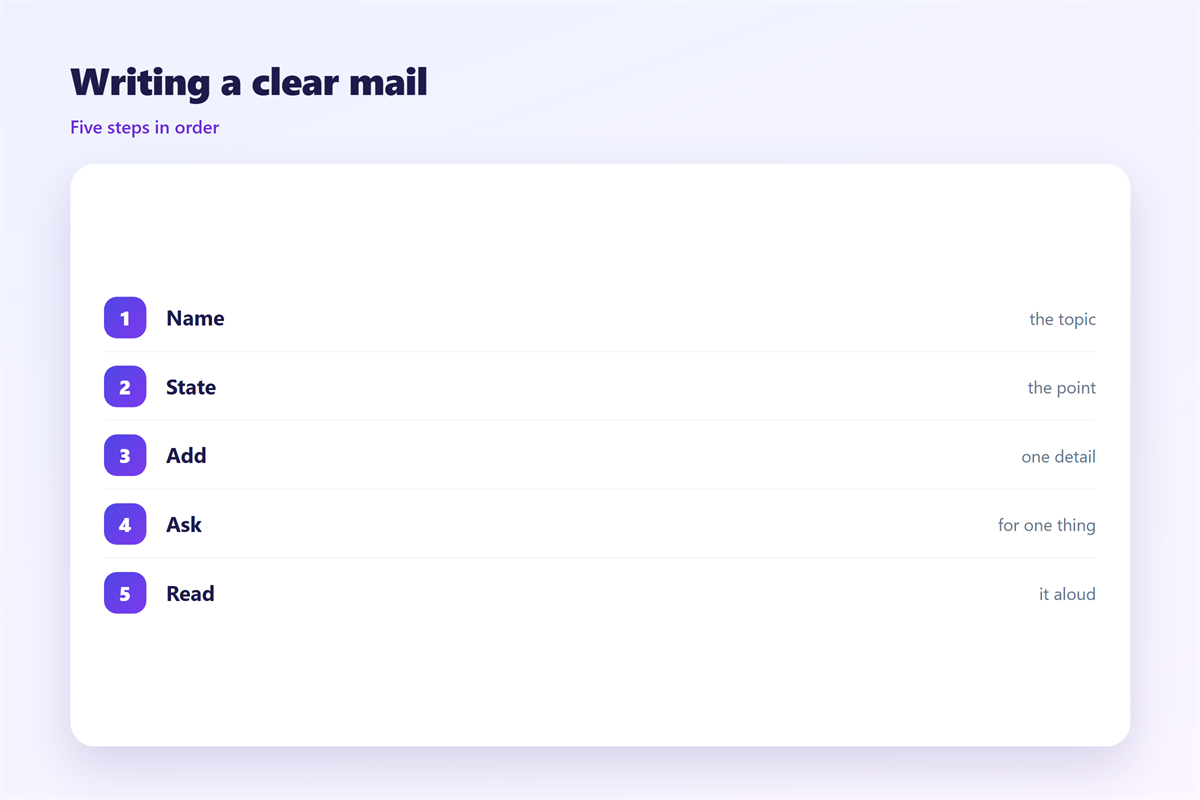
Start with the subject line.
Name the topic and the action in a few words.
Then write the first sentence as the whole point.
Add only the detail the reader needs to act.
Keep each paragraph to two or three lines.
End with one clear next step.
Then read the whole note aloud.
Cut every word your voice does not need.
Good 邮件写作 sounds like speech with the pauses removed.
The one-ask rule
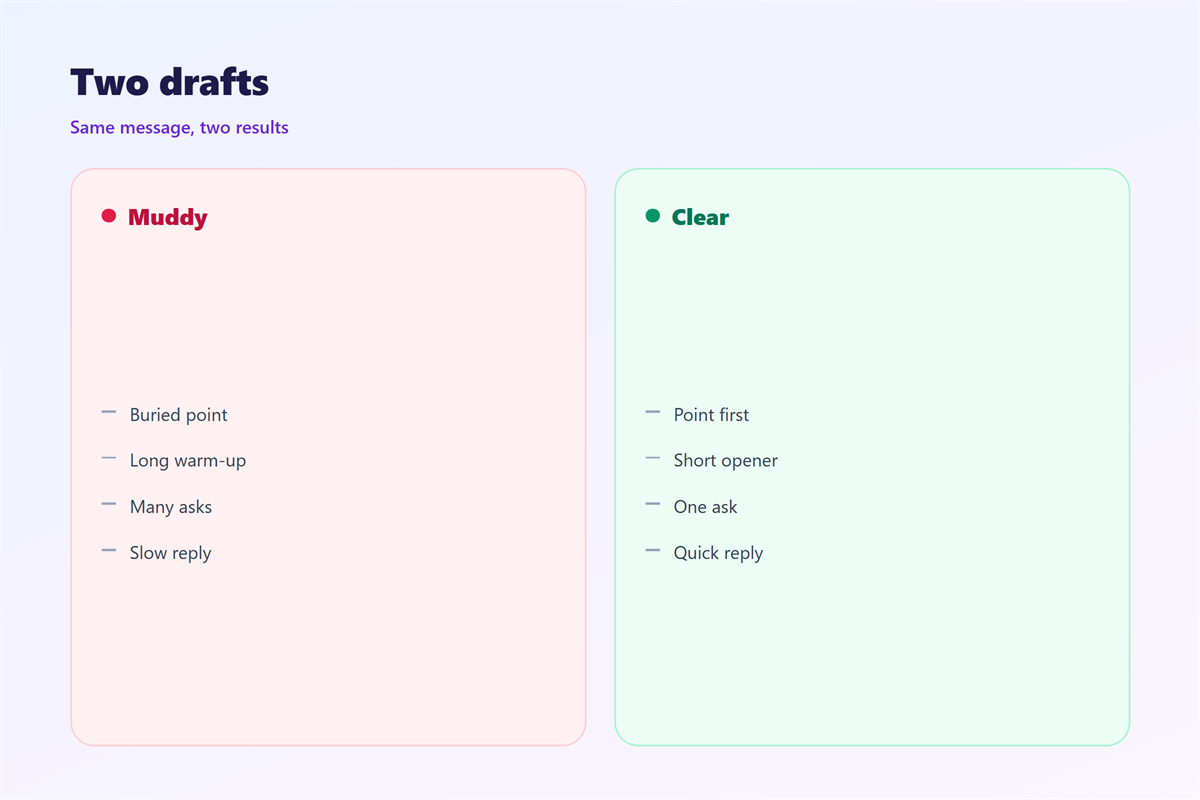
Every message should carry one ask.
Two asks split the reader’s attention.
Three asks usually get no answer at all.
If you need several things, send a short list.
Then mark the one item that matters most.
邮件写作 on a phone
Most messages are opened on a small screen.
That changes how the draft should look.
Short paragraphs are easier to scroll.
Long blocks get skipped, even when they are good.
Keep the first line under one screen width.
Put the ask before any background.
Then test the note on your own phone.
If you have to scroll to find the point, move it up.
A single idea per screen is a good target.
That keeps the scroll short and the reply likely.
Keeping 邮件写作 consistent
Consistency turns a good habit into a team standard.
Agree on a subject format and a sign-off.
Agree on how many paragraphs a note may hold.
The wider craft of drafting sits in 邮件撰写.
The editing pass is covered in 邮件润色.
The block-by-block layout appears in 邮件正文.
The plain-text option is explained in 邮件格式.
Then share two good examples with the whole team.
A shared standard makes 邮件写作 faster for everyone.
FAQ
Is 邮件写作 only about grammar?
No. Grammar matters, but structure and clarity matter more. A clean structure fixes most unclear sentences.
How long should a work email be?
As short as the ask allows. Most routine notes fit in five short sentences. Longer notes need a clear reason.
Should I use templates for 邮件写作?
Yes, for repeatable messages. Keep the structure and rewrite the details. Never send a template without reading it.
Does 邮件写作 change across cultures?
Yes. Some readers expect a warmer opening. Others want the point in line one. Match the reader when you can.
评论
还没有评论,来说两句吧。
评论功能已关闭。