 小影邮箱
邮件大小写怎么用?Caps, Lowercase and Tone
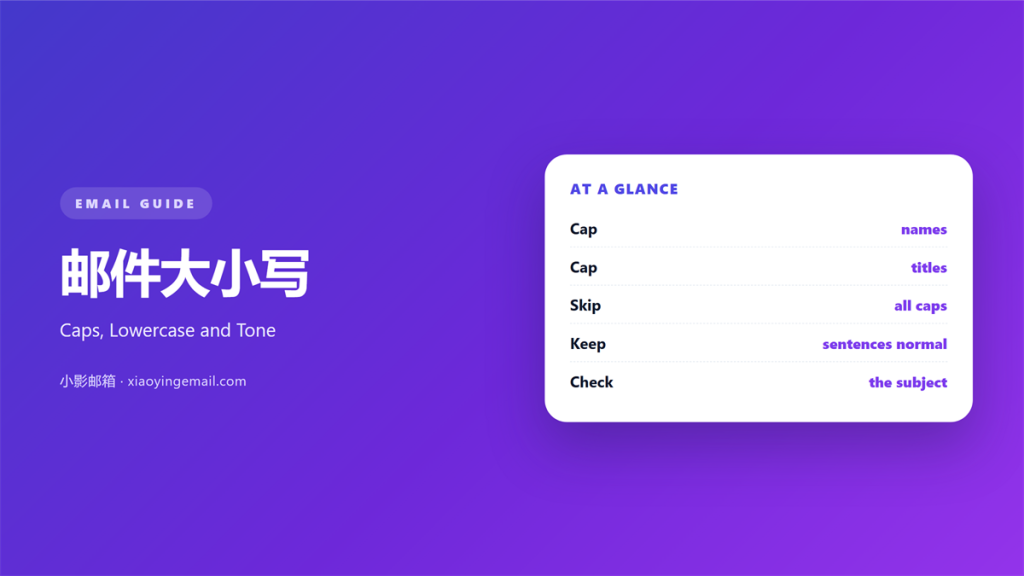
Key Takeaways
- 邮件大小写 carries tone as well as meaning.
- Capital letters add weight to a word.
- Keep names and titles in normal case.
- Never write a whole sentence in caps on purpose.
- Match the case your reader already uses.
What 邮件大小写 means
邮件大小写 is the way you use capital letters.
It covers names, titles, and the first word.
It also covers anything typed in full caps.
Case is not just a spelling rule.
It changes how loud a line feels.
So 邮件大小写 is really about tone.
A single capital word stands out in a line.
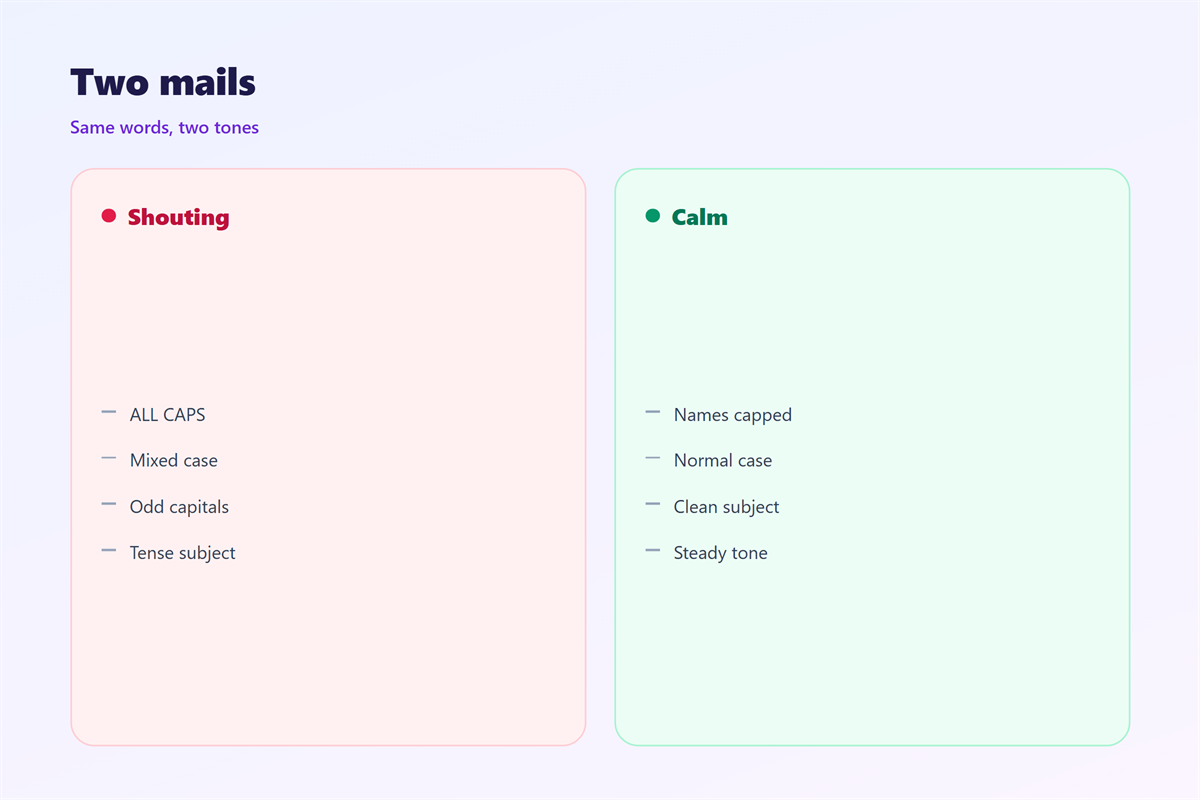
A whole line in caps feels like a shout.
That is why writers use caps so carefully.
Standard case means the first word and names.
Everything else stays lowercase.
That is the calm default for most mail.
That default is easy to read.
It also hides the writer’s mood.
So treat it as part of the message.
It is a quiet signal that readers feel.
Why 邮件大小写 matters
Case guides the reader’s eye.
It shows which words matter most.
It also sets the temperature of a line.
Warm mail and cold mail look different.
邮件大小写 helps you choose the mood.
Get it wrong and the tone turns sharp.
A stray capital can read as anger.
An all-caps line almost always does.
So case is a small tool with real weight.
Use it slowly and with intent.
Case also signals care.
A tidy line says the writer thought about it.
A careless line says the opposite.
Case is small but it is not trivial.
So check the case before you press send.
Caps for emphasis
One capital word can carry a point.
Two start to feel like a shout.
So save caps for the rare, true flag.
When 邮件大小写 helps
Good case helps in a few ways.
It makes deadlines and names easy to spot.
It keeps the tone steady and calm.
It also hides small emotional signals.
So a tense line stays polite.
And a warm line still feels warm.
Standard case is safe in every setting.
It works with a client and a friend.
So learn the default and hold it.
Then break it only for a reason.
It also keeps a busy line calm.
Readers trust a writer who stays even.
A steady voice puts readers at ease.
Starting a sentence
Capitalize the first word only.
Keep the rest in normal case.
Then check the names again.
When 邮件大小写 hurts
Bad case can cost you goodwill.
A full-caps request reads like a command.
A lowercase name can look careless.
Both send the wrong signal.
So read the line as the reader would.
Another risk is mixed case in a hurry.
Typed fast, it looks sloppy.
A sloppy line weakens a strong point.
So fix the case before you send.
It takes ten seconds to check.
A wrong capital can start a quarrel.
So choose the case before you type.
So never type a whole sentence in caps.
The all-caps trap
Caps feel urgent, but they read as rude.
Use one word if you must.
Then return to normal case.
邮件大小写 in practice
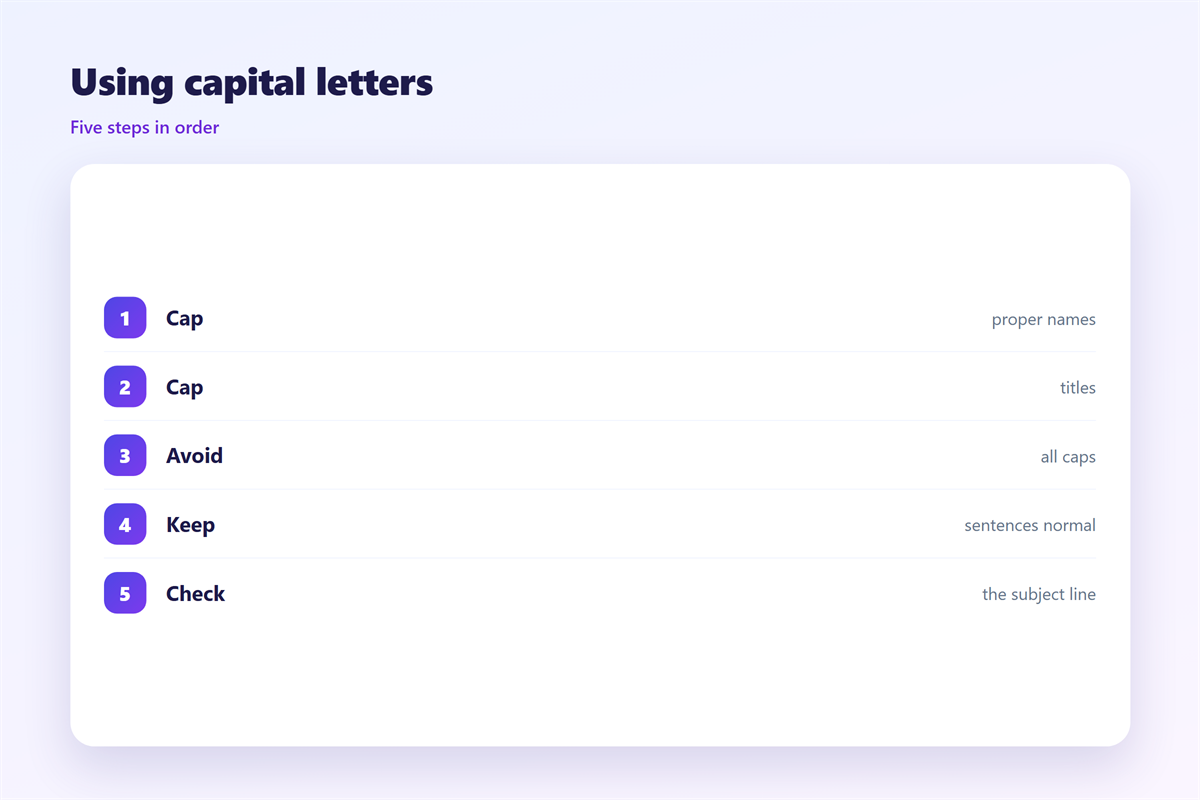
Start with a simple default.
Capitalize the first word and proper names.
Keep everything else lowercase.
Then read the line out loud.
If it sounds loud, the case is wrong.
Trim any extra capitals you find.
Watch the salutation and the sign-off.
Names there matter more than anywhere.
Small choices set the whole tone.
So keep the case steady and quiet.
Readers trust a calm, even line.
Keep a short list of your rules.
Then check the draft against it.
Two or three rules cover most cases.
Then read it once more before sending.
How to check 邮件大小写
Pick your default case first.
Write the draft in that case.
Then scan for stray capitals.
Fix the names and the titles.
Send it to yourself once.
After a week, reread a few replies.
If they echo your case, it worked.
If they sound cool, warm the line up.
Good 邮件大小写 changes slowly.
Next, check the subject line too.
Two shouted words there should be rare.
If they clash, pick the calmer one.
Then set the same rule for every draft.
Keep the rules in one note.
Then paste them into your drafts.
A small checklist beats memory.
Then fix the case and send.
邮件大小写 and the reader
Readers read tone before they read words.
Case is a big part of that tone.
So keep the default calm and plain.
A client expects clean, standard case.
A colleague may accept something lighter.
What breaks trust is a sudden shout.
A quiet mail and then full caps is a shock.
So save caps for a real alarm.
Test the style on one reader.
Then keep the style that fits.
Small shifts are enough for most people.
Readers also copy the case you use.
So set a good example each time.
So keep the tone even and kind.
Keeping 邮件大小写 steady
A steady case turns into a habit.
The line at the top of the mail is covered in 邮件标题.
The words that get a mail opened appear in 邮件主题行.
The marks that tidy a sentence sit in 邮件标点.
The choice between plain text and markup sits in 邮件格式.
Review the rule once a quarter.
Then keep the same case for every team.
A team that agrees on 邮件大小写 writes quieter mail.
Keep one rule for the whole team.
Write it down where everyone can see.
Then review the rule each quarter.
FAQ
Is all-caps ever fine in 邮件大小写?
Only for a short, true warning word.
Should job titles be capitalized in a mail?
Capitalize a formal title, keep a role lowercase.
Can 邮件大小写 change the tone that much?
Yes. Caps read as louder than the words suggest.
What case should a subject line use?
Sentence case, with one capital at the start.
评论
还没有评论,来说两句吧。
评论功能已关闭。