 小影邮箱
邮件引用怎么处理?Quoting in Replies Without Clutter
Key Takeaways
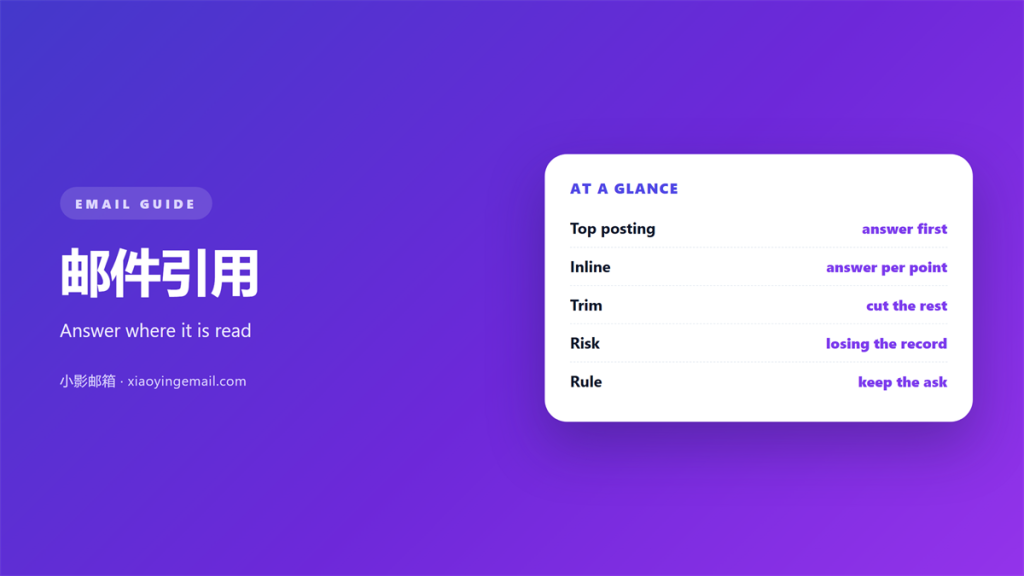
- 邮件引用 keeps part of an earlier message in your reply.
- That lets the reader follow the thread without guessing.
- Trimmed 邮件引用 points at what you are answering.
- Untouched quoting hides it instead.
- Top posting is fast to write and slow to read.
- A quoted line is also a record, so keep the part that settles a decision.
- The rule that survives real mail is short: quote only what you are about to answer.
What 邮件引用 is for
邮件引用 is what turns a reply into a conversation. When you answer a message, you can quote a line or two. Place your response next to that line. The reader then sees which question you are addressing. Remove the quoting entirely and every reply becomes a small puzzle.
The habit has a second purpose that is easy to forget. A quoted passage is evidence of what was agreed. In a long exchange it is often the only place where the original wording still exists. Trimming is useful precisely because it is selective. It keeps the part that matters and lets the rest go.
A useful way to picture 邮件引用 is as a set of brackets. The brackets sit around the part of the conversation you are still working on. Everything inside is live. Everything outside has been settled or abandoned. The discipline is deciding where the brackets should go. Do that for each message instead of leaving the whole history attached.
Top posting versus 邮件引用
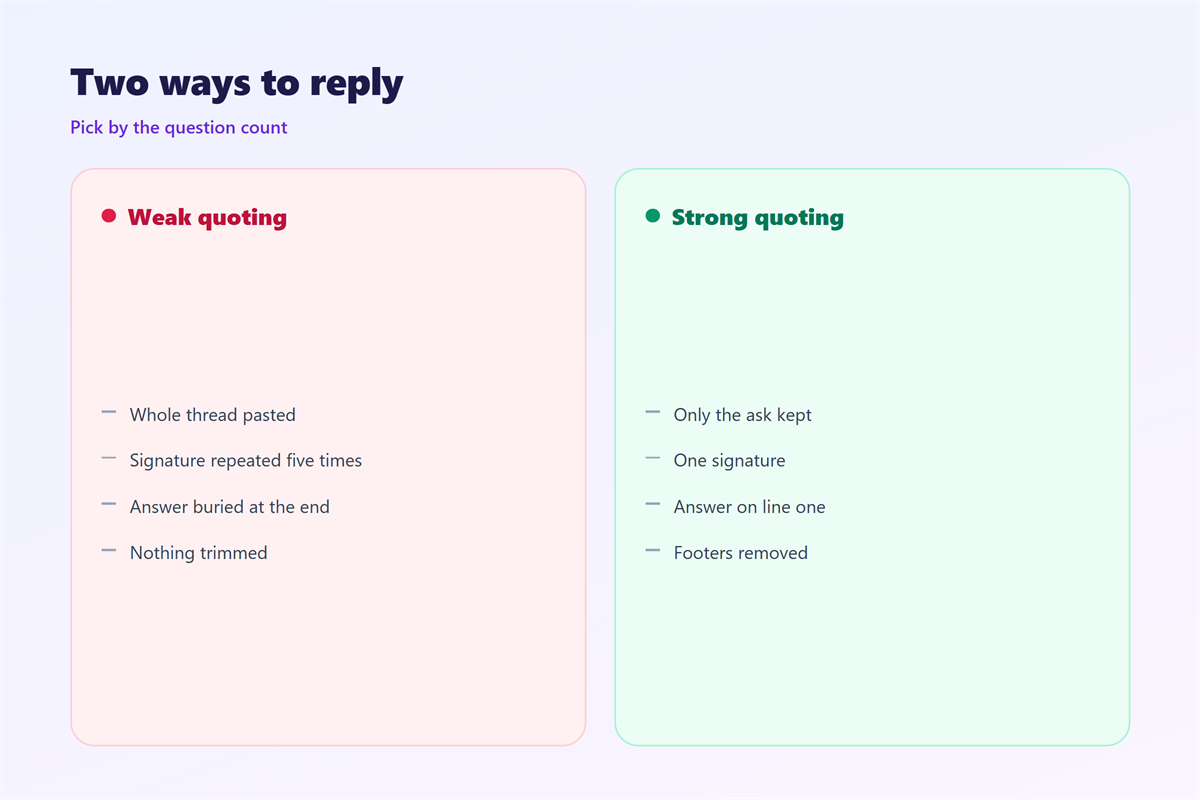
Top posting means typing your reply above the entire quoted message. The screen presents the history in that order. It is quick, and it never asks you to cut anything. It also buries the answer under many screens of history. The reader scrolls and finds your line by accident. Then the reader works out what it referred to.
Inline 邮件引用 does the opposite. You answer each point where it appears. The question and the answer then travel together. The cost is a little more care while writing. The payoff is a reply that can be read once, from the top. Nothing is held in memory.
Neither approach is wrong in every case. A short note to a colleague needs no quoting at all. A reply to a long thread with four open questions is unusable without it. The question is never whether to quote. It is how much 邮件引用 the reply actually needs.
How much 邮件引用 to keep
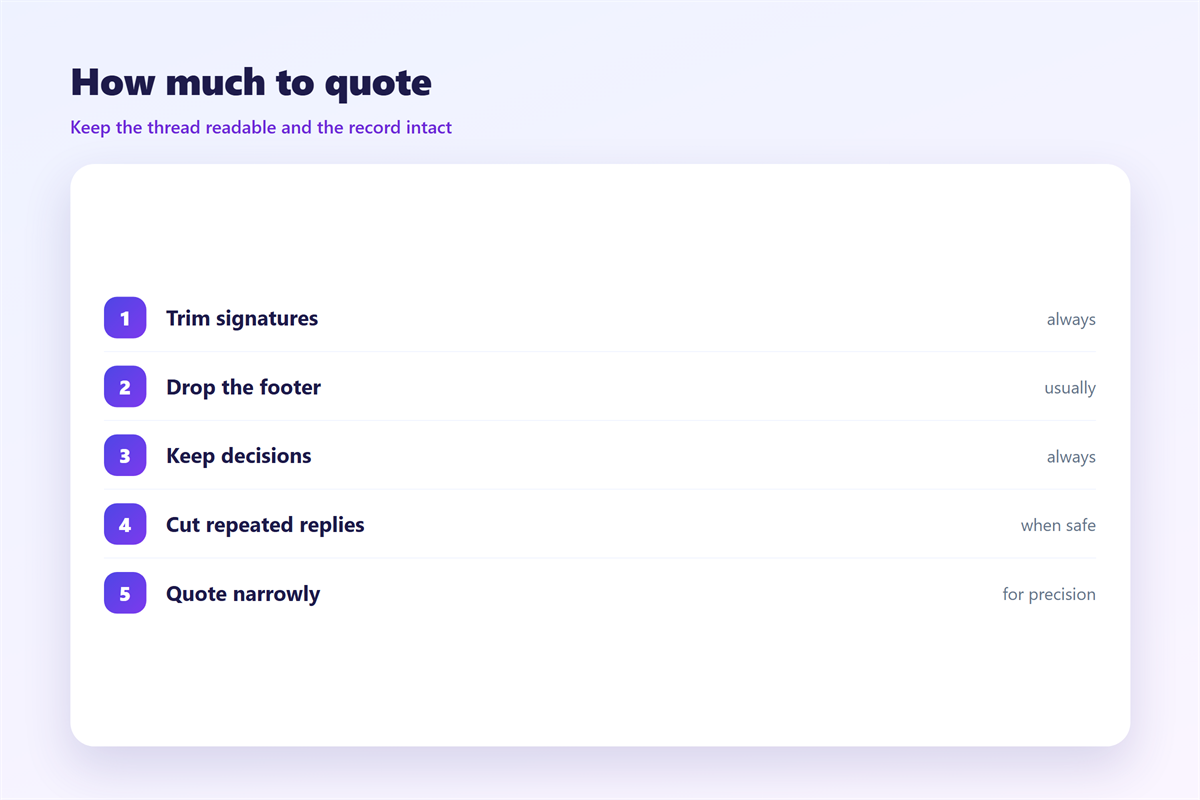
The useful measure is not length but relevance. A paragraph you are not answering can usually go. A paragraph you are answering should stay. Trim it to the sentence that carries the point.
The reply that answers first
If you are answering one question, quote that single line. Then answer beneath it. Everything else can be dropped. There is nothing else you are responding to.
The reply that answers inline
If the message contains several points, quote them in order. Answer each one underneath. This keeps the shape of the original request intact. It also makes it obvious when you have skipped something.
The two approaches are not rivals so much as different amounts of the same thing. A reply that answers first is right when there is one point. A reply that answers inline is right when there are several. Choosing between them is choosing how much 邮件引用 to preserve. The honest answer is usually less than the client offers by default.
邮件引用 etiquette in long threads
Long threads punish everybody, and quoting is the tool that keeps them readable. The first move is to cut the message you are replying to. Cut it down to what is still live. A reader joining later can then see the current state without archaeology.
The second move is to leave the signature in once. A quoted block that carries three old signatures is noise. Noise is what makes people stop reading quoted text at all. What survives that trimming is the part you actually want read. It is the same principle behind 邮件回复 and the structure of a 邮件会话. When a message has to move to someone new, the choices in 邮件转发 decide what travels with it. Anything that must stand as a record is best handled as 邮件确认.
There is also a courtesy version of the same rule. When you cut a quoted message, say in a few words what you have cut. The reader then knows nothing has been quietly dropped. A short note such as “trimmed for length” costs nothing. It removes the suspicion that the 邮件引用 was edited to change the meaning.
FAQ
Should I always use 邮件引用?
No. A short exchange between two people needs no quoting. Both already remember the context. Adding quoting only makes the message longer. Reach for it when a reply would otherwise be ambiguous.
Does 邮件引用 hide the answer?
Only when it is done carelessly. Quoting a whole message and typing one line on top hides the answer. Quoting the single line you are answering places the answer where it is expected.
How much of a thread should I keep?
Enough to make your reply clear, and no more. If a reader needs older context, put it in a short summary. Do not bury it in a quoted block nobody scrolls through.
Is 邮件引用 different from forwarding?
Yes. Quoting keeps a message inside the same conversation. Forwarding starts a new one with a copy of the old. The two leave very different traces in a thread.
References
- IETF RFC 3676: The Text/Plain Format and DelSp Parameters
- IETF RFC 5322: Internet Message Format
- Wikipedia: Posting style
评论
还没有评论,来说两句吧。
评论功能已关闭。