 小影邮箱
邮件早鸟怎么发?The First Few Places
Key Takeaways
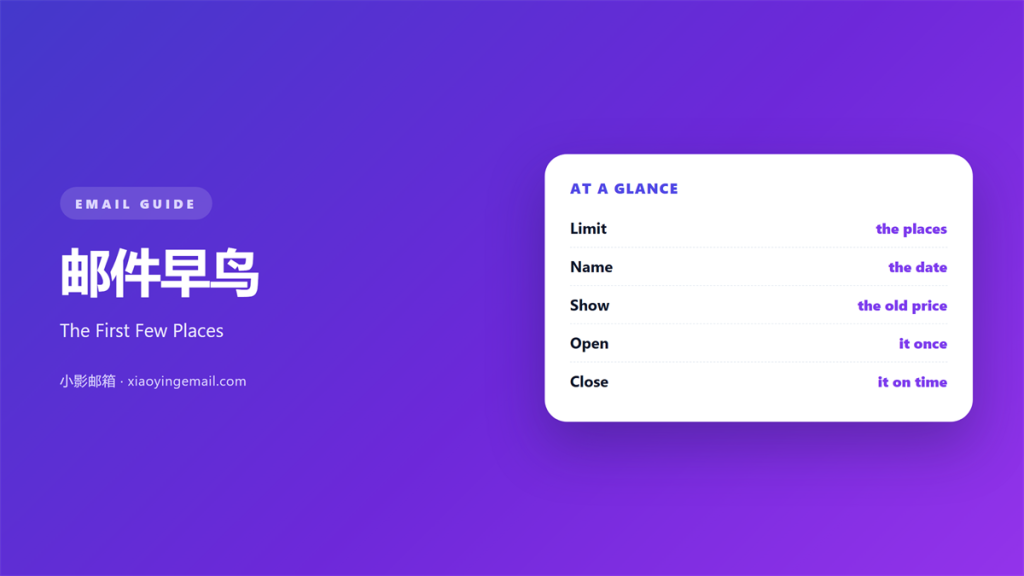
- 邮件早鸟 gives the first buyers a lower price.
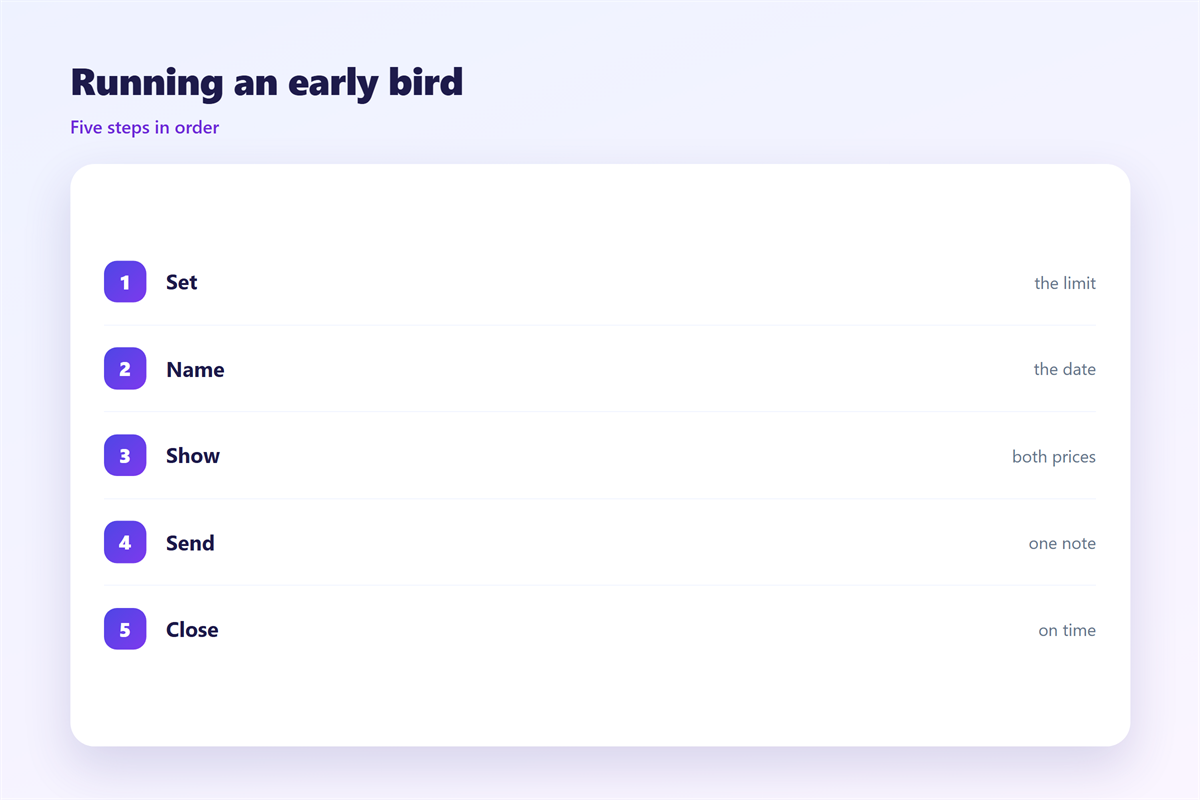
- Name the number of places and the date.
- Show the normal price next to the early one.
- Run it once per season, not every month.
- Close the offer even if places remain.
What 邮件早鸟 means
邮件早鸟 is a price for people who decide early.
It usually comes with a limit on places or days.
The limit is what makes the price mean something.
An early-bird price is not a general discount.
A general discount stays open until a fixed date.
An early-bird price ends when the first group fills.
That group is often small, sometimes fifty seats.
The mail must name that number.
It must also name the day the price ends.
Two limits can run at once, and the first one wins.
A clear 邮件早鸟 states both limits in one line.
The reader then knows whether they still qualify.
Why 邮件早鸟 matters
Early money pays for the room, the stock, or the staff.
It also turns a maybe into a booking.
People who pay early are more likely to arrive.
The price rewards them for that commitment.
A 邮件早鸟 also gives you a forecast.
You can size the second round from the first.
The offer creates a reason to act this week.
That reason is a limit, not a slogan.
A real limit makes the decision smaller.
It answers the question of why now, without pressure.
Two limits, one price
Places and time are different limits.
Places run out when people buy.
Time runs out when the clock reaches the date.
Say which limit closes the offer first.
When 邮件早鸟 helps
It helps when the room or the stock is finite.
A fixed number of seats makes the limit real.
It helps when you need a forecast before you commit.
Early bookings tell you how many staff to hire.
It helps when the full price is known, so the saving is easy to see.
It also helps when your list is small but warm.
Early buyers often tell their friends about the price.
A hundred readers can fill fifty places.
The first week does the work
Most early-bird sales land in the first days.
Send the main mail on day one.
Send one reminder two days before the close.
Then stop, even if places remain.
When 邮件早鸟 hurts
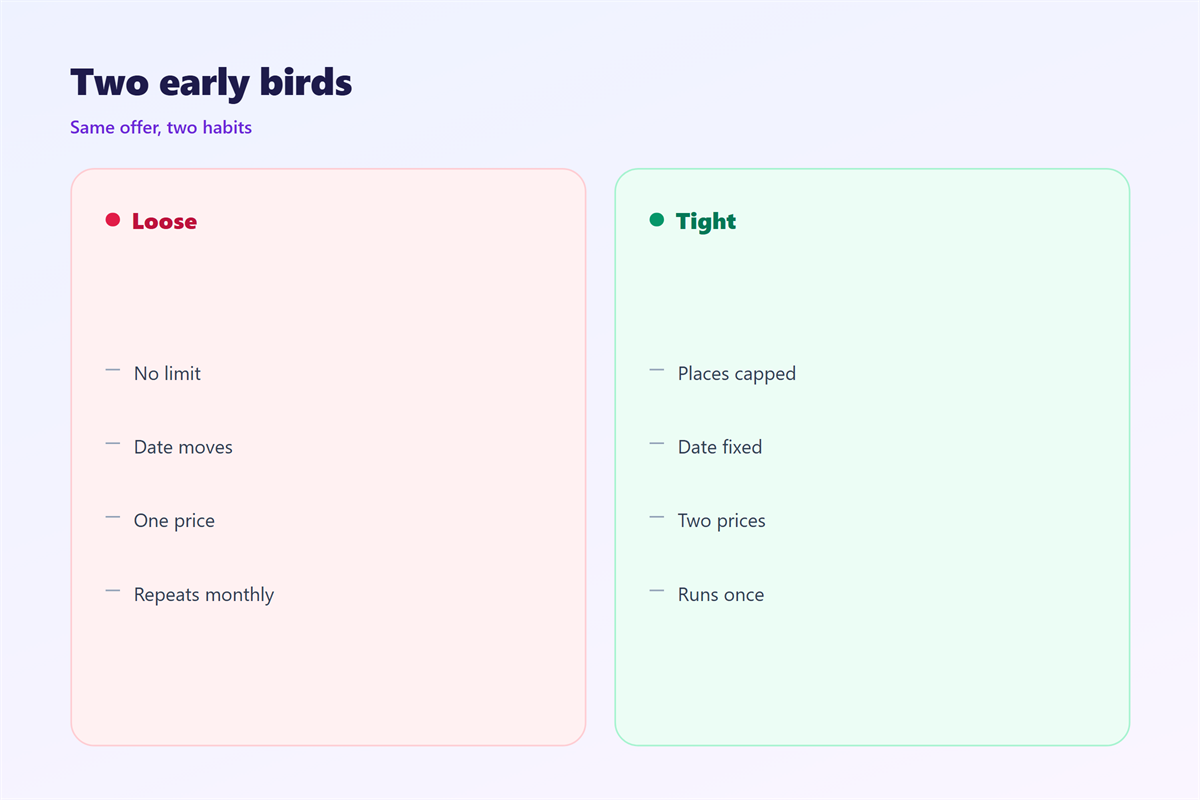
It hurts when the early price never ends.
A permanent early bird is just the price.
It hurts when the normal price is invented.
Readers check, and a fake anchor price costs trust.
It hurts when the limit is not countable.
A count that resets each week stops being a limit.
A limited-places line with no number means nothing.
It hurts when the same people get it every time.
New readers then learn to wait for the next round.
It also hurts when the saving is tiny.
Five percent off is not worth an early decision.
邮件早鸟 and the first hundred seats
A seat count only works if the count is visible.
Show the number left, or show the number sold.
Update that number in every reminder.
Do not reset the count when a batch sells out.
A 邮件早鸟 that reopens looks planned.
Instead, open a second batch at the normal price.
Then the first price keeps its meaning.
Tell the waiting list when the second batch opens.
That message is a service, not a second discount.
When the seats run out early
Close the offer the moment the count hits zero.
Then send a short note to the list.
Say the first batch is full and give the next date.
Do not quietly add seats to the same batch.
A second batch is honest and easy to explain.
How to write 邮件早鸟
Write the 邮件早鸟 in one screen.
Put the saving in the subject line as a number.
Then show the normal price and the early price together.
State the number of places and the closing date in the first paragraph.
Add the link to the form, not to a homepage.
Then send it to the warm half of the list first.
Keep the proof short: one photo, one line of detail.
End with the two limits again.
Say it once, clearly
One price, one date, one number of places.
Do not add a second code on top.
A stacked offer hides the real value.
Keep the mail to one action.
Then test the link before the send.
Check that the form still shows the early price.
邮件早鸟 on a phone
The price comparison must survive a narrow screen.
Stack the two prices, one above the other.
Put the saving in bold between them.
Keep the place count on its own line.
A 邮件早鸟 on a phone needs one clear button.
Make the button full width.
Check that the date does not wrap.
Then check the form on the same phone.
Two fields beat six on a small screen.
Test the whole path once with a real card.
Keeping 邮件早鸟 honest
An 邮件早鸟 should never be the only price.
Show the normal price in the same view.
Do not raise the normal price the week before.
The offer rules sit with 邮件促销.
The code mechanics sit in 邮件优惠券.
The closing rules sit in 邮件截止日期.
The sign-up flow sits in 邮件报名.
Then write the limit and the date in one sentence.
A reader who checks the count should find it correct.
FAQ
How many places should a 邮件早鸟 offer?
Fifty to a hundred is enough for most lists.
Should the early price apply to renewals?
No. Keep it for first-time buyers only.
Can I extend the deadline?
Once, with a reason, and never in silence.
What if nobody buys?
Close it on time. Then ask the list why.
评论
还没有评论,来说两句吧。
评论功能已关闭。