 小影邮箱
邮件澄清怎么写?Setting the Record Right

Key Takeaways
- 邮件澄清 clears up a point the reader mistook.
- Restate the fact plainly and stay calm.
- Never hint that the reader was careless.
- Confirm the fix once the air is clear.
- A short note beats a long argument.
What 邮件澄清 means
邮件澄清 is a short note that sets a fact straight.
It corrects a misreading, a mix-up, or a wrong number.
The word means to make something clear again.
It is not a scolding and not a lecture.
A good clarification stays neutral and brief.
It names the error without blaming a person.
Then it restates the truth in simple terms.
So a 邮件澄清 repairs understanding, not feelings.
Keep the note small and the tone even.
A long explanation often makes things worse.
Read your own note as a stranger would.
That simple test catches most confusion.
A small word swap can prevent a big argument.
Keep every sentence short and easy to scan.
Clarity is the only real goal here.
Why 邮件澄清 matters
A small mix-up can grow into a large problem.
Two people act on two different facts.
Work doubles. Tempers shorten. Deadlines slip.
A 邮件澄清 stops that drift early.
It costs two minutes and saves hours.
It also keeps the record accurate.
A clean record prevents the same argument later.
So a calm note pays for itself at once.
Clear facts keep the whole team aligned.
They also spare the reader a second guess.
Precision is a quiet form of respect.
The cost of a small mix-up
An unclear line gets read in two ways.
Each reader picks the meaning that fits their hope.
Soon the team works from different plans.
A quick correction settles the matter fast.
Two quiet assumptions are easy to miss.
Name them before they harden into rules.
When to send a 邮件澄清
Send one when you spot a wrong assumption.
Send one when a figure was misread.
Send one when two threads now disagree.
Hold back when the point is truly minor.
Hold back when a chat can settle it faster.
Act early, before the error spreads further.
Speed is a kindness in most cases.
A fast word beats a perfect one sent late.
If in doubt, a short note rarely hurts.
Signals that a message was misread
A reply answers a question you never asked.
Someone quotes a number you did not write.
A plan moves in a direction you did not choose.
Any of these means a short clarification helps.
Watch for a sudden change in the plan.
A puzzled reply is another clear sign.
How to phrase a 邮件澄清
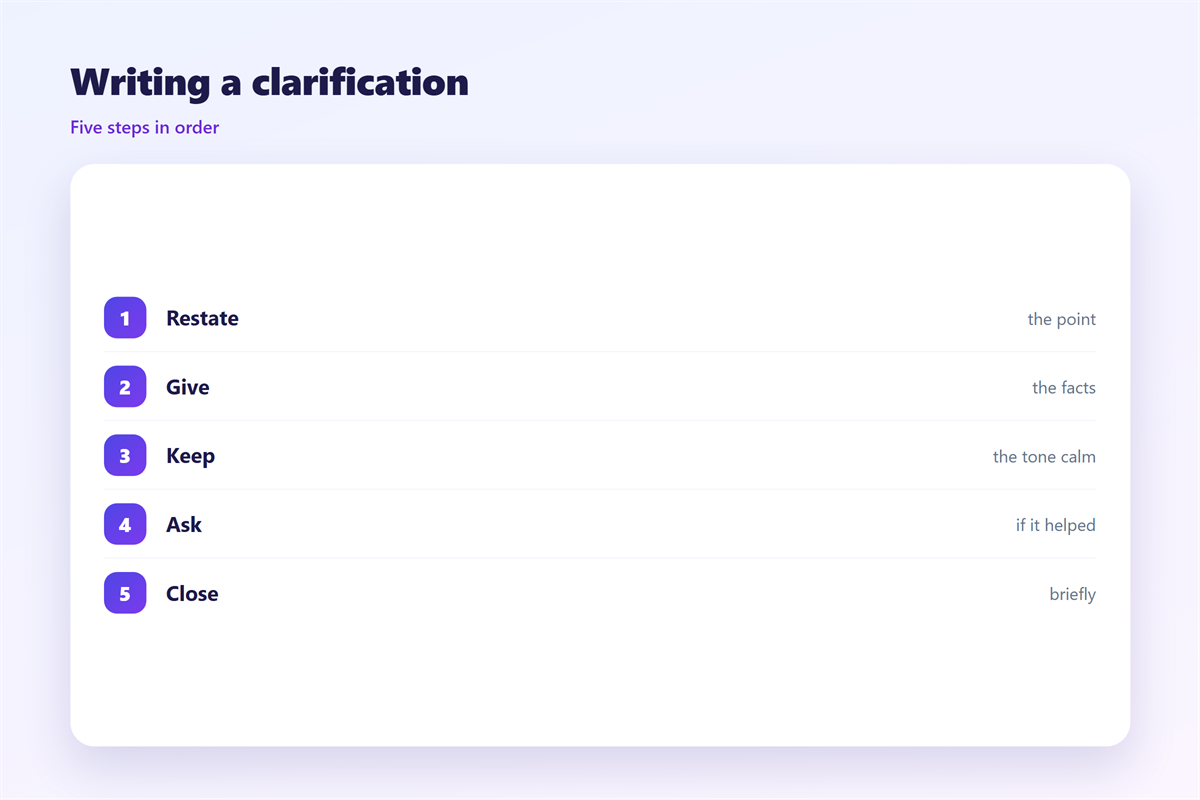
Open with a calm and friendly line.
State the fact you want to correct.
Give the accurate version in one sentence.
Invite the reader to check their side.
Close with a warm and forward-looking note.
A calm 邮件澄清 invites a calm answer.
Keep the opening plain and low-key.
Then let the fact do the work.
End with a question that invites a reply.
Words that calm a thread
Try a line asking to make sure we are aligned.
Another option is to clear up one small point.
Both sound helpful, not defensive.
Avoid any phrasing that sounds like blame.
A calm opener lowers the reader’s guard.
That makes the fix easier to accept.
邮件澄清 and staying factual
Facts settle a dispute. Feelings only heat it.
Stick to dates, names, and numbers.
Leave out any guess about the reader’s motives.
Cite the earlier message when it helps.
A factual 邮件澄清 is hard to argue with.
Keep opinions out of the first paragraph.
Let the evidence carry the message.
Quote the exact line when it matters.
A precise reference ends most debates.
Numbers travel better than adjectives in a dispute.
Mistakes that weaken 邮件澄清
Some notes sound like a quiet accusation.
Others drown the point in long backstory.
A third kind copies the whole thread again.
All of them make the reader defensive.
Keep the tone light and the note short.
Say the truth and then move on.
Never write while you feel annoyed.
Reread the note once the mood has passed.
Blame belongs in no version of the note.
A quick before and after
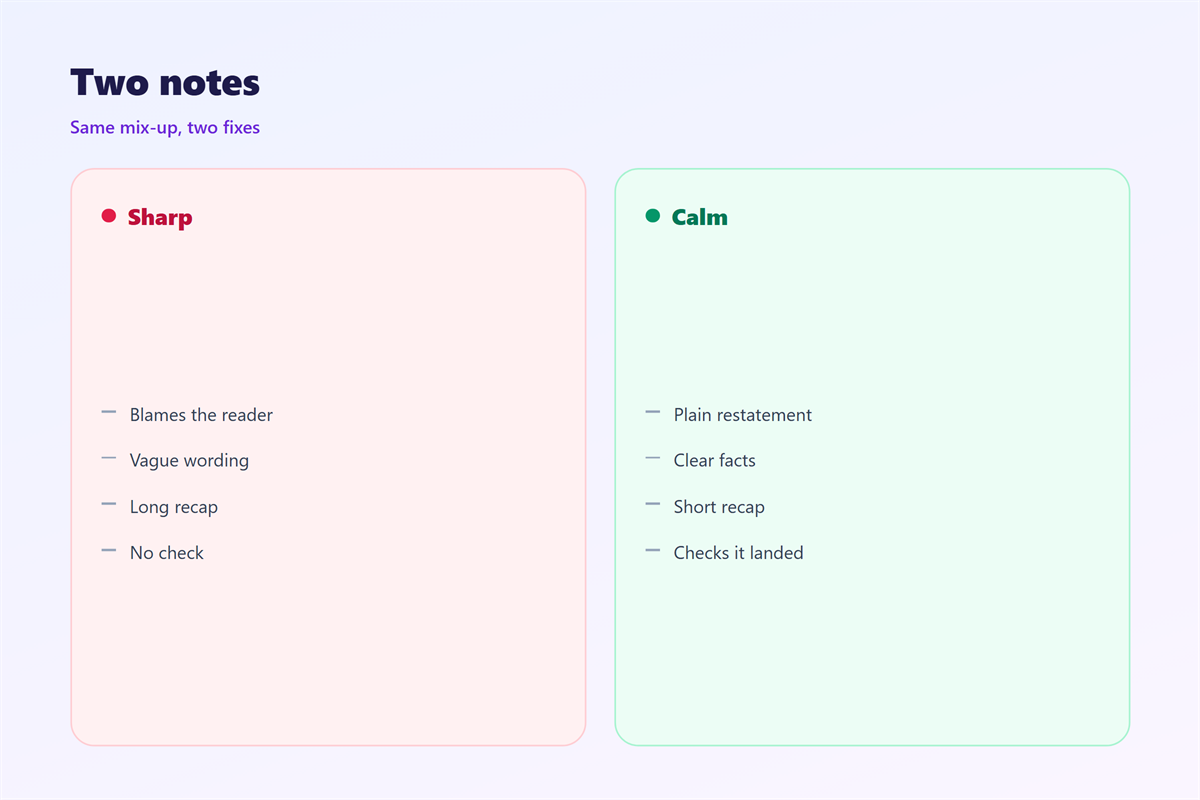
Weak: you clearly ignored my last email.
Strong: one correction to the figure I sent.
Same fix, kinder tone, better odds of a calm reply.
Notice how the gentle version still gets the fix.
Building a 邮件澄清 habit
Read each reply for the fact it assumes.
Catch a wrong number before it spreads.
Speak up early, while the cost is small.
Keep the same calm voice every time.
Then a 邮件澄清 becomes a quick, easy task.
Practice the wording until it feels natural.
Keep your notes short and specific.
That habit earns quick, calm replies.
Review the thread before you begin writing.
A calm habit spreads across the whole team.
Keeping 邮件澄清 consistent and linked
Consistency keeps a thread easy to trust.
The timing of a later message appears in 邮件跟进.
The choice between one reply and all appears in 邮件回复.
The wider habits of good conduct sit in 邮件礼仪.
How to catch small slips is explained in 邮件校对.
Match the same calm style across the whole exchange.
Readers value a 邮件澄清 that never turns sharp.
Agree on one approach with your team.
A shared habit removes doubt and delay.
Keep the same format across the team.
A shared standard makes trust easy.
Keep the tone level from start to finish.
FAQ
Is 邮件澄清 the same as an apology?
No. It corrects a fact, though a short sorry may fit.
Who should send the clarification?
Whoever first spots the mix-up, and quickly.
Can 邮件澄清 sound rude?
Only if you hint that the reader was careless.
How long should it be?
Three or four short sentences are usually plenty.
评论
还没有评论,来说两句吧。
评论功能已关闭。