 小影邮箱
邮件积分怎么讲?Points People Count
Key Takeaways
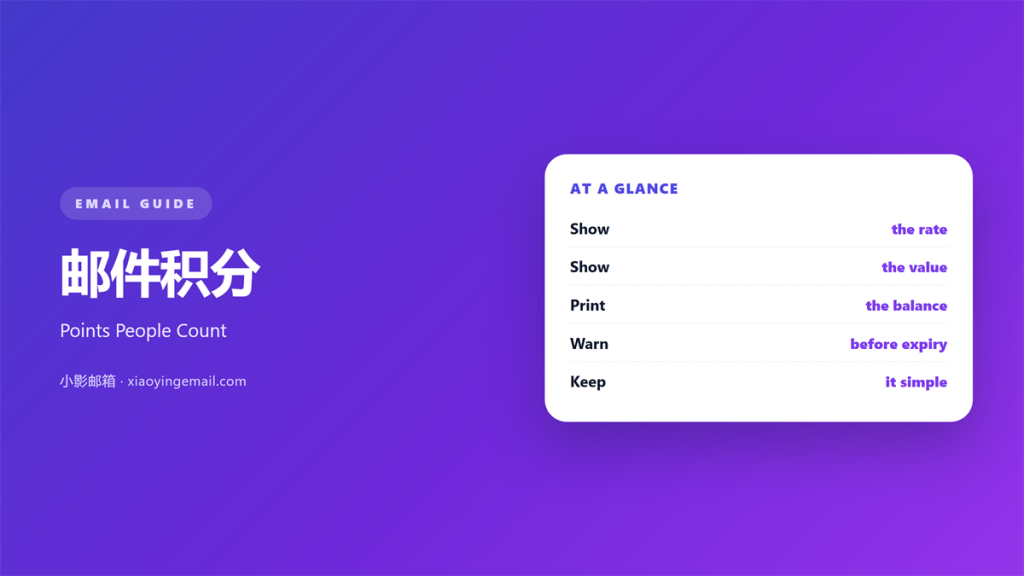
- 邮件积分 turns spending into a visible balance.
- Show the earn rate in plain numbers.
- Say what the points are worth.
- Put the balance in every member mail.
- Warn people before points expire.
What 邮件积分 means
邮件积分 is a balance that grows with each order.
The buyer earns points and spends them later.
One point usually equals a small amount of money.
A point is a unit with a fixed price.
Write that price where the balance appears.
The earn rate says how fast the balance grows.
The value says what the balance can buy.
Both numbers belong in the mail.
Without them the balance means nothing to a reader.
A 邮件积分 system also needs a rule for expiry.
Points that vanish without a warning feel like a trick.
Points that never expire become a liability for the shop.
A fixed window, stated up front, is fair to both sides.
The mail should repeat that window once a season.
Why 邮件积分 matters
Points give a reason to choose your shop again.
The reason is a number the buyer already owns.
People dislike losing a balance they earned.
That feeling brings them back before the expiry.
A 邮件积分 balance also makes the mail personal.
A mail that says you have 320 points gets read.
That line is more useful than a banner.
Points also reward repeat orders, which carry most of the profit.
So the balance works as a retention tool.
The balance also tells you who is still active.
Two numbers, one promise
The earn rate is the promise.
The redemption value is the proof.
Show both in the same block.
Then the reader can do the math.
When 邮件积分 helps
It helps when people order often.
Frequent small orders build a balance fast.
It helps when the catalogue is wide.
A wide catalogue gives the points somewhere to go.
Points let a buyer choose their own reward.
It also helps when you dislike discounts, because a balance rewards without cutting the price.
It helps when the account is already online.
Then the balance can update after each order.
Start with a simple rate
One point per dollar is easy to explain.
Then set the value at one cent per point.
That is a one percent return, and it is honest.
Raise it later if the margin allows.
When 邮件积分 hurts
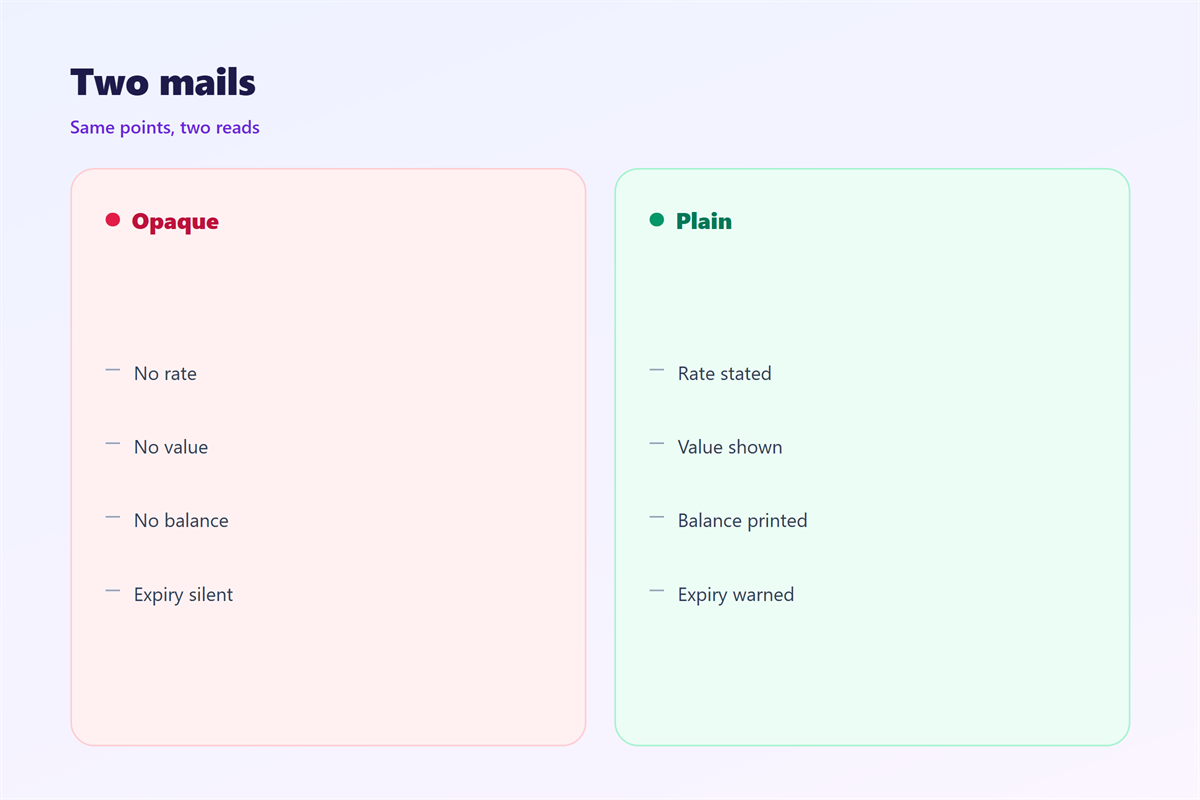
It hurts when the rate is hidden in the terms.
A rate nobody can find is a rate nobody trusts.
It hurts when the value is impossible to calculate.
Buyers stop collecting what they cannot value.
Small balances stop feeling worth the effort.
It hurts when points expire without a warning.
A silent expiry costs more than the points saved.
It also hurts when the reward is out of reach.
A ten thousand point item on a small balance is a joke.
It hurts when the balance is missing from the mail.
It also hurts when the rules change every month.
A member mail without a balance is a missed chance.
邮件积分 and the balance
The balance is the whole point of the system.
Put it near the top of every member mail.
Then say how many points the next order earns.
A reader who sees both can plan a purchase.
A 邮件积分 mail without a balance feels generic.
The same mail can show the nearest reward.
Eighty points to a free delivery is a clear goal.
Keep that goal one order away.
A goal that sits too far away stops working, and a still balance looks broken.
Show the gap, not the total
A total is abstract, while a gap is a plain task.
You need forty more points.
It names the exact step that is left.
It gives the reader something to complete.
That small finish brings the next order.
How to run 邮件积分
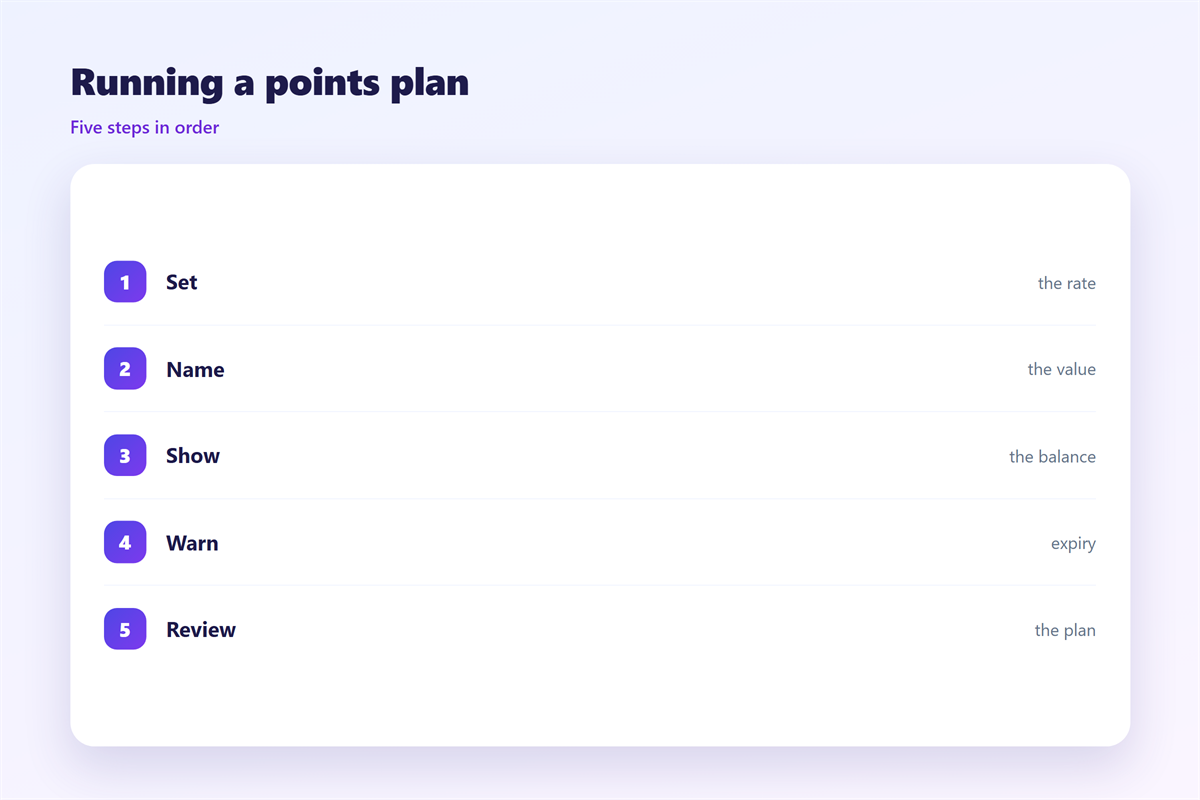
Run 邮件积分 with two numbers and one rule.
The numbers are the earn rate and the value.
The rule is the expiry window.
Write all three in one paragraph.
Then add the balance to every member mail.
Show the balance after each order.
Send a warning thirty days before expiry.
Send a second warning seven days before.
Put the rate in the footer of every mail.
Make the reward reachable
List three rewards at different levels.
The first should be one order away.
The second should take about a month.
The third can take a year.
Keep the list short and stable.
Changing rewards too often resets trust.
邮件积分 on a phone
The balance belongs in the first screen.
A small badge in the header works well.
The badge should not cover the logo.
Then place the next reward under it.
Keep both to one line each.
A 邮件积分 mail on a phone should fit one screen.
Long tables of points do not fit.
Show three rows at most, then link to the full history.
Test the balance against the account page.
A mismatch between the two is a bug.
Keeping 邮件积分 honest
Points are a promise, and promises need dates.
Say when points expire and how to keep them.
Do not shorten the window after people earned points.
The member event sits in 邮件会员日.
The repeat order sits in 邮件复购.
The warm follow-up sits in 邮件客户关怀.
The long view sits in 邮件留存.
Publish the redemption rules on one page, and show the expiry date beside the balance.
Review the numbers once a year.
FAQ
When should 邮件积分 expire?
Twelve months after the order is a fair default.
How much is one point worth?
One cent per point is easy to explain.
Should points count on delivery fees?
No. Keep the rate on goods only.
Can points be transferred?
Rarely. Keep them tied to one account.
评论
还没有评论,来说两句吧。
评论功能已关闭。