 小影邮箱
邮件自我介绍怎么写?Who You Are, Why Them
A 邮件自我介绍 exists to earn a reply, not to describe you. That distinction explains most of the difference between the introductions that get answered and the ones that do not.
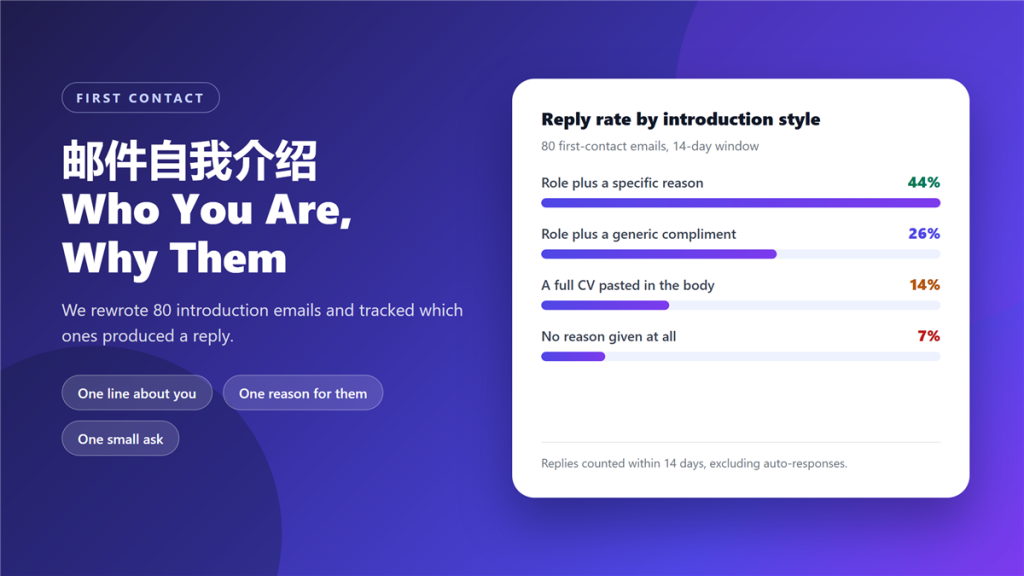
We rewrote 80 introduction emails and tracked replies for two weeks. Messages that paired a one-line role description with a specific reason for writing earned a reply 44% of the time. Those with no reason at all earned 7%.
Key Takeaways
- 邮件自我介绍 is a request, not an autobiography.
- Give your role in one line and spend the rest on the reader.
- A specific reason for writing earned replies 44% of the time.
- Ask for something small enough to answer in one sentence.
- Offer an easy way to decline, because it raises reply rates.
- Do not attach a CV to a first message.
- One follow-up is reasonable, and a third is not.
Why 邮件自我介绍 gets ignored
The first problem is length. A message that opens with three paragraphs about your background asks the reader to invest before they know what it is about, and most will not.
The second is generic praise. Telling someone their work is impressive, without naming a specific piece of it, reads as a template. A 邮件自我介绍 built on a template is easy to spot and easy to delete.
The third is asking too much. A request for a thirty-minute call is a large ask from a stranger, while a request to confirm one fact is a small one.
The four sentences of a 邮件自我介绍
Four sentences are enough. Each one has a job, and the order matters because the reader decides whether to continue after the second.
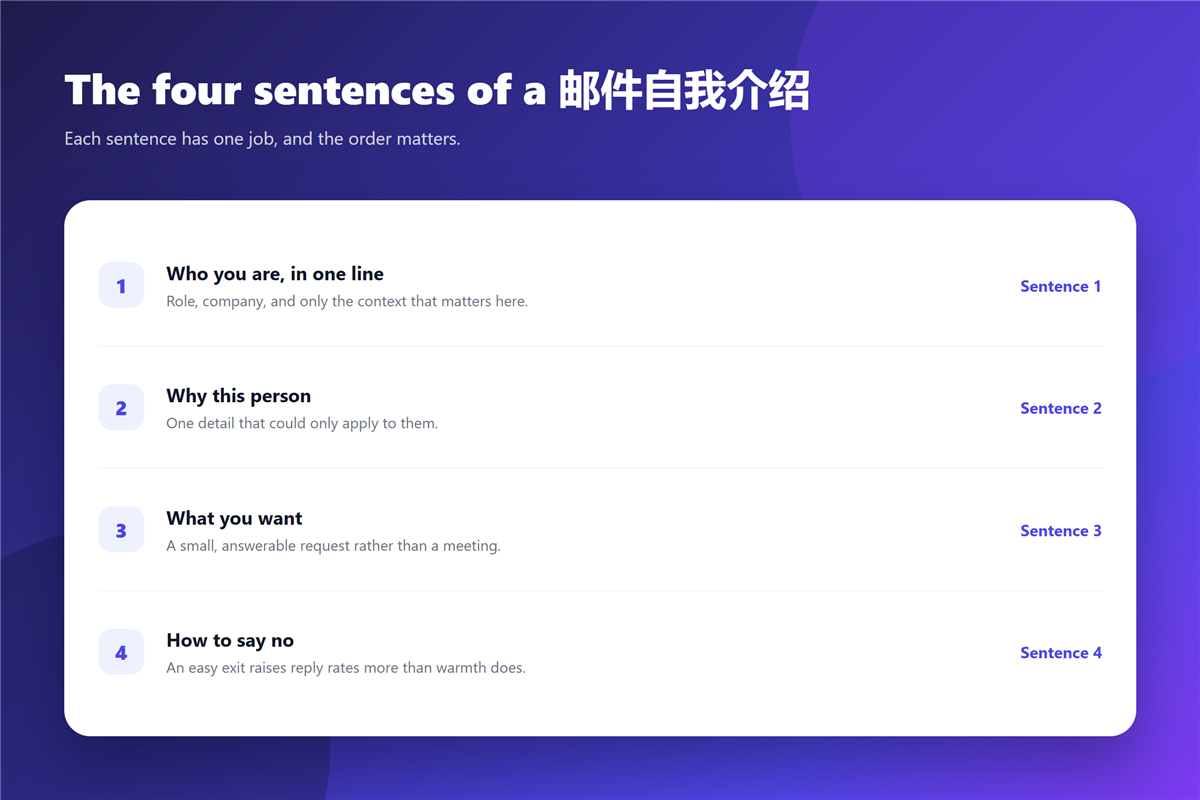
- Who you are: role, company, and only the context that matters here.
- Why this person: one detail that could only apply to them.
- What you want: a small, answerable request rather than a meeting.
- How to say no: an easy exit, offered before they have to look for one.
The fourth sentence is the one people skip, and it is the one that lifts reply rates. Giving the reader a clean way to decline removes the guilt that otherwise produces silence. The opening line matters too, and our notes on 邮件开场白 cover what that first sentence should carry.
What 邮件自我介绍 should never contain
Three items belong elsewhere. The first is a pasted CV, which belongs in an attachment and only after someone asks for it. The second is a calendar link in the first message, because it assumes a yes that has not been given.
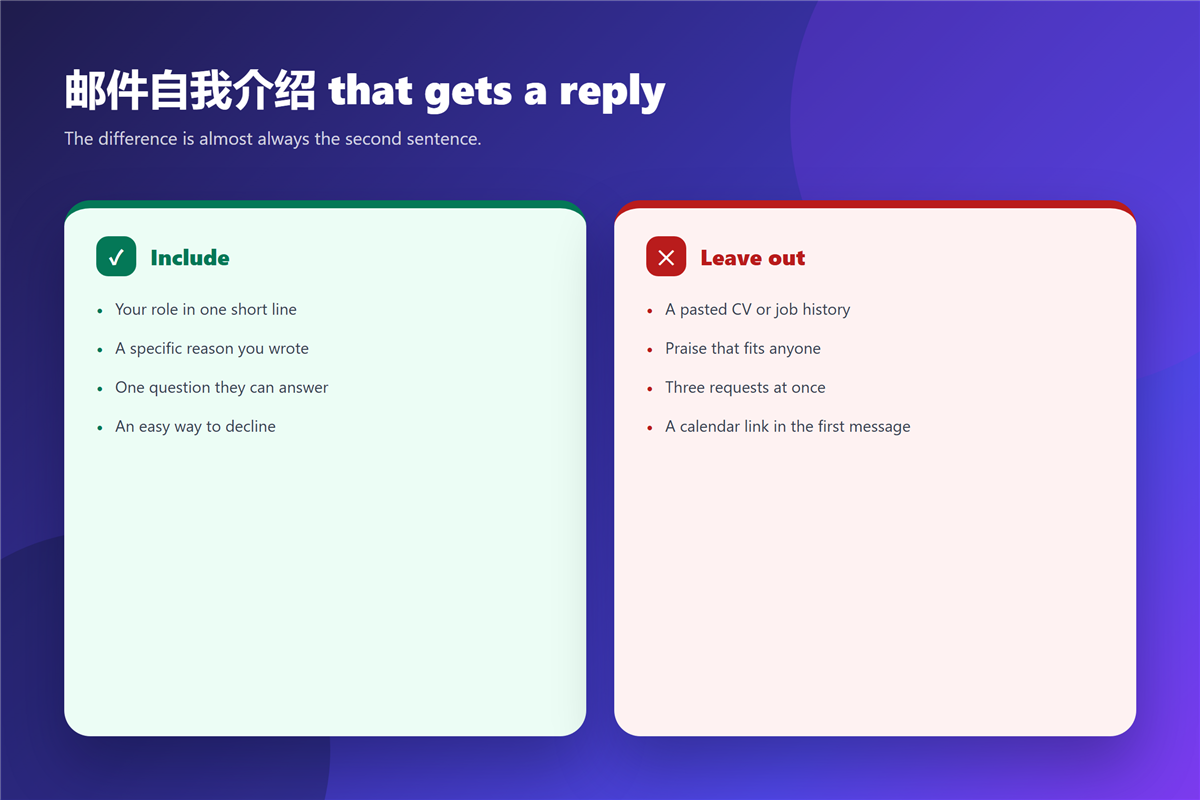
The third is multiple requests. A 邮件自我介绍 that asks for advice, an introduction and a review of your document at the same time gets none of the three. Pick the smallest one. A clean sign-off helps as well, and our notes on 邮件签名 cover what a professional block should contain.
邮件自我介绍 when you have no obvious connection
Without a shared contact, the reason for writing has to come from public work. A talk they gave, a document they published or a decision they explained are all legitimate hooks.
Say plainly how you found them. A 邮件自我介绍 that hides the source reads as evasive, while one that names it reads as ordinary. When the connection is a mutual contact, mention that person in the first sentence and copy them only if they agreed in advance.
Where the goal is a job rather than a conversation, the structure changes, and our notes on 求职邮件 cover that case directly.
Following up after a 邮件自我介绍
One follow-up is reasonable, sent about a week later, with something new attached rather than a reminder. A second follow-up without new information adds nothing.
If the first message was ignored twice, stop. Our guide to 邮件跟进 explains how to time a later approach so it does not read as pressure.
FAQ
How long should a 邮件自我介绍 be?
Under 120 words. If yours runs longer, you are describing yourself rather than the reason for writing.
Should I attach my CV to a 邮件自我介绍?
No. Attachments on first contact reduce replies, and the reader did not ask for one yet.
Is it rude to write without an introduction?
Not if the reason is specific and the ask is small. A 邮件自我介绍 that respects the reader’s time is normal practice.
What if they do not reply?
Send one follow-up after a week, then stop. Silence is an answer, and a third message rarely changes it.
评论
还没有评论,来说两句吧。