 小影邮箱
邮件节奏怎么定?A Sending Cadence That Fits
Key Takeaways
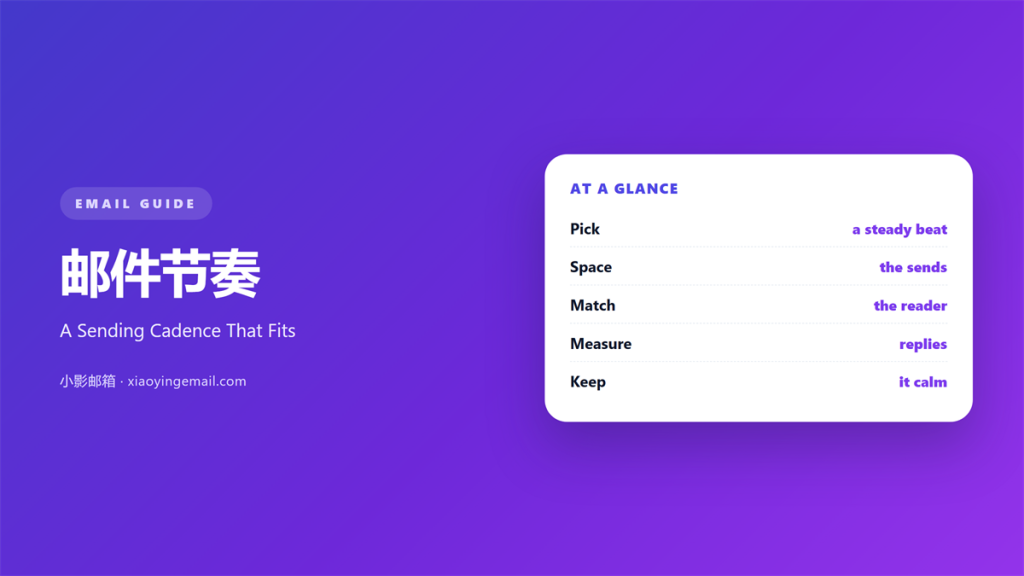
- 邮件节奏 is how often you send, and how evenly.
- A steady beat beats a sudden burst.
- Match the pace to the reader’s own habits.
- Too many notes train people to ignore you.
- Measure replies, not just opens.
What 邮件节奏 means
邮件节奏 is the pace at which your messages arrive.
It has two parts. The first is how often you send.
The second is how evenly the sends are spaced.
A daily note and a monthly note are two different rhythms.
So are five notes in one week and none for a year.
The tool is not a button. It is a habit you choose.
Once you pick it, you keep it.
That steady beat is what people recognise.
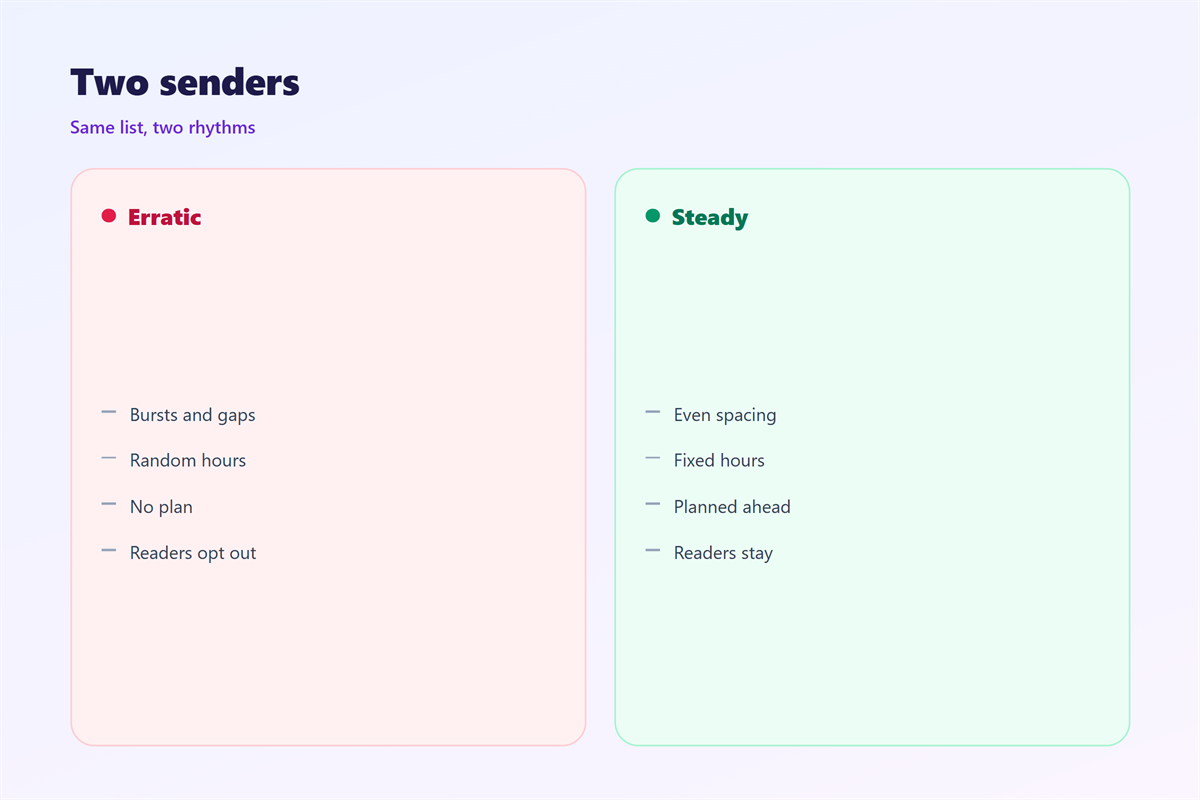
A burst of notes and a long silence are the opposite.
Both feel random to the person receiving them.
Random mail is easy to ignore.
So the first job is to choose a beat at all.
Why 邮件节奏 matters
Readers build a memory of your mail.
A steady 邮件节奏 fits into that memory.
An erratic one keeps breaking it.
People also judge risk by frequency.
Too many notes feel like pressure.
Too few feel like silence, then a sales pitch.
The middle ground is a rhythm they can expect.
Expectation is the quiet goal here.
When a reader knows what to expect, they plan for it.
They open the note at the usual time.
They give it a fair share of attention.
That fair share is worth more than a short spike.
Daily, weekly or monthly
Daily suits news and alerts.
Weekly suits round-ups and tips.
Monthly suits reports and summaries.
Pick one and hold it for a full quarter.
When 邮件节奏 helps
A good pace helps in several ways.
It keeps you in the reader’s mind without noise.
It makes each send feel normal, not sudden.
It also makes your own work easier.
You plan one note instead of ten.
The topic queue fills itself over time.
And the numbers settle into a steady line.
Steady lines are easy to read.
You can also compare one month with the last.
A sudden jump stands out at once.
So does a sudden drop.
Both are worth a closer look.
Catching the drift
Pace drifts when nobody watches it.
A busy month adds two extra sends.
A quiet one drops three.
Track the count per month to spot the drift.
When 邮件节奏 hurts
A broken 邮件节奏 costs you attention.
Three notes in a day looks desperate.
Six months of silence looks careless.
Both push the reader toward the bin.
Frequency can also hide weak content.
Sending more does not fix a dull message.
It just multiplies the problem.
So fix the message before you raise the count.
There is a second risk as well.
A rushed send often carries a mistake.
The mistake costs more than the silence would have.
So slow down before you press send.
The quiet-reader rule
A reader who never replies is still reading.
Do not slow down just for them.
Do slow down if they ask you to.
邮件节奏 in practice
Start with one honest question.
How often can you write something useful?
That number is your ceiling.
Then look at what your readers already get.
If they are buried, send less.
If they hear nothing, send a little more.
The aim is the smallest pace that still works.
Small and steady beats big and rare.
Write the pace into your plan for the quarter.
Then treat each send as a small promise.
Keep the promise and the rhythm holds.
Break it twice and the pattern fades.
How to set 邮件节奏
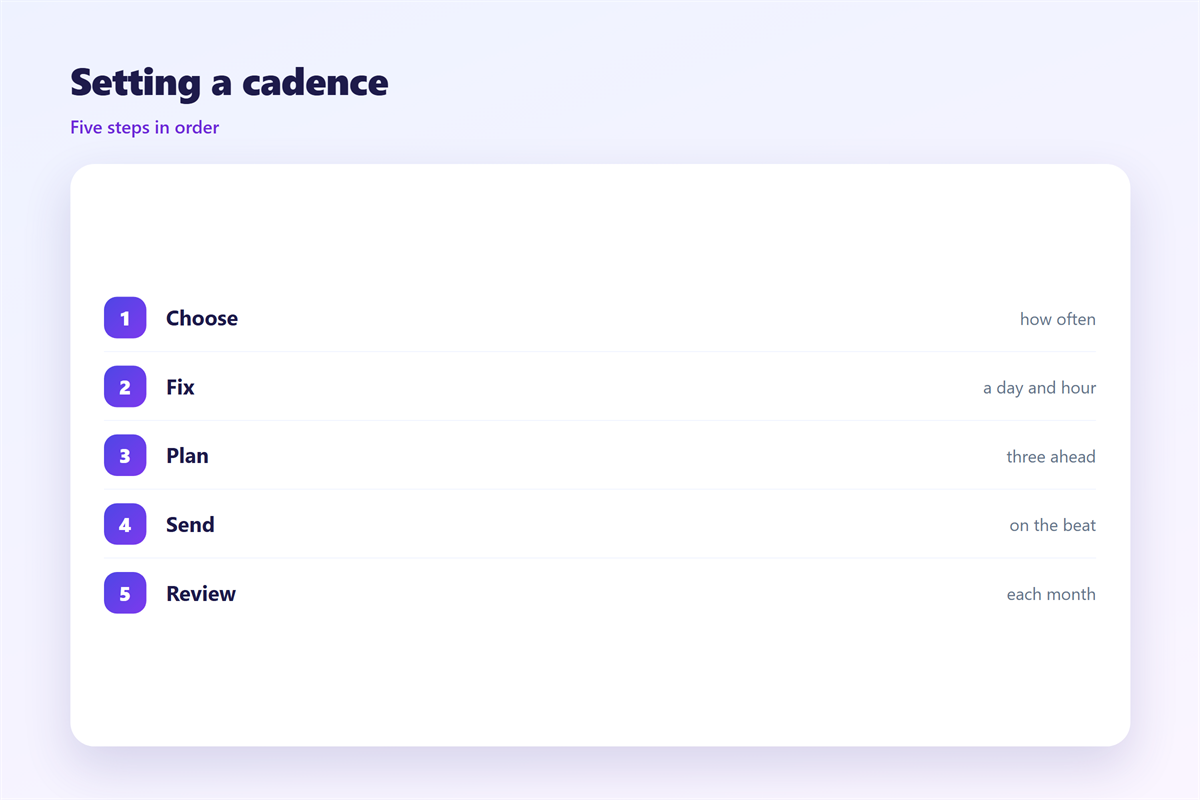
Pick a cadence and write it down.
Choose a day and a rough hour.
Then plan three notes ahead.
Keep each one short and useful.
Send them on the same beat.
After a month, read the response rate.
If replies fall, change one thing only.
Change the topic before you change the pace.
Good 邮件节奏 changes slowly.
Next, check the calendar for clashes.
Two sends in one day should be rare.
If they collide, move one.
Then set a reminder for the next three dates.
A fixed date removes the daily decision.
That single habit keeps the pace alive.
邮件节奏 and the reader
Readers live in different time zones.
They also work different hours.
So the same beat lands at different moments.
That is fine. The rhythm still feels steady.
What breaks the rhythm is surprise.
A long gap and then five notes in a day is a surprise.
So keep the gap roughly even.
Test one send at a different hour if you like.
Then keep the winning hour.
A small shift is enough for most readers.
A large shift resets their habit.
So move the hour in small steps.
Keeping 邮件节奏 steady
A steady pace turns into a habit.
Pick a house beat and hold it across the team.
The number of sends per period is covered in 邮件发送频率.
The best hour for each note appears in 邮件发送时间.
The alerts that ride along are explained in 邮件通知.
The gentle nudges that follow sit in 邮件提醒.
Review the beat once a quarter.
Then keep the same rule for every list you run.
A team that agrees on 邮件节奏 writes calmer mail.
FAQ
How often should I send to keep a good 邮件节奏?
As often as you can stay useful, and no more than that.
Does the same beat suit every list?
No. A busy inbox needs less, and a loyal list can take more.
Can I change my 邮件节奏 later?
Yes, but move it slowly and keep the gap even.
What if a big news day breaks the rhythm?
Send the one urgent note, then skip the next planned one.
评论
还没有评论,来说两句吧。
评论功能已关闭。