 小影邮箱
邮件限流怎么做?Slow Down to Arrive
Key Takeaways
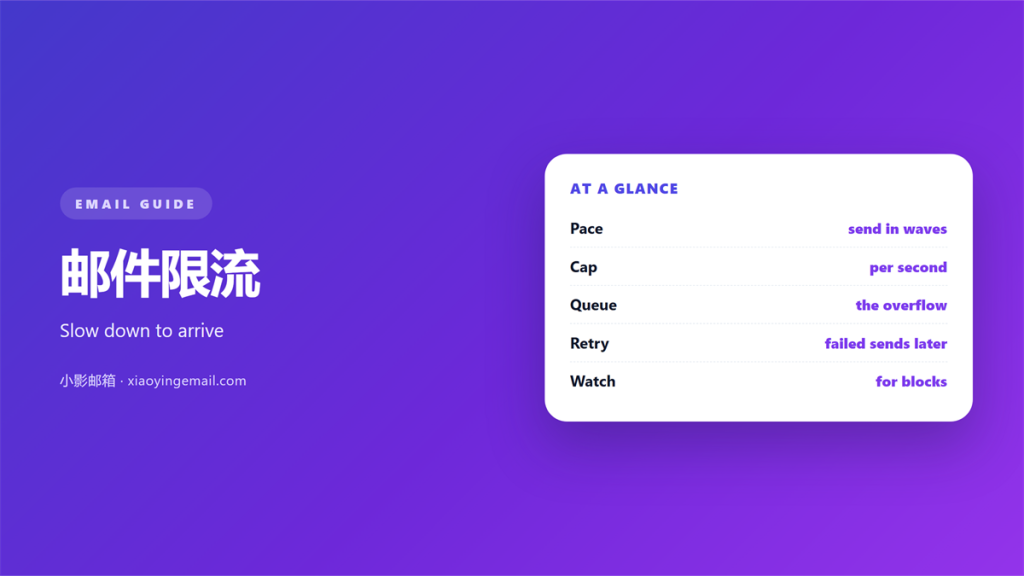
- 邮件限流 means pacing mail so it does not flood.
- Filters read speed as a signal of intent.
- A steady trickle beats one giant burst.
- A queue smooths the peaks without losing mail.
- Consent and clean lists still come first.
What 邮件限流 really means
邮件限流 is the practice of controlling how fast you send.
It sets a ceiling on messages per minute or per hour.
The goal is to look like a normal sender, not a machine.
Filters compare your speed with your own history. A sudden jump looks suspicious.
So pacing protects both your list and your name.
The ceiling is not a punishment. It is a way to keep the door open.
Rate is different from volume. You can send a lot, slowly, and still arrive.
That small distinction is the heart of 邮件限流.
A good pace also leaves room for urgent mail.
So speed becomes a tool, not a limit you fight.
The right pace depends on your own history.
What works for one sender may fail for another.
So measure first, then choose a gentle limit.
Why 邮件限流 matters
A burst of mail can trigger a block within minutes.
Receivers protect their own systems first. They will drop anything that looks like an attack.
Even honest mail suffers when it arrives too fast. The receiving server simply runs out of room.
Good 邮件限流 also keeps complaints low, because people see mail they expect.
Pacing keeps your delivery steady through the whole day.
It also keeps your sending name out of trouble.
A sudden burst can look like an attack to a filter.
Once a block starts, it can spread to other receivers.
A calm pace keeps your whole day predictable.
A stable pace also makes your reports easier to read.
You can spot a problem before it becomes a block.
Filters watch the pattern
Modern filters look at shape, not only content. A flat burst stands out.
A 邮件限流 curve that rises and falls looks human.
That shape earns trust slowly but reliably.
So the rhythm matters as much as the words.
They compare each minute with the one before.
A slow climb looks far safer than a cliff.
Small batches also make failures easier to trace.
You can pause and adjust without a big loss.
How 邮件限流 works in practice
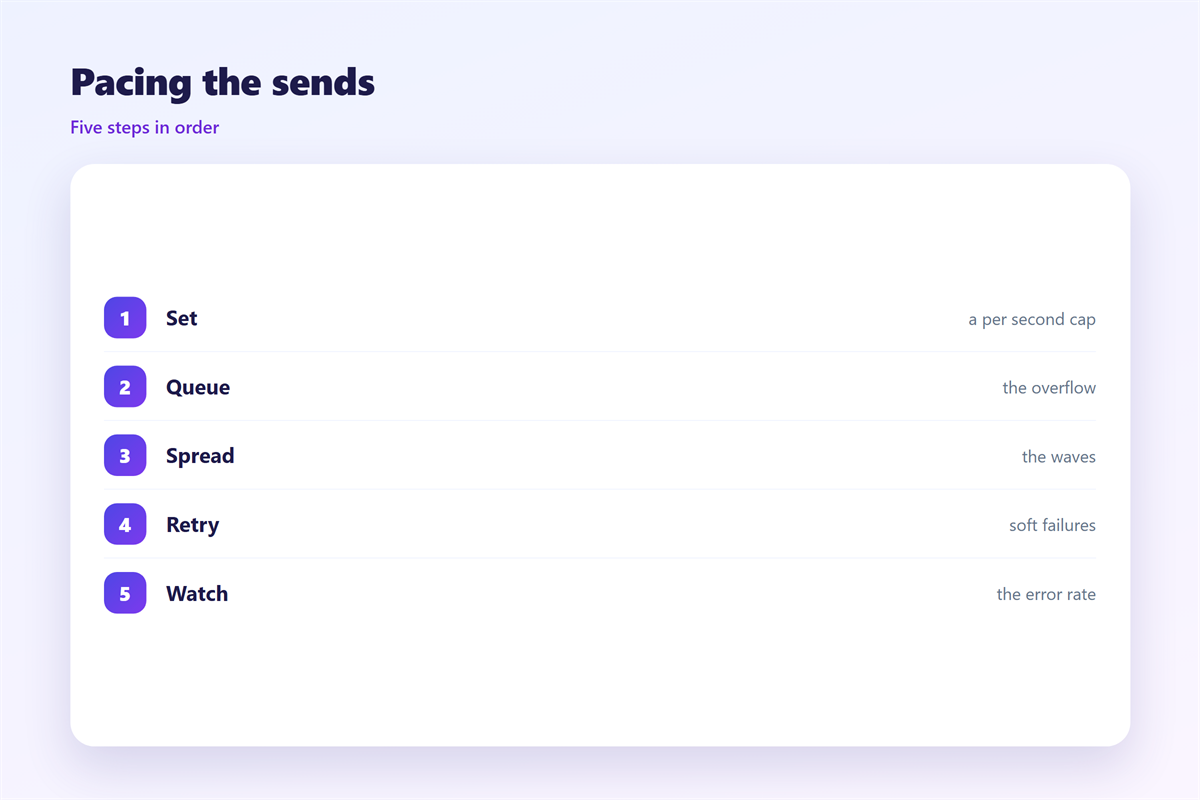
Start by measuring a normal day. Find your true peak, not your dream peak.
Then set a rate slightly below that peak. Small steps are easier to defend.
A queue holds the extra mail until a slot frees up.
Retry logic matters as much as the 邮件限流 rate.
Write the rate down where the team can see it.
Review it after every large campaign.
Keep the peak well below what the provider allows.
A safe margin protects you when a campaign grows.
Measuring your own pace
Log sends per minute across a busy week. The pattern will surprise most teams.
A 邮件限流 tool can throttle by domain or by hour.
Keep a buffer for replies and alerts.
Review the numbers after every campaign.
Split marketing from transactional traffic.
Give each stream its own gentle pace.
Common mistakes with 邮件限流
One mistake is a fixed rate for every receiver. Big providers accept far more than tiny ones.
Another is ignoring soft bounces. A rate that keeps failing is not a good rate.
Some teams forget transactional mail. A login code must never sit behind a campaign.
Always give urgent mail its own fast lane. 邮件限流 should never delay a password reset.
Never raise the rate just to catch up. That is exactly when blocks happen.
A rate that is too slow can also cause harm.
Stale mail often gets ignored or marked as spam.
So aim for steady, not merely slow.
A single fast batch can undo weeks of careful work.
So slow down even when the queue feels long.
Habits that keep the pace calm
Send at the same hours each day. Predictable senders get fewer questions.
Spread campaigns across several slots. One big push invites a block.
Warm new addresses before a large launch.
A steady 邮件限流 rhythm beats a clever schedule.
Watch delivery rates after every change.
Keep a simple log of what changed and when.
Start each day with a modest batch.
Then grow the size only if reports stay clean.
Keep an eye on complaints as well as delivery.
Note the exact hour of every large send.
Compare that hour with your delivery report.
Keeping 邮件限流 steady day to day
Know the hard ceilings on your account. The rules are set out in 邮件发送限制.
Match your pace to each audience. The timing is described in 邮件发送频率.
Let a queue absorb the peaks. How mail waits is explained in 邮件队列.
Then watch where mail actually lands. The result is measured in 邮件投递率.
Keep the routine small enough to last. Calm 邮件限流 is boring on purpose.
Write the plan down so the team agrees.
Review it each season as volume changes.
Keep the plan in a place the whole team can see.
Update it whenever your volume or tools change.
FAQ
Is 邮件限流 the same as a quota?
No. A quota is a hard cap. Pacing is about the speed instead.
Can 邮件限流 slow my campaigns too much?
Rarely. A short delay beats a blocked domain any day.
How do I find my limit?
Read your provider’s guide. Then watch your reports for a week.
Should I pause during a spike?
Yes. A short pause protects your name and your list.
评论
还没有评论,来说两句吧。
评论功能已关闭。