 小影邮箱
邮件长度多少合适?How Long Is Too Long
Key Takeaways
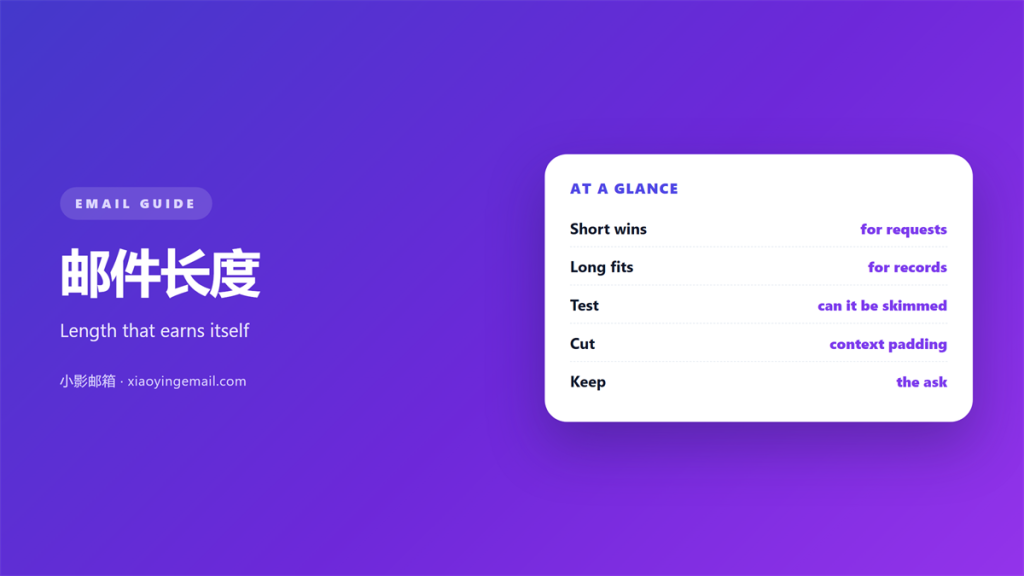
- 邮件长度 is a judgement about the reader’s time, not a number you can look up.
- Short is not automatically better; unearned length is the real cost.
- Every extra paragraph has to buy the reader something they cannot get elsewhere.
- The right 邮件长度 depends on the ask, the relationship and the medium.
- Cutting words is easier once you know which lines only served the writer.
Why 邮件长度 is a judgement, not a rule
邮件长度 is the kind of question that invites a single number and resists one. Advice ranges from “keep it under five sentences” to “give the reader everything they need”, and both are correct for different messages. What separates them is not length itself but whether every line earns its place.
The reason a fixed rule fails is that reading has a price. A line that saves the reader a follow-up question is worth its space; a line that restates what they already know is a small tax. Threads that feel too long are almost never long because of word count alone. They are long because the useful part is buried under material that only mattered to the sender.
So the useful framing is comparative. Ask what the reader loses if a paragraph is removed. If the answer is “nothing”, the paragraph is length without return, and length without return is the only kind that reliably damages a reply rate.
What readers do with 邮件长度
Readers do not consume a message evenly from top to bottom. They sample it, and the sample becomes their impression of the whole.
Skimming
Most people read the first line, the last line and anything that looks like a list. That single habit explains why a well-ordered long message often outperforms a short one that meanders. The structure is doing the work, not the word count.
The cost of reading
Each additional paragraph adds a small decision: read it now, read it later, or skip it. Too many of those decisions and the reader defers the whole message, which is how a two-day reply delay begins.
A working range for 邮件长度
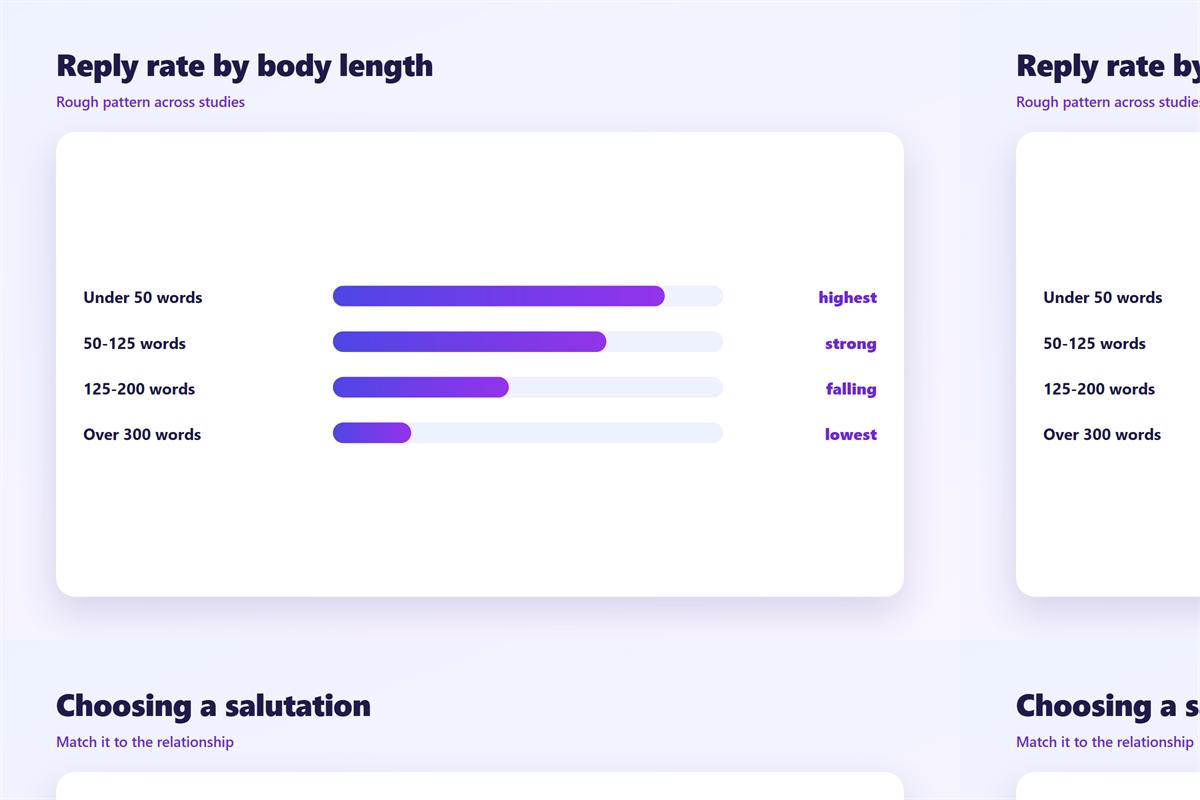
Within a normal work thread, a message of roughly one to three short paragraphs covers most situations. That is long enough to give context and short enough to survive a phone screen without scrolling twice.
That range is a starting point rather than a ceiling. A handover note, a specification or a decision record is legitimately longer, because the reader will return to it and needs the detail in one place. The test is not how it feels at first read but how useful it stays on the second.
邮件长度 and the ask
The clearest signal about the right 邮件长度 is the ask itself. A yes-or-no question rarely needs more than a few lines; a request to change a plan needs the reasoning that makes the change reasonable.
When you cannot tell which you are writing, look at what you want back. If the reply is a decision, give the reader everything needed to decide. If the reply is an acknowledgement, anything beyond that is padding.
There is also a medium effect that is easy to miss. A message read on a phone behaves as if it were longer, because the screen shows fewer lines at once, so the 邮件长度 that feels brisk on a desktop can feel endless on a handset. When you are unsure, write for the smaller screen.
Cutting 邮件长度 without losing meaning
The first cut is almost always background the writer found interesting and the reader does not need. The second is hedging, the qualifiers that protect the sender rather than inform the reader.
- Move detail down: keep the ask near the top and let the rest follow.
- Replace a paragraph with a list: three items scan faster than three sentences.
- Attach, do not append: a long table belongs in a file, not the body.
- Delete the warm-up: the first sentence of a draft is often throat-clearing.
After those cuts the message usually gets shorter and clearer at the same time, which is the sign that the earlier length was accidental. If it does not get shorter, the extra words were carrying real weight, and the length was justified after all.
The formatting choice that frames your length is covered under 邮件格式, while the line above it belongs with 邮件标题. How a message closes has its own budget, described in 邮件结尾, and the effect of all this on responses is tracked as 邮件点击率.
Testing 邮件长度 in practice
Send two versions of a recurring message to comparable groups — one trimmed, one as usual — and compare the reply time rather than the reply style. Reply time is the honest measure of whether length helped or hurt. Keep the experiment small and repeatable, because one message is a coincidence and a month of paired sends is a pattern you can act on.
FAQ
Is shorter 邮件长度 always better?
No. A message that omits context forces a follow-up question, and the extra round trip costs more time than the paragraph would have.
Does 邮件长度 include the signature?
Practically, no. The signature is expected furniture, so readers discount it; what they judge is the part carrying the substance.
What 邮件长度 suits a cold email?
Shorter than an internal note. Without an existing relationship, every extra line increases the chance the reader stops before reaching the ask.
Can 邮件长度 be too short?
It can. A one-line request with no context reads as terse, and terseness is often interpreted as indifference rather than efficiency.
References
- Wikipedia: Reading
- Nielsen Norman Group: How little do users read?
- IETF RFC 5322: Internet Message Format
评论
还没有评论,来说两句吧。
评论功能已关闭。