 小影邮箱
邮件截止日期怎么写?Deadlines That Stick

Key Takeaways
- 邮件截止日期 names the exact hour work is due.
- State the date, the hour, and the zone.
- Say what the deadline is for, in one line.
- Name what happens if the date slips.
- A clear deadline removes guesswork and worry.
What 邮件截止日期 means
邮件截止日期 is the last moment work is due.
It marks a point where a task must be done.
The phrase covers both a date and an hour.
A date alone can leave the hour open.
So a full deadline carries both parts.
It may also name the zone for a distant reader.
A deadline is a promise about time.
A deadline can be soft or hard.
A soft goal invites an early reply.
A hard stop marks work that cannot wait.
Say which kind you mean.
Treat 邮件截止日期 as a shared agreement on time.
A clear deadline also sets a shared pace.
So make that promise clear and easy to meet.
A vague 邮件截止日期 invites a late reply.
Why 邮件截止日期 matters
A clear deadline helps a reader plan their week.
It turns a loose request into a planned task.
It also protects you as the sender.
You can point to a date you both agreed on.
A shared date also helps two teams plan.
Each side knows when the other needs the work.
That reduces the last-minute rush.
It also gives you a reason to follow up.
The cost of a vague deadline
A vague deadline invites a slow reply.
The reader guesses at the hour you meant.
Two guesses rarely match, so the work slips.
A clear date ends that guessing game.
It keeps a small task from drifting for days.
Writing a clear 邮件截止日期
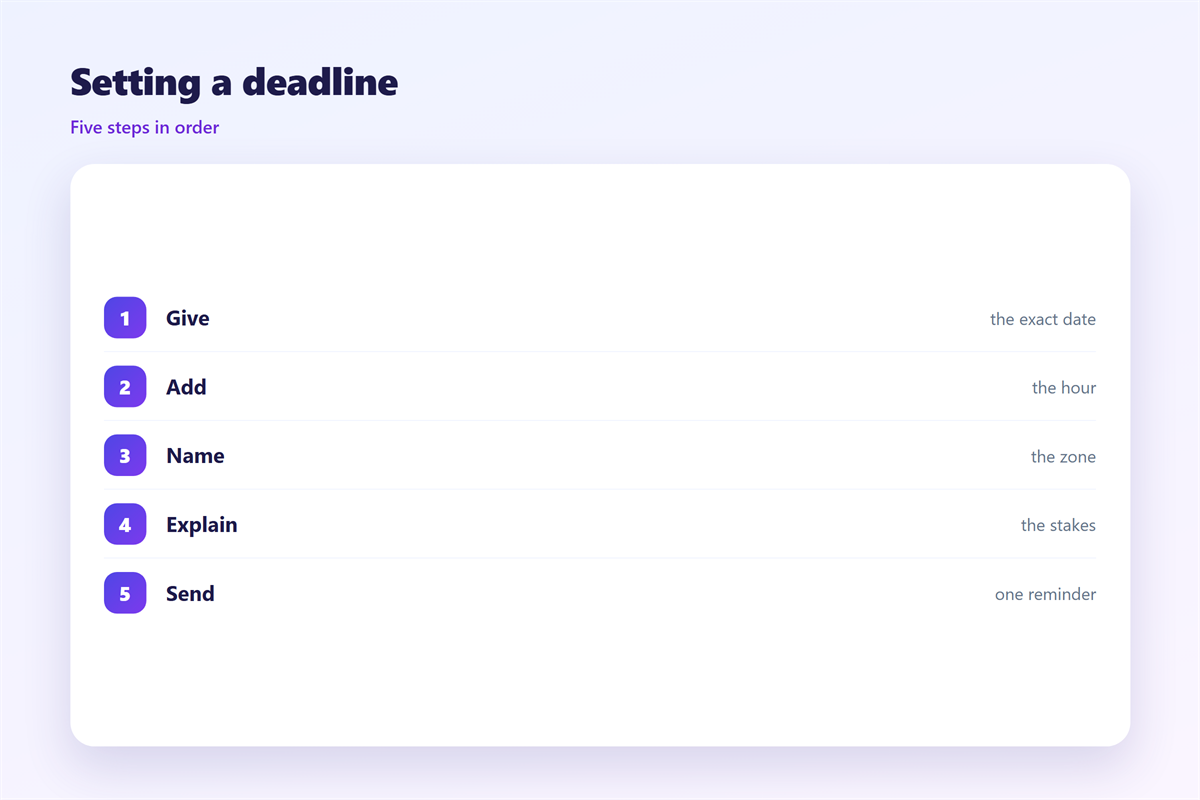
A good deadline states three things.
It gives the day, the hour, and the zone.
It names the task and the person who owns it.
Then it says what happens if the date slips.
Put the deadline near the top, not in a footnote.
Use a clear label, like “Due”.
Then a reader can find it in a glance.
A bullet can hold the date and the task.
Keep the format the same every time.
Day, hour, and zone
Spell the day and month in full words.
A short number can confuse readers across regions.
Add the hour with a clear label, like “17:00”.
Then name the zone to close the last gap.
邮件截止日期 and the time zone
A deadline can fall on a different day in another zone.
A late hour in one place is early in the next.
So attach the zone to every 邮件截止日期.
Write the offset when two teams share the task.
Save the tool’s zone setting with the invite.
Then both sides see the same final hour.
A shared setting leaves little room for doubt.
Repeat the date in the body
Put the deadline in the first line.
Then repeat it near the end as well.
A reader should never need to search for it.
When a 邮件截止日期 slips
A deadline will slip now and then.
What matters is how you handle the slip.
Say so early, not after the hour passes.
Name a new date and confirm it.
A quiet slide is worse than an open one.
Warn the reader before the hour passes.
Offer a new date and a short reason.
Most people accept a clear, early warning.
A short note of warning keeps trust intact.
Silence is the one thing to avoid.
Alternatives to a hard 邮件截止日期
Not every request needs a hard stop.
A softer goal can work for a friendly task.
Try “by Friday if you can” for a light ask.
A soft date works for a draft or a first look.
A hard date fits a launch or a payment.
Pick the one that matches the risk.
Keep the hard date for work that truly must land.
Match the firmness to the stakes.
The tone should match the size of the task.
A gentle ask often gets a faster reply.
Common 邮件截止日期 mistakes
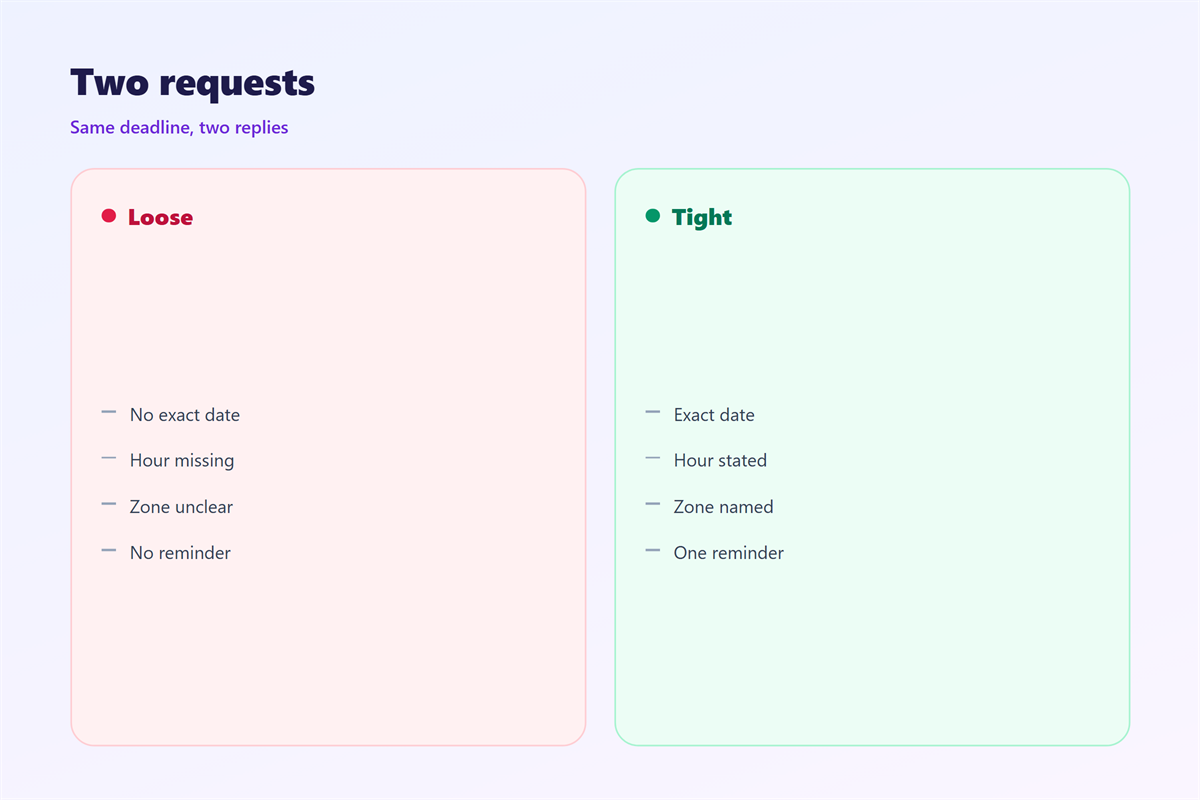
One mistake is a bare date with no hour.
Another is a deadline buried in a long paragraph.
A third is two dates that seem to disagree.
A fourth is forgetting the zone again.
Some dates appear only as bare numbers.
Others clash because two lines disagree.
A deadline with no owner may never be met.
A date already past only frustrates the reader.
A quick check catches most of these.
Each one costs the reader time and trust.
Read the line once more before you send.
Keeping 邮件截止日期 habits consistent
A fixed format makes every deadline easy to scan.
The signs that flag a due date are covered in 邮件提醒.
A kind nudge is described in 邮件催促.
The timing of a second note is weighed in 邮件跟进.
Turning a request into a done task is shown in 邮件待办.
Then apply the same format to every request.
Save the format as a short template.
Then every request looks the same.
New members copy it from day one.
Review the template twice a year.
A team that writes 邮件截止日期 the same way misses fewer dates.
FAQ
Should a 邮件截止日期 include a time zone?
Yes, whenever the reader sits in another zone.
How early should I send a deadline?
Give enough lead time for the reader to plan.
What if the work cannot meet the date?
Warn the sender early and offer a new date.
Can 邮件截止日期 sound too harsh?
Not if you explain why the date matters.
评论
还没有评论,来说两句吧。
评论功能已关闭。