 小影邮箱
邮件培训怎么做?Training Mail That Sticks
Key Takeaways
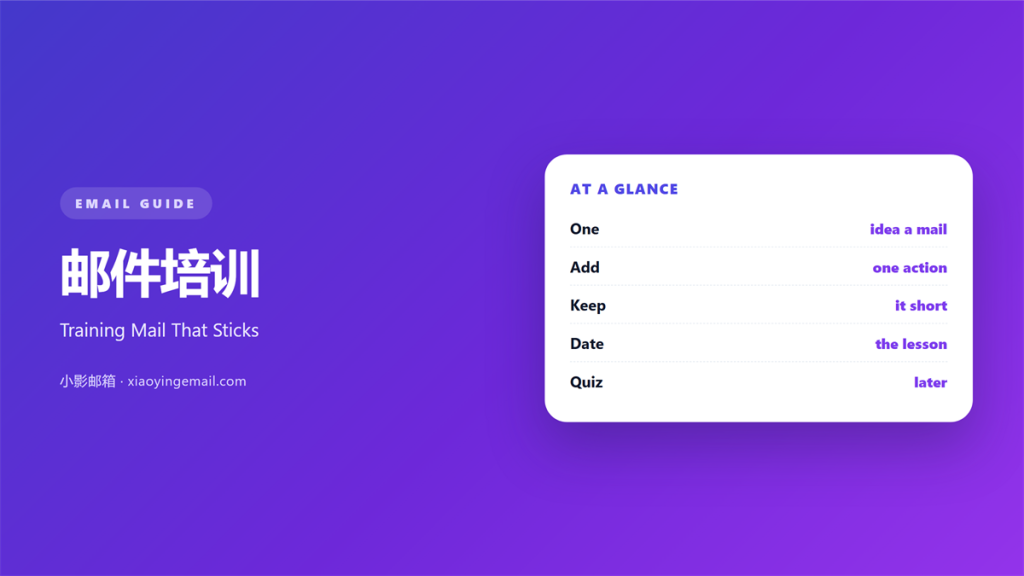
- 邮件培训 teaches one skill in a short note.
- Give one clear idea and one clear action.
- Keep each lesson short and dated.
- Follow up with a quick quiz or a question.
- Repeat the core point across several sends.
What 邮件培训 means
邮件培训 is teaching through short messages.
Each note carries one small idea.
The reader learns in a few minutes.
It is not a manual dropped into the inbox.
It is a series, not a single shot.
One note builds on the one before.
The order matters as much as the content.
So plan the whole path first.
Then send one step at a time.
That pacing is what makes it stick.
Each note is small on purpose.
A small piece is easy to absorb.
So people keep reading to the end.
Why 邮件培训 matters
People forget most of what they read once.
Spacing a message out fixes that.
The lesson returns right before it is needed.
Mail also reaches people where they work.
No meeting hour is required.
Each reader learns at their own pace.
And the notes leave a written record.
Anyone can revisit a lesson later.
New hires can read the whole series.
That saves a manager many calls.
A steady 邮件培训 builds real skill over time.
Small gains compound across a month.
So trust the slow pace.
Lesson, then practice
An idea alone rarely changes behavior.
Add one task the reader can do.
Practice is what turns a note into a habit.
Ask for one quick proof of use.
A single reply is enough.
When 邮件培训 helps
A training series helps in many cases.
It suits new tools and new rules.
It suits a growing team that keeps hiring.
It also suits refreshers for old hands.
And it helps across many locations.
Everyone gets the same lesson on the same day.
A shared lesson keeps standards level.
Nobody misses a key rule.
It is cheap to run and easy to repeat.
A manager can start a course in an hour.
A good 邮件培训 scales without extra cost.
That reach is hard to match in person.
It also fits a busy schedule.
People learn when they have a minute.
Where it fits
Use it for small, repeatable skills.
Save deep topics for a live session.
Mail works best as a short reminder.
Deep training needs a human touch.
So mix the formats where you can.
When 邮件培训 hurts
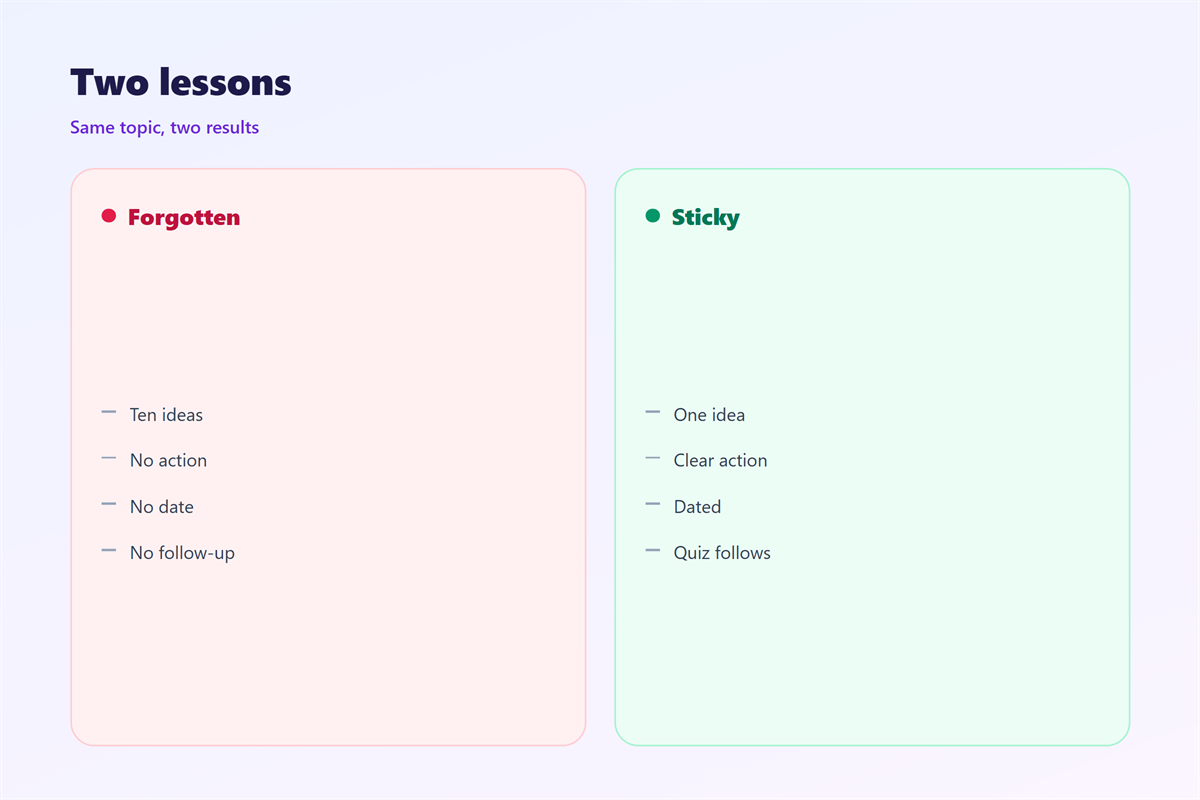
A poor 邮件培训 gets deleted unread.
Too much text is the first problem.
A wall of rules turns people away.
No action is the second problem.
Reading without doing changes little.
No follow-up is the third.
A single note rarely survives a week.
So pair each lesson with a nudge.
Then check that the skill was used.
A quick audit closes the loop.
Then you know if it worked.
A forgotten lesson is a wasted send.
So make the lesson easy to recall.
A story or an example helps.
One clear image beats a list.
The overload trap
Daily lessons feel like a flood.
One or two a week is plenty.
Give people time to practice.
A rushed course teaches little.
So leave space between the notes.
邮件培训 in practice
Start by choosing a single goal.
Break it into five or six steps.
Give each step its own note.
Send one note at a fixed interval.
Open every note the same way.
State the goal and the day number.
Then teach the one idea.
Add a single clear action.
Keep the whole note under one screen.
Long notes get skimmed or closed.
So cut anything that is not needed.
Then set the next send date.
A fixed date builds the habit.
Readers learn when to expect it.
How to write a 邮件培训 note
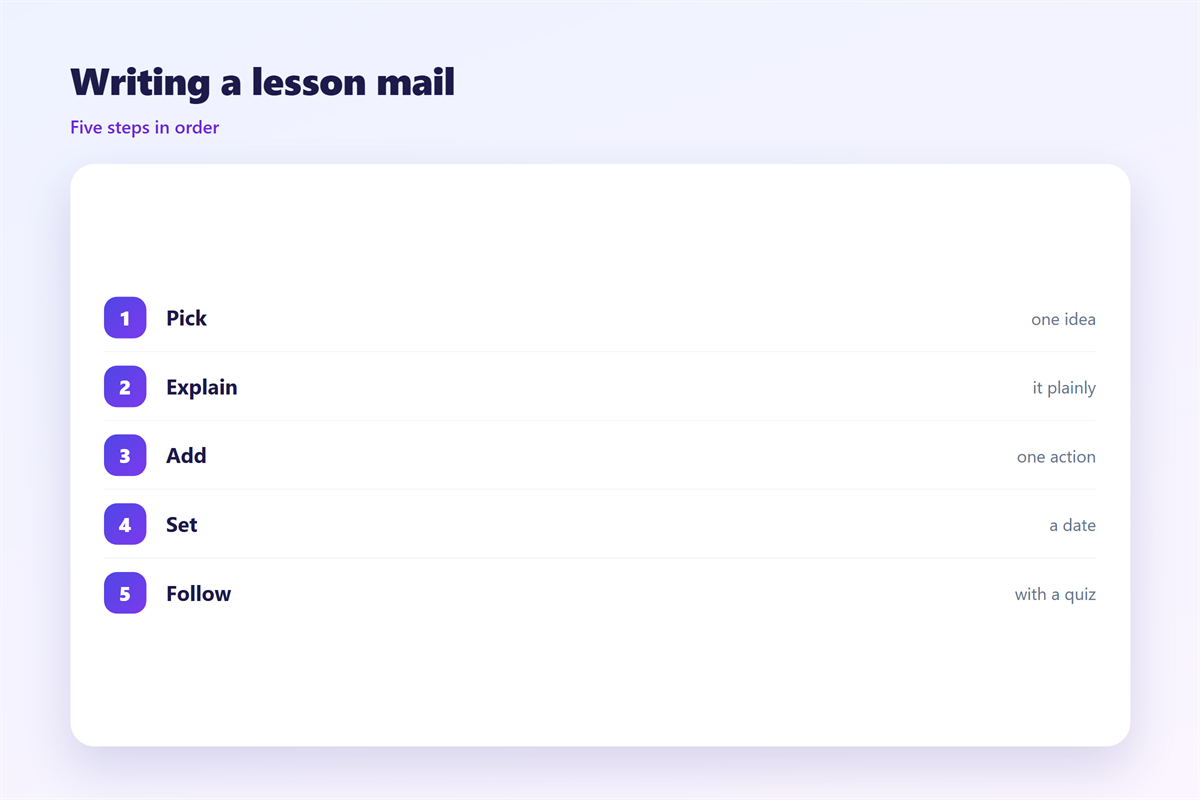
Use a subject that names the number.
Open with the one idea of the day.
Explain it in two or three lines.
Give one short example that fits the work.
Then add the action for today.
Make the action small and specific.
End with one question to answer.
Keep the tone helpful, not preachy.
Respect the reader’s time and skill.
Adults learn best without a lecture.
Use plain words and short sentences.
Save the frame for the whole series.
Then hold the same sending rhythm.
A steady pulse is easy to follow.
So keep the interval fixed.
A dated note is easy to track later.
Keep the series easy to follow.
Number every lesson in the subject.
Then nobody loses the thread.
邮件培训 and the reader
Readers skim training mail fast.
So make the value clear at once.
Put the action in the first screen.
Use bold for the single task.
Keep the rest quiet and short.
Write as if you speak to one person.
Ask for a reply when you can.
A tiny reply proves they read it.
Then answer every reply you get.
That loop keeps the course alive.
Reply to every question you get.
Fast answers keep people engaged.
A good 邮件培训 listens as much as it tells.
Ask one question at the end of each note.
A reply shows the idea landed.
Use those replies to fix the course.
Keeping 邮件培训 on track
A fixed rhythm keeps a course moving.
The first-week note for new hires is covered in 邮件入职.
The alerts around the course appear in 邮件通知.
The best time to send sits in 邮件日程.
The feedback loop that follows is in 邮件满意度调查.
Review the series after each run.
Cut the lessons nobody finished.
Keep the ones that changed behavior.
Then rebuild the course for next quarter.
A course is never truly finished.
Each run teaches you something new.
So keep the parts that worked.
FAQ
How long should a 邮件培训 note be?
One screen, and never more than that.
How often should lessons go out?
Once or twice a week works well.
Can a 邮件培训 replace a live class?
For small skills yes, for deep ones no.
What makes people finish the series?
A short action and a quick reply loop.
References
- Nielsen Norman Group: Email usability research
- Mailchimp: Email marketing resources
- Harvard Business Review: Learning and development
评论
还没有评论,来说两句吧。
评论功能已关闭。