 小影邮箱
邮件表情符怎么用?Emoji That Add, Not Distract
Key Takeaways
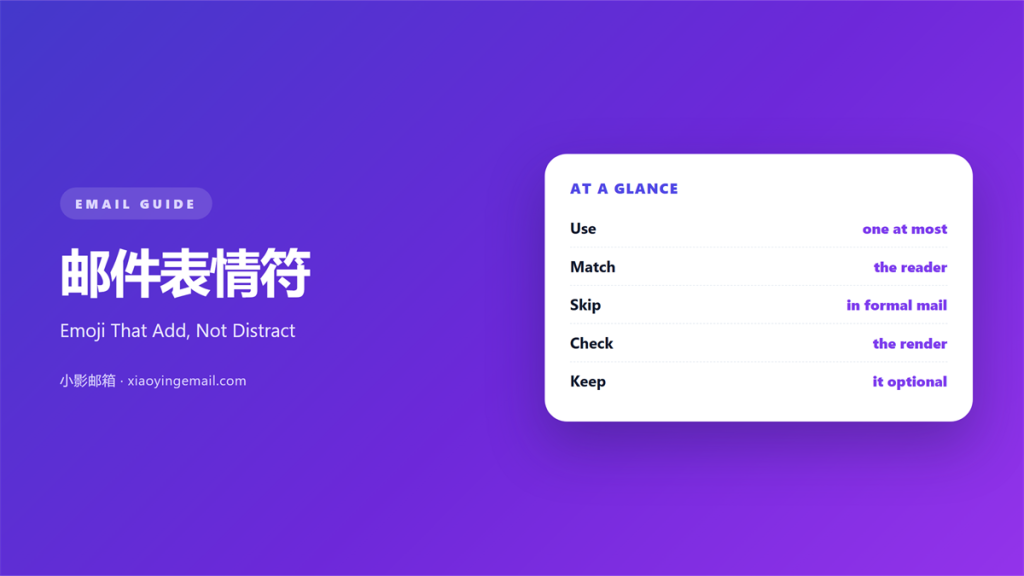
- 邮件表情符 are a small set of pictures you type.
- One mark can warm a line or break it.
- Use at most one per message.
- Test that it renders in every client.
- Skip emoji in formal and legal notes.
What 邮件表情符 means
邮件表情符 are the little pictures you can type into a note.
They come from a fixed set that most devices share.
A smiling face is one example.
A small check mark is another.
Each one carries a feeling in a single mark.
That is both the help and the risk.
A feeling can land well or badly.
So the choice should be slow and small.
The picture is not the message.
It only colours the words around it.
Treat it as seasoning, not as a meal.
Used once, it lifts a sentence.
Used five times, it drowns one.
So the first rule is restraint.
Why 邮件表情符 matters
Tone is hard to read in plain text.
A short line can sound cold by accident.
One small 邮件表情符 can soften that line.
It tells the reader how to hear the words.
That signal often saves a second reply.
It can also fix a flat subject line.
A single mark can earn attention.
But attention is not the same as respect.
Used badly, the mark looks childish.
The reader then doubts the writer.
So the mark must match the mood.
Warm, neutral or formal
A warm note can take one smile.
A neutral note takes one at most.
A formal note takes none at all.
Pick the lane before you pick the face.
When 邮件表情符 helps
An emoji helps in a few clear cases.
It helps when you thank a close colleague.
It helps when you share quick good news.
It helps when you soften a small request.
It helps when a thread has turned tense.
A calm face can lower the temperature.
It also helps in chat-style tools.
Readers there expect a lighter tone.
It helps in a subject line as well.
One mark can signal the mood up front.
The reader then opens with the right frame.
So the mark does useful work.
A good mark for a subject line
Place it at the very start or end.
Never in the middle of a phrase.
Keep the rest of the line plain.
One mark is the whole budget.
When 邮件表情符 hurts
An emoji hurts when the stakes are high.
A contract or a legal note needs none.
It hurts in a first message to a stranger.
The reader may read it as too casual.
It hurts in a message about a mistake.
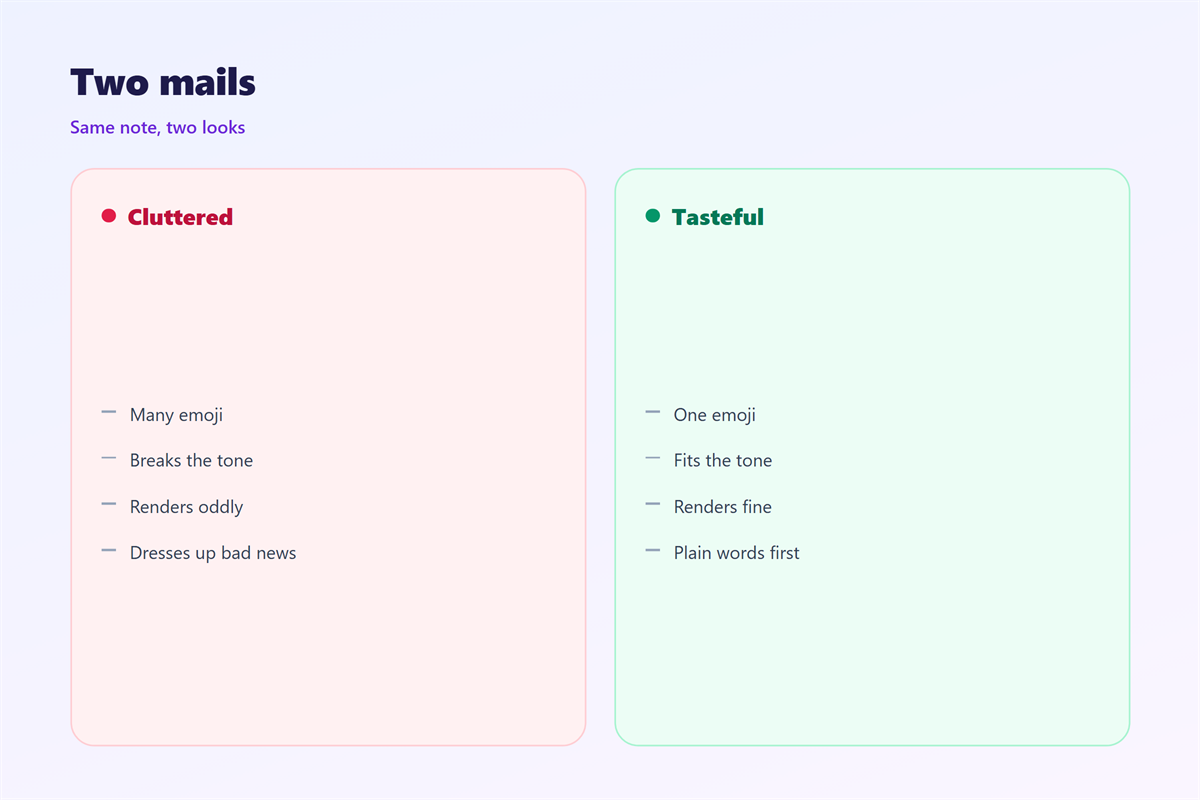
A bright face next to bad news looks wrong.
It hurts when the client uses a plain style.
Mirror their tone, not your own habit.
It also hurts when the character breaks.
A missing glyph shows an empty box.
That box looks like a fault in your work.
So test a rare mark before you trust it.
The rendering trap
Every device has its own picture set.
A new symbol may fail on old software.
Send a test to yourself on two devices.
If it breaks, drop it or replace it.
邮件表情符 in practice
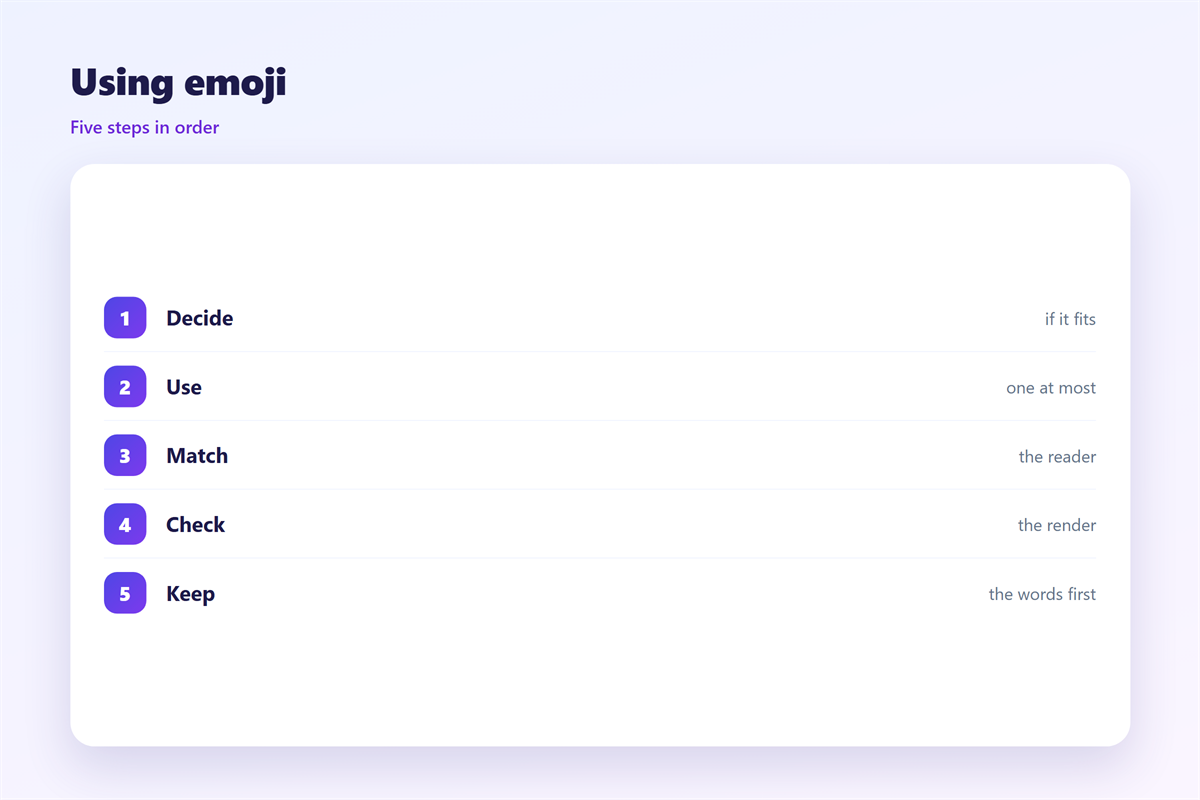
Start with a single approved set.
Write down which marks are allowed.
Then limit each note to one.
Place it near the line it colours.
Keep it out of the greeting and the sign-off.
Those two spots look careless with a face.
An image needs a written label instead.
An emoji does not, but it still shifts tone.
So read the whole note aloud once.
If the mark adds nothing, remove it.
If it adds warmth, keep it.
That simple test settles most cases.
Save the allowed marks in a short list.
Then share the list with the team.
How to place 邮件表情符
Pick the sentence that needs a boost.
Add the mark at its end.
Then read the line again.
Ask whether the mark changed the meaning.
If not, it is decoration only.
Decoration is fine once, not twice.
Next, watch the reader’s reply.
If they answer in kind, you matched the tone.
If they stay formal, drop the mark.
Then set the 邮件表情符 rule for the team.
A shared habit reads as one voice.
That voice is worth more than one face.
邮件表情符 and the reader
Every reader carries a different habit.
Some people love a friendly face.
Some people find it unprofessional.
You cannot please both at once.
So choose the tone your audience expects.
A bank and a games studio differ here.
When in doubt, leave the mark out.
Plain text almost never offends anyone.
You can always add warmth with words.
A short kind sentence works as well.
So let the words do the main work.
Let the picture do a little extra.
Two short lines can warm a note too.
A kind word often beats a small face.
Keeping 邮件表情符 steady
A steady rule is easy to follow.
The overall tone of a note is covered in 邮件语气.
The wider manners of the note appear in 邮件礼仪.
The line at the very top is explained in 邮件主题行.
The small-screen view sits in 邮件移动端.
Write the rule into your team guide.
Review it once a year.
A team that agrees on 邮件表情符 writes calmer mail.
FAQ
Should I use 邮件表情符 in a work email?
Yes, if you use one and your reader expects it.
How many emoji are too many?
More than one per message is usually too many.
Can 邮件表情符 replace a word?
No. It adds tone and never carries the facts.
What about emoji in the subject line?
One can help, but keep the rest plain.
评论
还没有评论,来说两句吧。
评论功能已关闭。