 小影邮箱
邮件折扣怎么写?A Saving That Reads
Key Takeaways
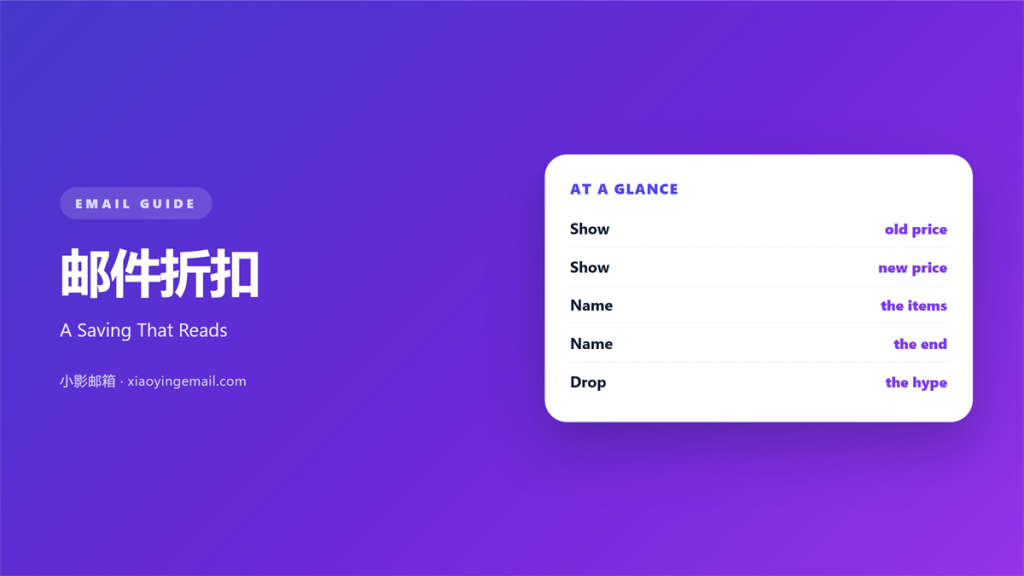
- 邮件折扣 states one price and one condition.
- Cross out the old price and show the new one.
- Say which items the discount covers.
- Give a date and a time zone for the end.
- Drop vague claims like “save up to”.
What 邮件折扣 means
邮件折扣 is a stated reduction with clear terms.
It names the old price and the new one.
It says what the reduction applies to.
It says when the offer ends.
Anything less is a hint, not an offer.
A reader should be able to compute the saving.
That takes two numbers and one line.
Most mails make it harder than that.
They hide the new price under a headline.
They use a percentage without a base.
Then the reader has to guess.
Guessing is where the sale is lost.
A short 邮件折扣 is also easier to check than a long one.
Why 邮件折扣 matters
Price is the most checked line in a sales mail.
Readers look for it before they read the copy.
If the number is hard to find, they leave.
A clear 邮件折扣 rewards that search.
It also reduces support questions.
Half the replies after a campaign ask about terms.
A single line prevents most of them.
Clarity also protects the sender.
Vague terms invite disputes and refunds.
Written terms settle those quickly.
Two numbers, one line
Show the old price with a line through it.
Show the new price larger, right beside it.
Keep both in the same currency format.
Then the saving is visible without arithmetic.
When 邮件折扣 helps
邮件折扣 helps when the reduction is real and dated.
It helps when the reader already knows the product.
Then price is the only open question.
It helps in a renewal reminder.
The reader has paid before and compares quickly.
It helps in a win-back mail after a quiet period.
A concrete number gives a reason to return.
It also helps when stock is genuinely limited.
When to name the amount
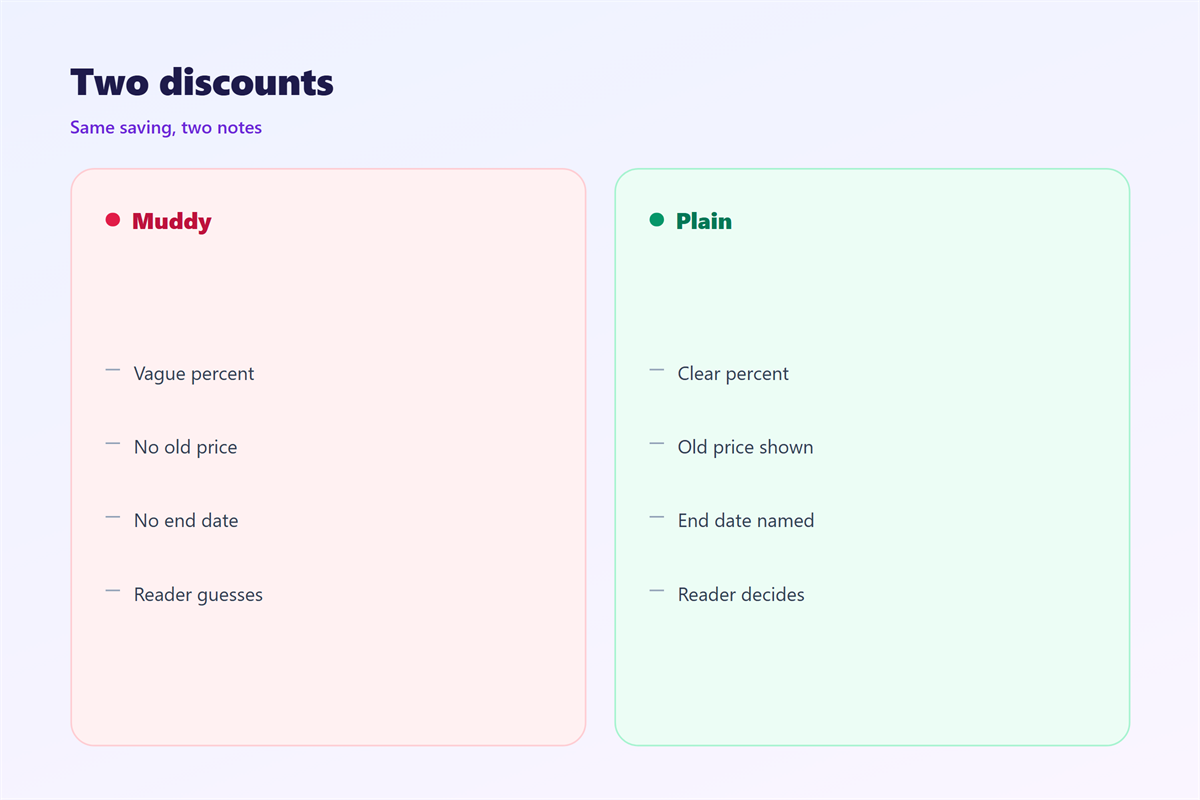
Name the amount, not just the percentage.
“Twenty percent off” needs a base to mean anything.
“Forty dollars off” stands alone.
Use the percentage as a second line if you like.
When 邮件折扣 hurts
邮件折扣 hurts when the old price was invented.
Readers check, and a fake anchor ends trust.
It hurts when the discount excludes the popular size.
Then the offer arrives and cannot be used.
It hurts when the deadline has no time zone.
A midnight cut-off differs by country.
It hurts when three discounts compete in one mail.
The reader cannot tell which is best.
It also hurts when the code is buried in an image.
Anyone with images off never sees it.
Finally, “up to” claims hurt more than they help.
They promise a saving that almost nobody receives.
A single honest number outperforms a range every time.
邮件折扣 and the price line
The price line is a small piece of design.
It needs two sizes and one rule.
Old price small, grey, and struck through.
New price larger, dark, and close beside it.
Keep the currency symbol attached to the number.
Do not split a price across two lines.
On a narrow screen the pair can wrap badly.
Test the line at the phone width.
If it wraps, shorten the text around it.
Terms in one sentence
Put the end date in the same block as the price.
Add the code and the covered items.
One sentence can hold all three.
Anything longer belongs in a linked page.
Keep that sentence under twenty words.
How to write 邮件折扣
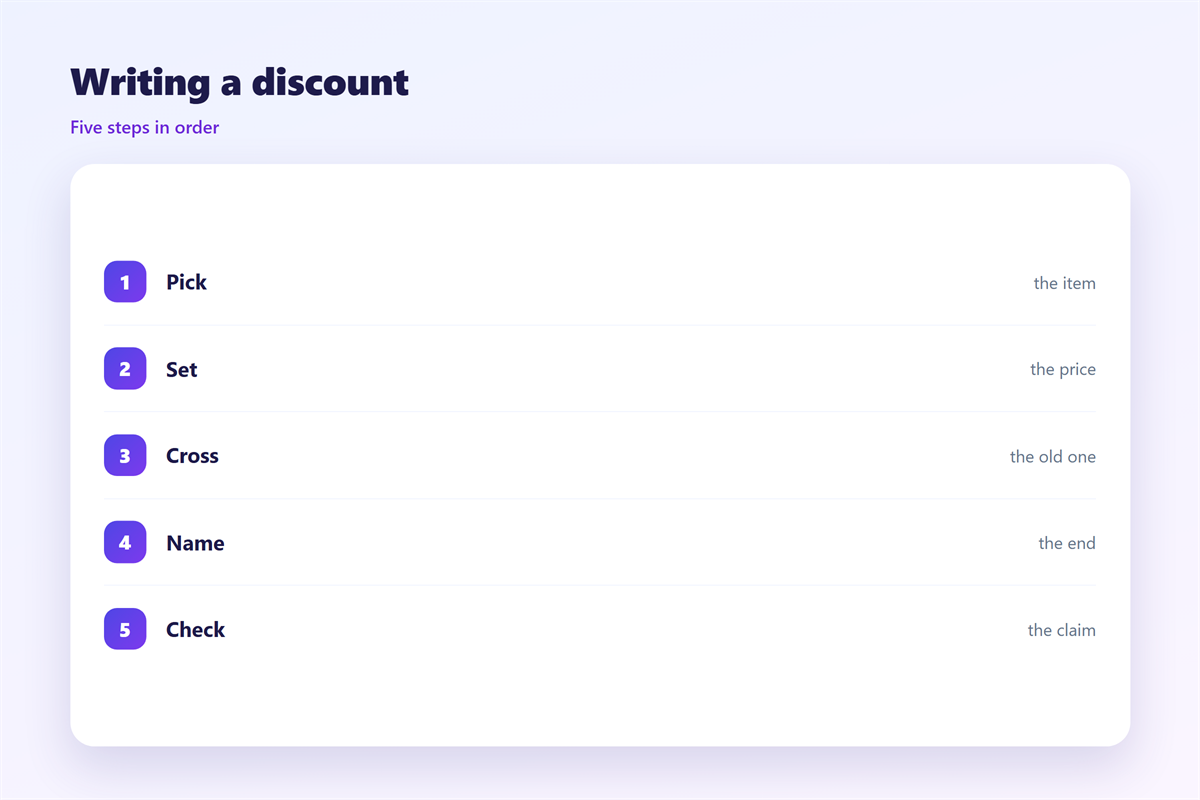
Start with the new price, written as a number.
Add the old price only if it was really charged.
Name the products the discount covers.
Give the end date with a time zone.
State the code in plain text.
Then read the block as a stranger would.
If a term is missing, add it now.
Cut every adjective that carries no fact.
Words to leave out
Drop “massive”, “huge”, and “once in a lifetime”.
Drop “up to” unless you also give the typical case.
Drop exclamation marks from the price line.
Keep “from” only when a range is honest.
A calm line reads as a real offer.
A loud one reads as a warning.
邮件折扣 on a phone
Most discount mails are opened on a phone.
The price must be visible without scrolling far.
Keep the old and new price on one line.
If they must wrap, put the new price first.
Set both at fourteen pixels or more.
A struck-through price at ten pixels turns to dust.
Put the code where a thumb can copy it.
Never place the code inside an image.
Check the button label against the offer.
“Shop the sale” beats “Click here” every time.
Repeat the date under the button, not only above it.
Then check the whole block in a dark theme.
Keeping 邮件折扣 honest
邮件折扣 is a promise with a number attached.
Honour it for everyone who received the mail.
Never raise a price to fund the reduction.
Code handling sits in 邮件优惠券.
Campaign timing appears in 邮件促销.
The click path is covered in 邮件转化率.
Page alignment belongs to 邮件落地页.
Check every link before the send.
A discount that leads to a full-price page wastes the mail.
Then send the same terms to the whole list.
Quiet consistency is what makes an offer believable.
FAQ
Should a 邮件折扣 show a percentage or an amount?
The amount, when you can. It needs no base to be understood.
How long should a discount last?
Long enough to be seen, short enough to mean something.
Can I stack two discounts?
Only if the rule is clear. Otherwise readers assume both apply.
What about free shipping?
Treat it as a discount and give the minimum order.
评论
还没有评论,来说两句吧。
评论功能已关闭。