小影邮箱
小影邮箱一次性邮箱有哪 5 种?机制、成本与适用场景
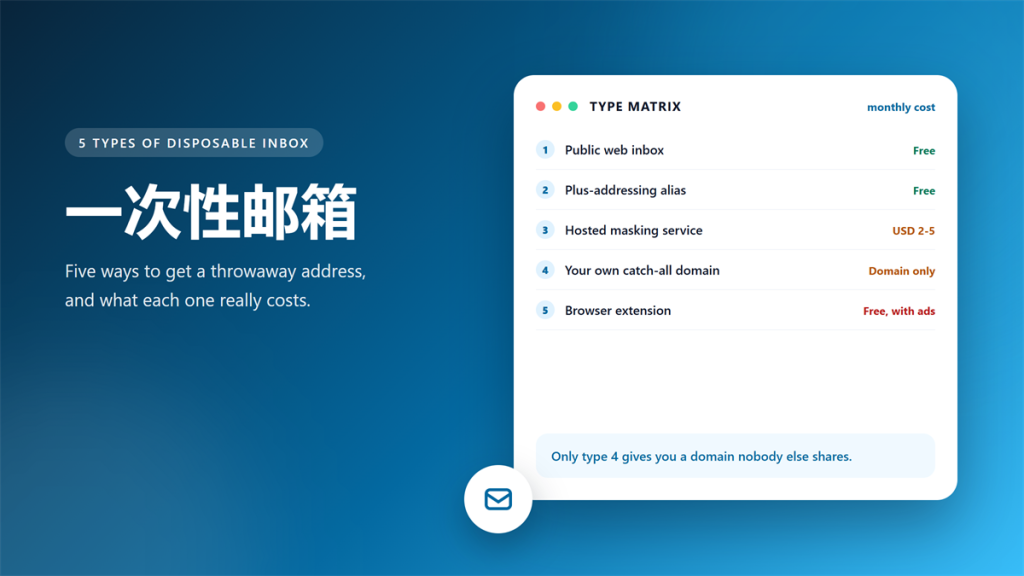
I have run five different kinds of 一次性邮箱 over the past two years. They are not interchangeable. Two of them I still use weekly, and one I abandoned after a single afternoon.
The differences between one 一次性邮箱 and another come down to three things. Who owns the domain, how long the address lives, and who can read the mail. This guide walks through all five types, so you can match the tool to the job.
Key Takeaways
Here is the short version before the details.
- A 一次性邮箱 is not one product but five different mechanisms.
- Shared domains are free and fast, and anyone can be blocked from them.
- Aliases hide your address, yet every alias still points to your real inbox.
- A catch-all domain costs a domain fee and rarely gets blocked.
- Browser extensions add the most tracking, so read the permission list.
- Stack two kinds of 一次性邮箱: free inboxes for one-off forms, a domain for the rest.
Why a 一次性邮箱 Has Five Implementations
Every 一次性邮箱 solves the same problem with a different trade-off. Some trade privacy for speed, and others trade money for control.
Consequently, the five types diverge after the first week. For instance, a public inbox disappears, while an alias keeps forwarding for years.
The Five Types of 一次性邮箱, Compared
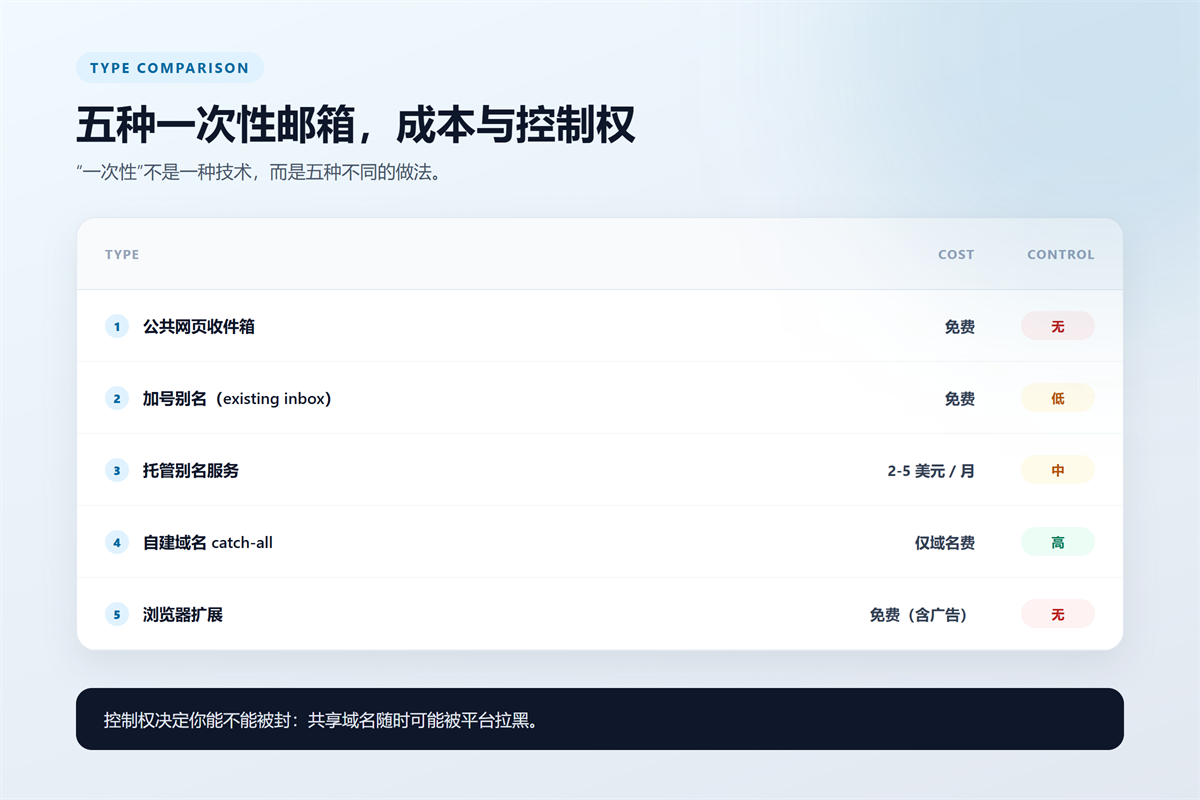
The table below reflects two years of 一次性邮箱 use, including the failure modes that matter.
| Type | Cost | Address lifespan | Who controls the domain |
|---|---|---|---|
| Public web inbox | Free | About one hour | The operator |
| Plus-addressing alias | Free | Forever | Your mail provider |
| Hosted masking service | 2 to 5 USD monthly | Until you cancel | The vendor |
| Your own catch-all domain | Domain fee only | Forever | You |
| Browser extension | Free with ads | Session based | The publisher |
Types one to three: free and shared
A public web inbox, a plus-addressing alias and a browser extension all cost nothing. Moreover, none of them needs a domain or a server.
However, they share one weakness. The domain belongs to somebody else, so you inherit its reputation. If the operator is blocked, you are blocked with it.
Types four and five: paid and controlled
A hosted masking service and your own catch-all domain put you in charge. Specifically, the hosted service gives you a dashboard, and your own domain gives you the address space.
Both types still count as a 一次性邮箱, yet they behave like a permanent address. Consequently, both survive a blocklist, because you can retire a prefix and keep the rest of your accounts working.
Why Domain Ownership Decides a 一次性邮箱 Block
For any 一次性邮箱, domain ownership decides whether a block is permanent. If a shared domain lands on a blocklist, every user of that 一次性邮箱 loses access at once.
In contrast, a catch-all domain belongs to you. Therefore, you can move the domain, add another one, or drop a prefix without losing your accounts.
What a 一次性邮箱 Really Costs
Money is the smallest part of the calculation, and time is the largest. A public inbox costs nothing and takes five seconds to open.
An alias costs nothing either, yet it needs a naming rule so you can trace a leak later. Furthermore, a catch-all domain costs one domain fee per year, which works out to about a dollar a month.
In contrast, a hosted masking service charges monthly, and it adds a dashboard you may never open. Therefore, compare the yearly total rather than the sticker price.
How to Choose a 一次性邮箱 by Situation
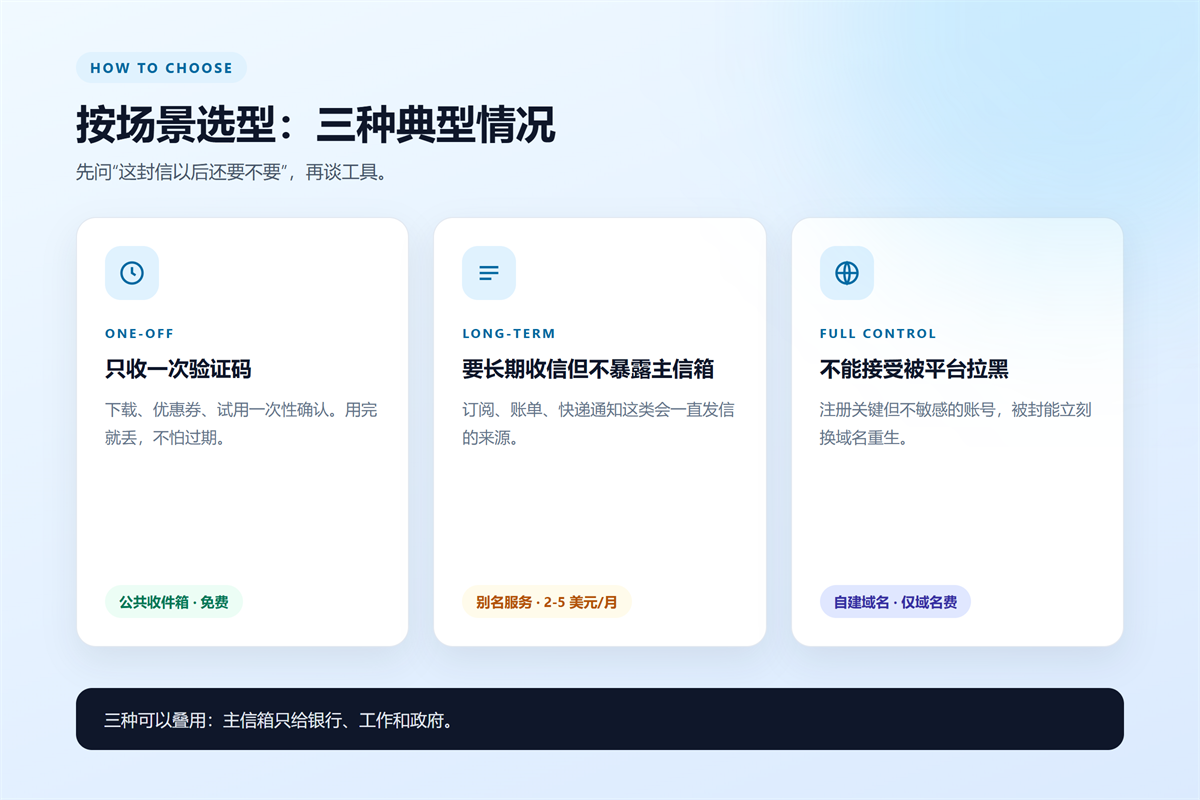
Pick a 一次性邮箱 by asking one question: will you need this mail again? If the answer is no, use a public inbox, and if the answer is maybe, use an alias.
Furthermore, keep your real address for the small set of accounts you can never lose. Banks, employers, tax portals and clinics belong there.
Before you commit to a provider, run our 免费临时邮箱 checklist over it. Seven checks take about five minutes.
Two 一次性邮箱 Mistakes I See Often
First, people assume an alias makes them anonymous. It does not, because the alias still forwards to an inbox tied to your name.
Second, people self-host a catch-all domain and then reuse one address everywhere. Consequently, a single leak exposes every account created with it.
If you are new to disposable inboxes, read our 临时邮箱 usage guide first. It covers the daily workflow in about ten minutes.
Failure Modes I Have Hit with a 一次性邮箱
Every 一次性邮箱 I have used eventually failed in a predictable way. Knowing the failure mode in advance saves an afternoon.
- A public inbox expired mid-signup, so the verification link arrived too late.
- An alias kept working, but one vendor leaked it and the forwarding never stops.
- A catch-all domain lapsed during a forgotten renewal, which broke every alias at once.
- A browser extension injected its own tracking script into the page.
Notably, only the domain failure was fully in my control, and it was also the cheapest to prevent.
Frequently Asked Questions
Is a 一次性邮箱 the same as a temporary inbox?
The words overlap, though the term covers five mechanisms. Public inboxes expire within an hour, while aliases and domains last as long as you pay. Therefore, describe the behaviour you need rather than the label.
Which 一次性邮箱 type works best for a paid trial?
Use a public inbox when you will never pay, and an alias when you might. Once money is involved, the account must survive a receipt or an invoice. At that point, a 一次性邮箱 becomes a liability instead of a shortcut.
Can I keep a 一次性邮箱 forever?
Yes, if you own the domain. A catch-all domain renews like any other domain, and you control every prefix. Hosted services vary, so check what happens when you cancel a subscription.
Do I need technical skills to run a 一次性邮箱 domain?
You need a registrar, one DNS record and about twenty minutes. Most registrars publish a catch-all setting, and the 小影邮箱 inbox covers the free side of the workflow.
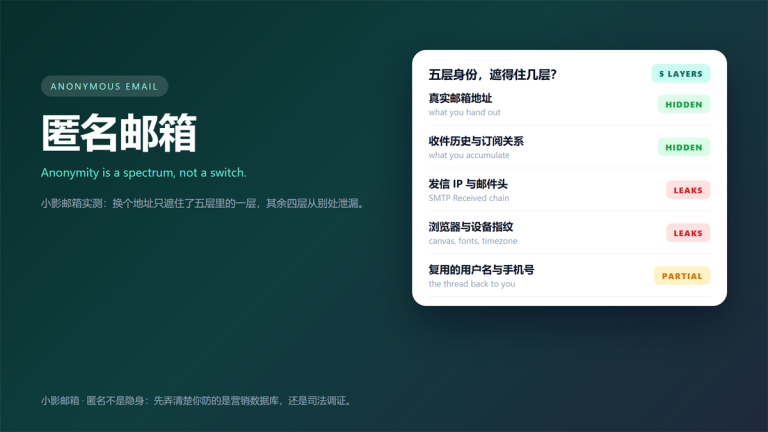
For the other half of this picture, see our guide to where pseudonymity ends and leakage begins.