 小影邮箱
投诉邮件怎么写?Evidence, Sequence and Escalation
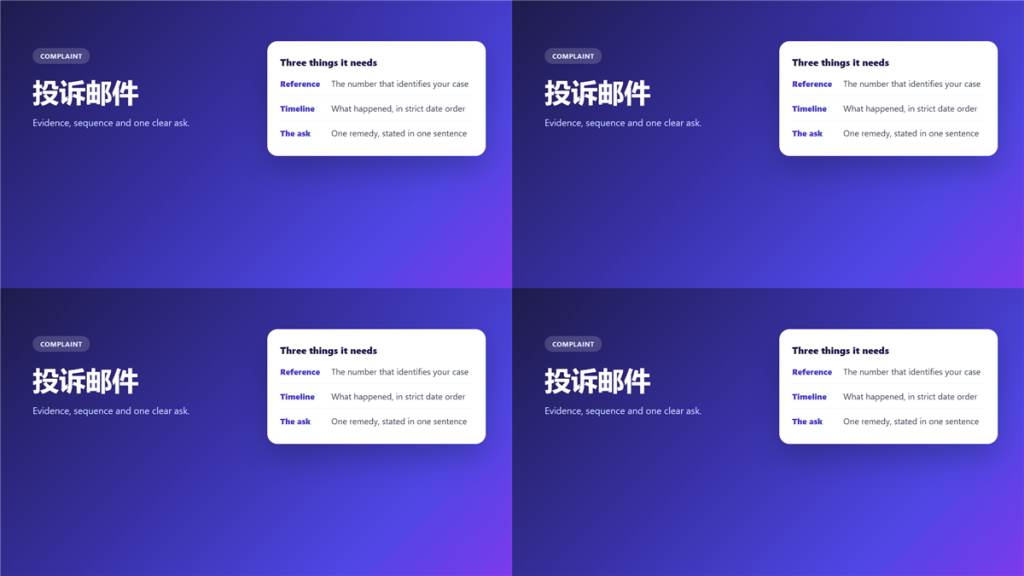
What a 投诉邮件 has to achieve
投诉邮件 has one job: to give somebody inside the company a reason and a means to fix your problem. Everything that does not serve that job is noise.
A tenant once sent a 900 word 投诉邮件 about a broken heating system. The reply took three weeks and asked for her address. A second version, five lines long with the reference number at the top, was resolved in two days.
Key Takeaways
- 投诉邮件 needs one issue, one reference and one ask.
- Dates persuade better than adjectives do.
- Evidence belongs in the message, not behind a drive link.
- A stated deadline is what gets a reply.
- Escalation works only after the first attempt fails.
- Never mix a complaint with a new request.
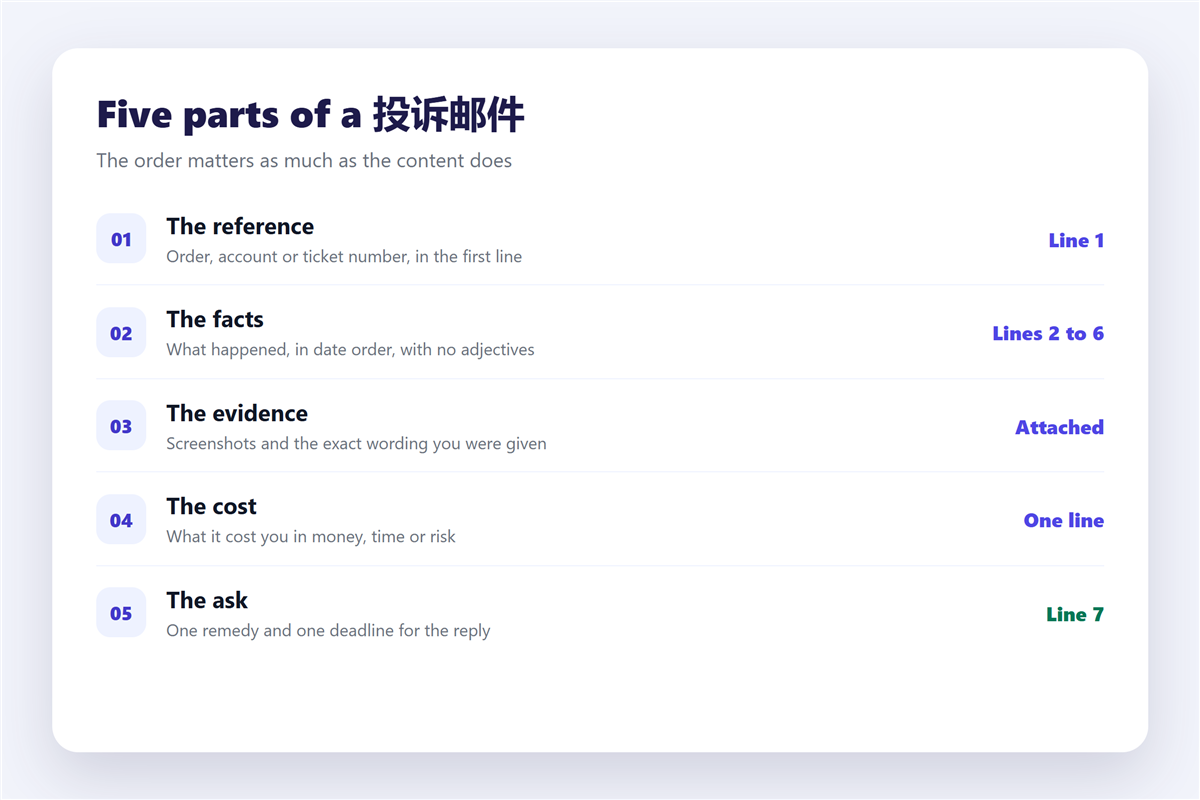
Five parts of a 投诉邮件
- The reference number, in the very first line.
- The facts, in date order, with no adverbs.
- The evidence, attached rather than linked.
- The cost, stated as money, time or risk.
- The ask, as one remedy with one deadline.
The second part carries the most weight. Because a reader cannot verify a feeling, a list of dates and amounts is what moves a case forward. Meanwhile the last part is what stops the reply from being a holding message, and the wording that gets answers is in 邮件回复.
How to write the facts in a 投诉邮件
Neutral sentences survive being forwarded, and emotional ones do not.
Use dates, not intervals
Write that the engineer did not arrive on the agreed date, rather than that nobody came for ages. Notably, a date can be checked against a system, and an interval cannot.
Quote what you were told
Repeat the exact promise in quotation marks and name who made it. In addition, this turns a dispute about tone into a question of fact.
Separate the event from the cost
Keep the loss in its own line, with a figure where one exists. Consequently the remedy you ask for looks proportionate rather than arbitrary.
Escalation in a 投诉邮件
Escalation works when it reads like a process rather than a threat.
Send the first version to the address that owns the problem. If nothing arrives by your deadline, forward the same message to the next level and say plainly that you are doing so. Carbon copying a regulator into the first message is the fastest way to be routed into a legal queue, and the visibility rules are covered in 邮件抄送. Once a case has several participants, keep the history in one chain, which is what 邮件会话 is about.
Where a 投诉邮件 goes wrong
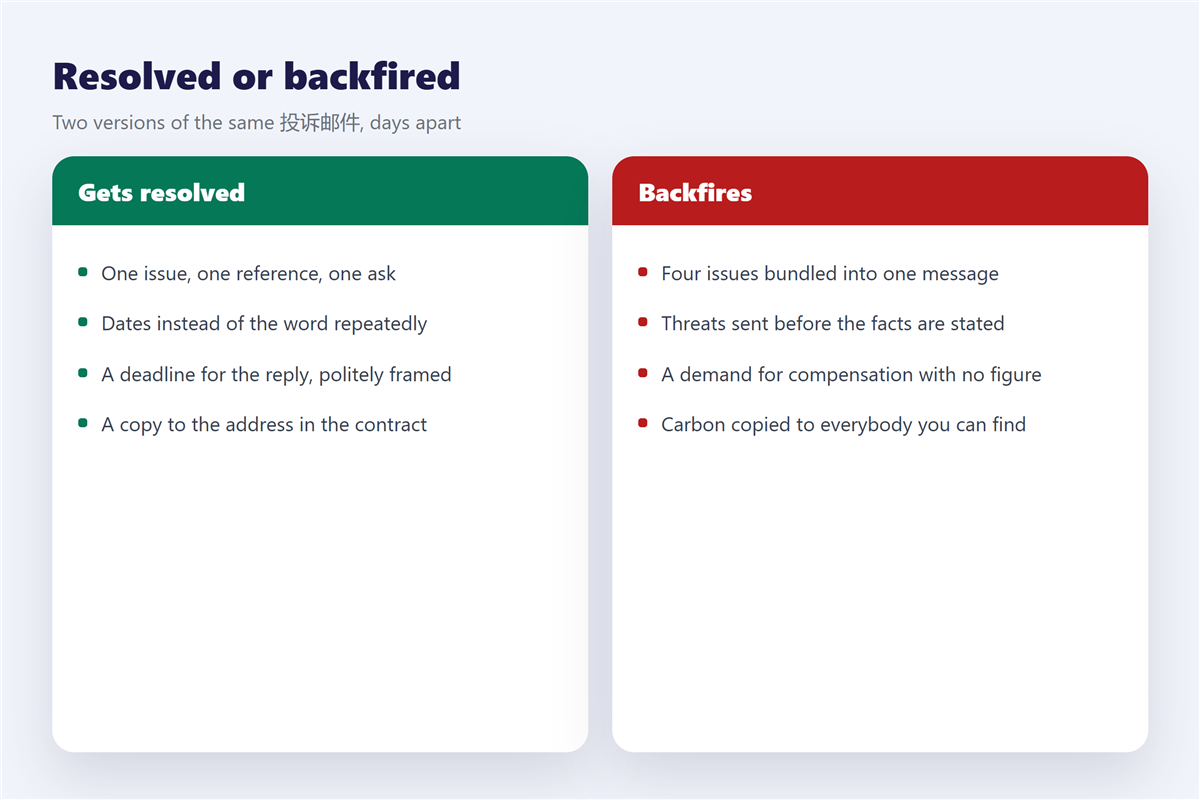
Four habits reliably produce a worse outcome than doing nothing.
The first is bundling several issues, which lets the other side answer the easiest one and close the case. The second is a threat with no mechanism behind it. The third is asking for compensation without a number, which nobody is authorised to approve. The fourth is sending a fresh message instead of replying, which splits the record in two. If the matter involves wording you reuse, the pitfalls are in 邮件模板, and a clearer subject line helps more than most people expect, as shown in 邮件标题.
Frequently asked questions
How long should a 投诉邮件 be?
As short as the facts allow. Under 200 words is usually enough for a first attempt.
Should a 投诉邮件 mention a regulator?
Only after the internal route has failed, and only if you are prepared to use it.
Can a 投诉邮件 ask for compensation?
Yes, with a figure and a reason. An open ended request cannot be approved by the person reading it.
Does a 投诉邮件 need to be polite?
It needs to be unemotional. Politeness is optional and brevity is not.
评论
还没有评论,来说两句吧。