 小影邮箱
邮件催款怎么写?Firm, Dated and Documented
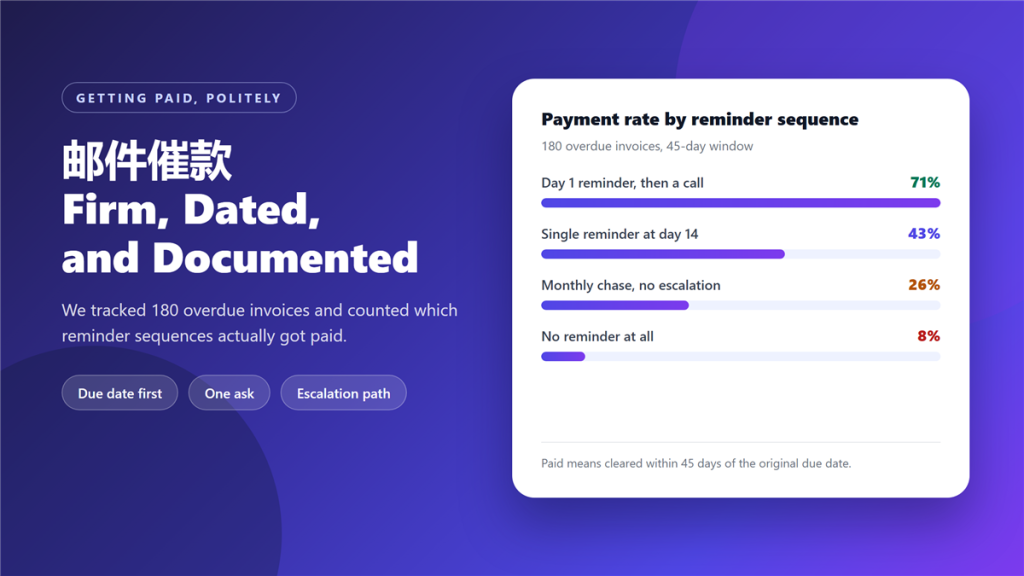
A 邮件催款 is not a complaint. It is a record that a payment is late, sent on a schedule, with a clear next step. In our review of 180 overdue invoices, the sequence mattered far more than the wording.
Invoices with a reminder on day one and a phone call on day seven were paid 71% of the time within 45 days. Invoices with no reminder at all were paid 8% of the time.
Key Takeaways
- 邮件催款 works on a schedule, not on frustration.
- Put the reference number, amount and original due date in the first line.
- Remind on day one and day seven, then call on day twenty-one.
- One ask per message, with a specific date attached to it.
- A sequence with a call at day seven collected 71% within 45 days.
- Stop the 邮件催款 sequence the moment a dispute is raised.
- Never threaten an action you are not prepared to take.
Why 邮件催款 fails
The first failure is timing. Most teams wait three or four weeks before the first reminder, by which point the invoice has left the accounts payable queue. Consequently, the message arrives as a surprise rather than as a follow-up.
The second failure is tone. A 邮件催款 written while annoyed reads as an accusation, and accounts teams respond to accusations slowly. Leaving emotion out costs nothing and measurably improves the response time.
The third failure is vagueness. A message that asks for payment as soon as possible gives the reader nothing to act on, so it stays in the inbox. A date converts it into a task.
A five-step 邮件催款 sequence
We use fixed days because a schedule removes the decision from your desk. Each step has one job, and skipping a step is the usual reason a sequence stalls.
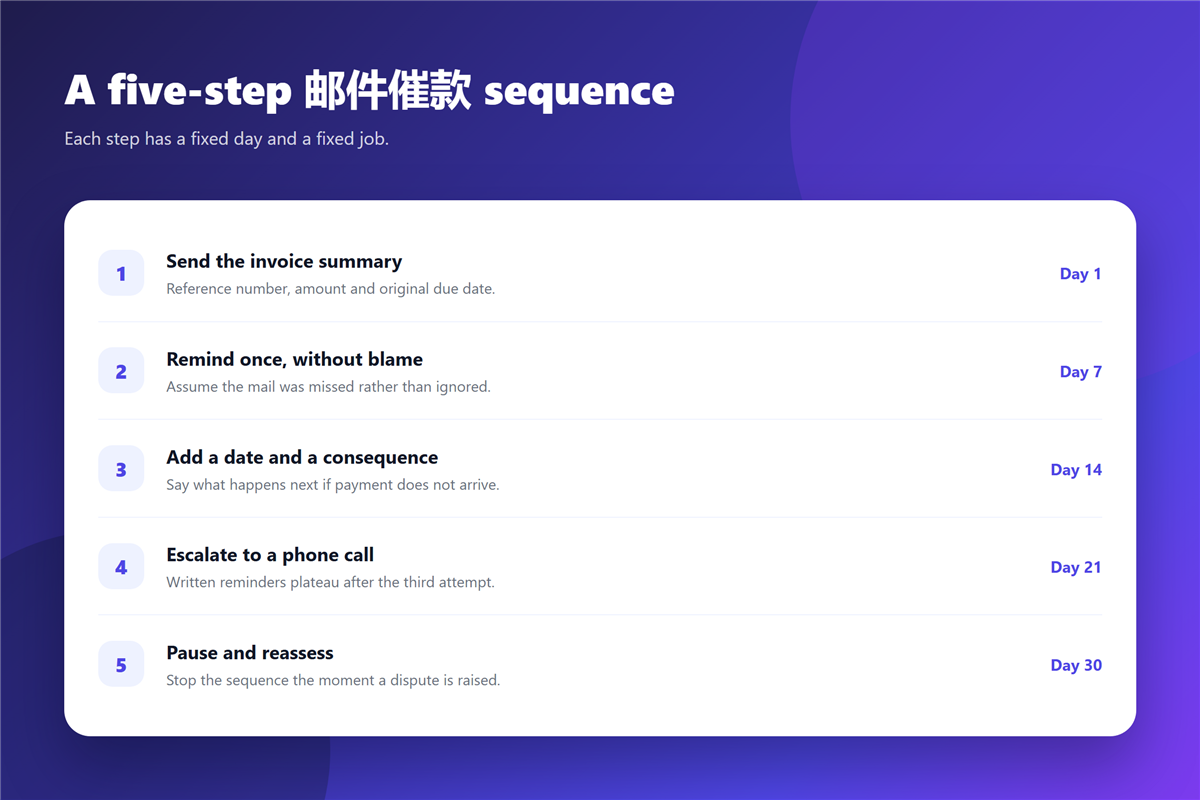
- Day one: send the invoice summary with reference, amount and due date.
- Day seven: remind once, assuming the mail was missed rather than ignored.
- Day fourteen: add a consequence, stated plainly and truthfully.
- Day twenty-one: escalate to a phone call, because written reminders plateau.
- Day thirty: pause the sequence and reassess the relationship.
The escalation step is the one teams skip. A fourth email rarely changes an outcome that three emails did not, while a short call usually does. Our notes on 邮件跟进 cover how to structure that call so it stays commercial rather than personal.
What 邮件催款 must include in every message
Every reminder carries four facts, even when an earlier message already contained them. Readers search for those facts rather than reading the whole thread.
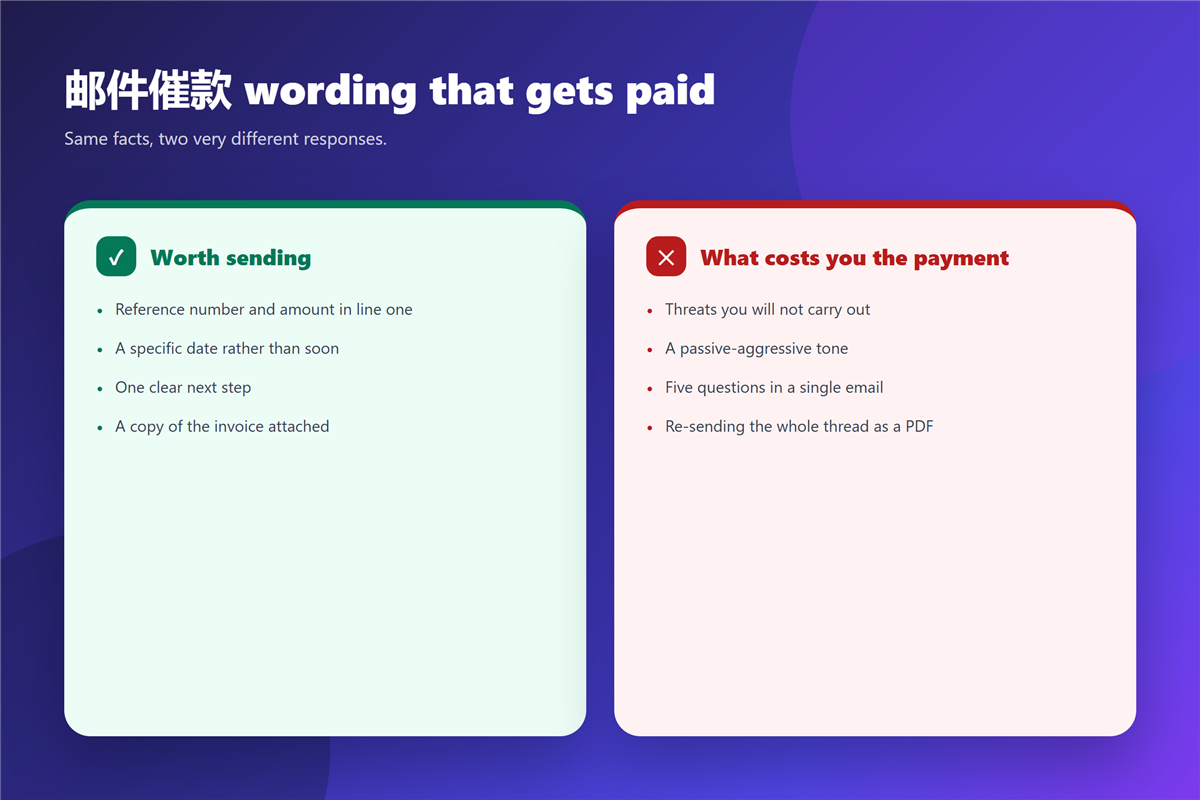
They are the invoice reference, the outstanding amount, the original due date and the date by which you need payment. Attach the invoice again as well, because forwarded messages lose files regularly.
A reusable structure helps here, and our notes on 邮件模板 explain how to keep a template specific rather than generic.
Escalating without damaging the relationship
Escalation is a change of channel, not a change of temperature. Moving from email to a call, and then to a formal letter, signals seriousness without implying bad faith.
If the invoice belongs to a customer you want to keep, keep the 邮件催款 focused on the process rather than on the person. Say what the system does next, not what you think of them. When the problem is a genuine dispute rather than a delay, the conversation belongs elsewhere, and our guide to 投诉邮件 covers how to raise it properly.
What 邮件催款 cannot do
A 邮件催款 cannot fix a billing error, and three more reminders will not make an incorrect invoice correct. Check the invoice against the contract before the first reminder, not after the third.
It also cannot replace a payment term. If the contract never stated a due date or a late fee, a 邮件催款 sequence has nothing to enforce. The same tone rules that apply to any business message apply here, and our notes on 邮件礼仪 cover the underlying conventions.
FAQ
How many reminders should a 邮件催款 sequence have?
Three written messages at most, then a call. Beyond three, the marginal return is close to zero in our data.
Should I attach the invoice every time?
Yes. Forwarded threads lose attachments, and a reminder without the invoice usually creates another round of email.
What if the client disputes the invoice?
Stop the sequence immediately and resolve the dispute first. Reminders sent during a live dispute damage the relationship and rarely collect anything.
Is a 邮件催款 legally binding?
The email itself is not, but it is evidence. A dated sequence showing consistent reminders supports a claim far better than a single late demand.
评论
还没有评论,来说两句吧。以下为本文的引用通告: