 小影邮箱
邮件要点怎么写?The Bullet Summary
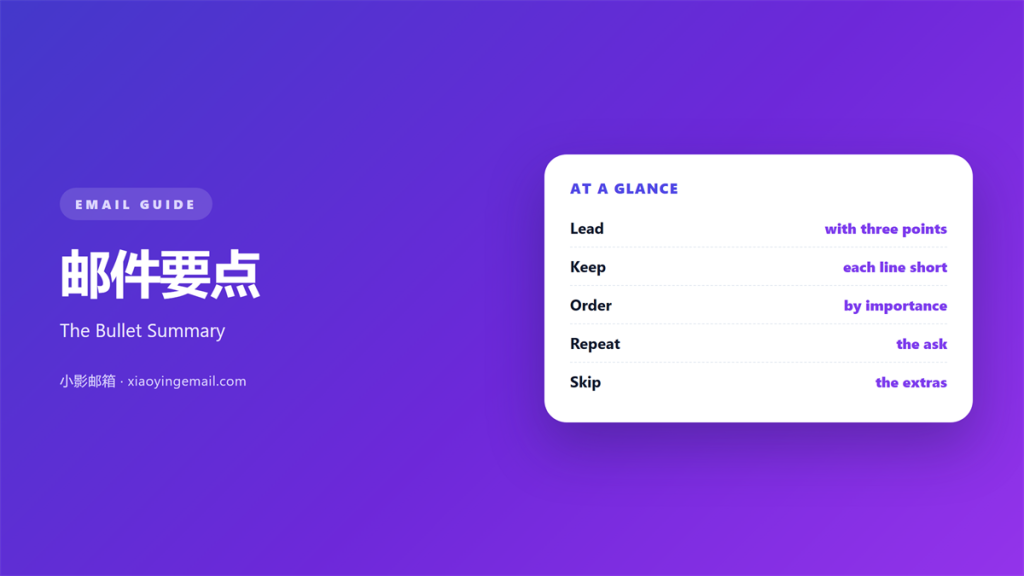
Key Takeaways
- 邮件要点 is the short summary placed at the top.
- Three clear points beat one long block.
- Put the ask where the eye lands first.
- A short list scans faster than dense prose.
- Write the summary last, once facts are clear.
What 邮件要点 means
邮件要点 is the short summary that sits at the top of a message.
It hands the reader the main facts before the detail arrives.
It is not a title or a greeting. It is one to three short lines.
Many senders bury the point in the fourth paragraph.
Most readers never reach that far down the page.
A clear summary fixes that problem in a few seconds.
It serves the reader who only has ten seconds to spare.
It also serves you, because it forces one sharp decision.
A good 邮件要点 fits on one line or two.
The summary is a map, not the whole journey.
It shows the shape of the message before the walk begins.
A reader trusts a message more when the top is honest.
Why 邮件要点 helps
People scan long messages before they settle down to read.
A summary works with that habit instead of fighting it.
It also shortens reply time, since the ask is visible at once.
A strong 邮件要点 answers three small questions for the reader.
What is this about? What do you want? By when?
When those answers come first, fewer follow-up questions return.
The message also feels shorter than it really is.
That calm feeling makes a busy person more likely to act.
The 邮件要点 also sets the tone you want to use.
A short summary lowers the fear of a blank page.
It gives the writer a clear place to start.
Teams that share this habit waste less time in meetings.
A shared shape makes every message easier to compare.
How to write 邮件要点
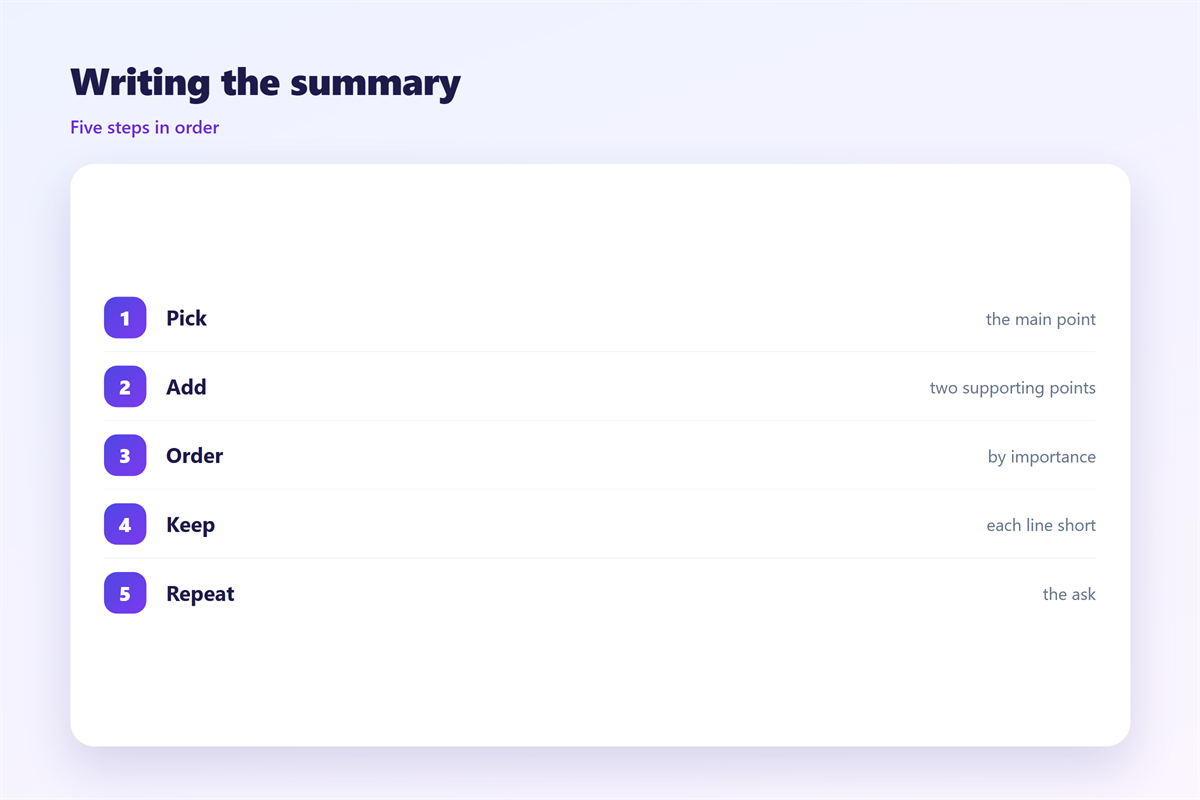
Keep the same shape every time, because a known shape is fast.
Write the summary after the body, never before it.
By then you know what actually matters and what does not.
Draft the 邮件要点 in the order the reader will read it.
Do not polish the words yet. Get the facts down first.
Lead with the purpose
Name the topic within the first few words.
A reader should know the subject before the greeting ends.
Add the number or date
Concrete facts carry more weight than soft adjectives.
Write “twelve units” instead of “a large recent order”.
State the action
End the summary with the one thing you need.
A single request is easier to answer than three.
Give a deadline if the task has one.
Then read the summary aloud to test how it sounds.
邮件要点 for long reports
Long messages need a summary the most, yet often get it least.
Place it above the detail, never hidden at the foot.
Three bullets can carry a report of ten pages.
Keep each bullet tied to a single clear idea.
If a bullet needs a comma, it is probably too long.
Save the proof and the method for the body below.
Use plain verbs so the reader moves quickly.
Avoid jargon that only your team understands.
Number the points when the order matters.
A strong 邮件要点 stands alone if nothing else is read.
Common mistakes with 邮件要点
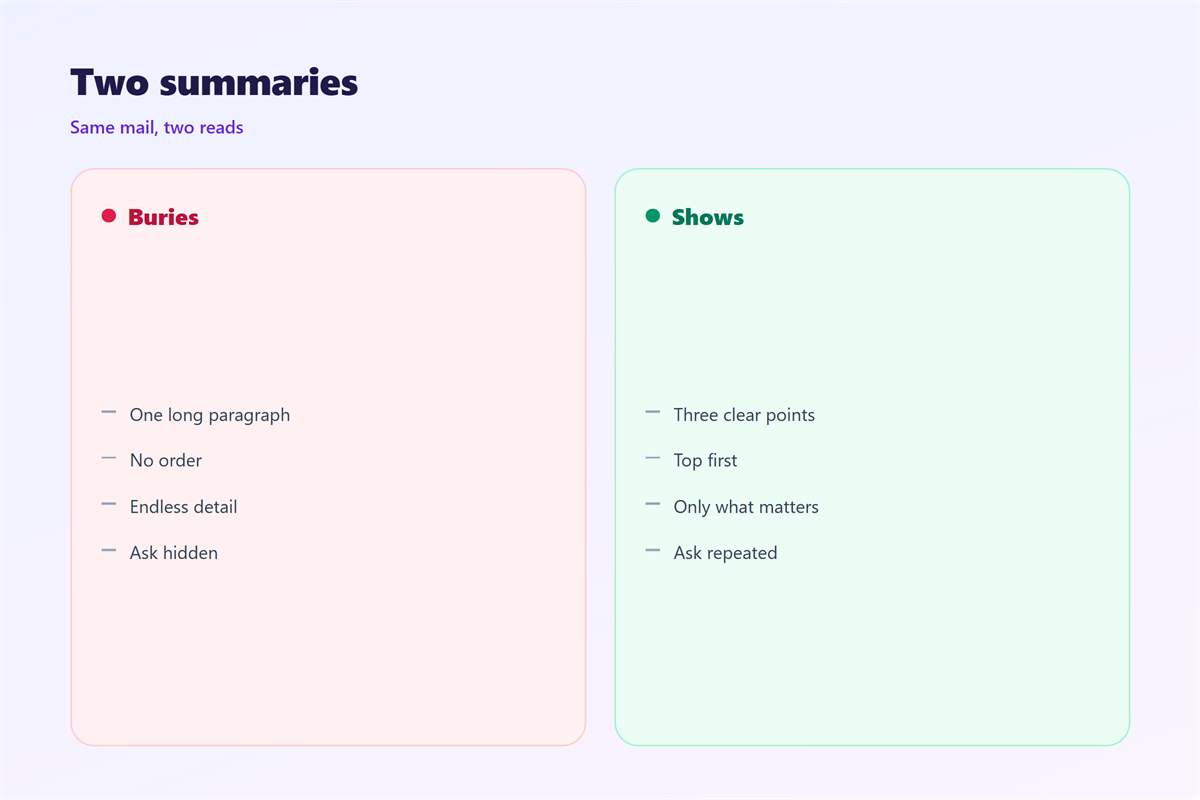
The first mistake is writing full sentences in the summary.
Short phrases scan faster and read much cleaner.
The second is hiding the ask beneath background detail.
The third is mixing three topics into one line.
Another mistake is using vague words like “soon” or “later”.
Exact dates remove doubt and save a follow-up email.
Finally, do not repeat the whole message in the summary.
A summary is a doorway, not the room behind it.
Do not pack every fact into the top few lines.
Leave some detail for the body to explain.
A five minute 邮件要点 beats an hour of nervous editing.
Summary tone and length
Keep the tone plain and steady from the first line.
A neutral voice suits almost every workplace message.
Save strong emotion for the sentences that need it.
Shorter lines feel calmer than long ones.
Aim for one idea in each short line.
If a line runs past ten words, tighten it.
Numbers and names are the last things to cut.
Trim the adjectives before you trim the facts.
Keeping 邮件要点 handy
Save the 邮件要点 that worked and reuse their shape.
The reason to compress a message is set out in 邮件摘要.
A workable order for the whole message is described in 邮件正文.
The habits behind a first draft appear in 邮件撰写.
Progress updates that need a summary live in 邮件汇报.
Then trim each new summary until it is even shorter.
Keep a small list of openers that always work.
A folder of good summaries saves time every week.
Sending and follow-up
Send the message as soon as the summary is ready.
Do not sit on a clear summary for a whole day.
If no reply comes, wait two working days first.
Then send a short reminder that repeats the ask.
Quote the original summary so the reader recalls it fast.
Offer a smaller first step if the task feels large.
Stop after the second reminder and try another route.
Keep every follow-up as light as the first note.
Log the date you sent each reminder.
A calm follow-up is more likely to get a calm reply.
Keep the whole thread short and easy to scan.
One clear ask per message is the safest path.
Reply speed often improves when the ask is plain.
FAQ
Is 邮件要点 needed in every message?
No. A one line note needs no summary of its own.
How long should it be?
One to three short lines. Four is usually too many.
Where does it go?
Right at the top, before any background detail.
Can I reuse an old one?
Yes, if the facts still match the new message.
References
- IETF RFC 5322: Internet Message Format
- Harvard Business Review: Writing email with precision
- Litmus: Email design research
评论
还没有评论,来说两句吧。
评论功能已关闭。