 小影邮箱
邮件重试怎么做?Retry, Rewrite or Stop
Key Takeaways
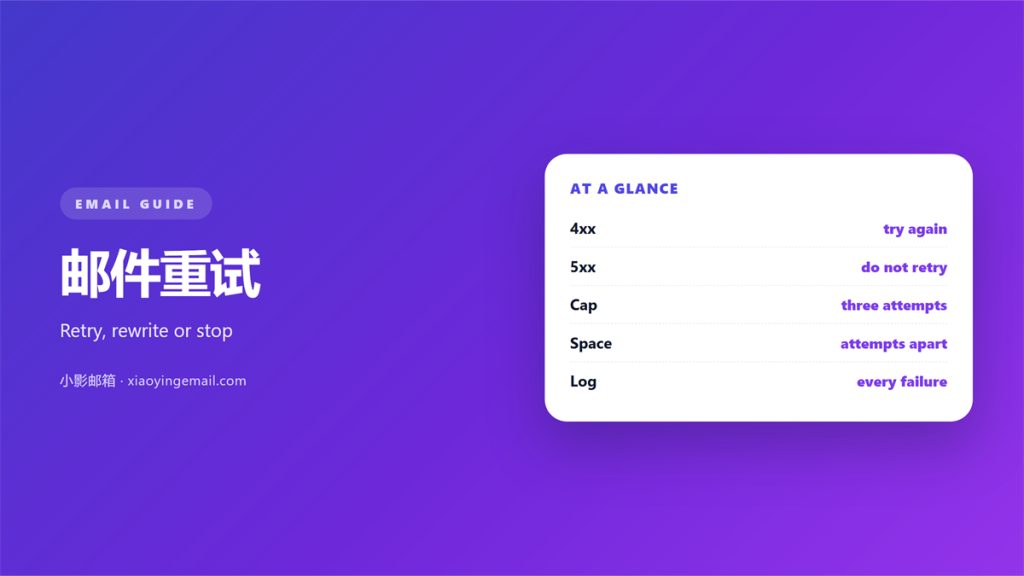
- 邮件重试 is a decision, not a reflex.
- Retry a transient error. Never retry a hard one.
- Space the attempts out over several hours.
- Give every message a firm retry limit.
- Log each attempt so you can prove it.
What 邮件重试 rules decide
邮件重试 rules answer one question. Does this failure deserve another attempt?
A temporary error often clears on its own. A permanent error never will.
The server usually tells you which one you have. The reply code carries the answer.
Getting that call wrong wastes time or loses mail. Neither outcome is necessary.
So a 邮件重试 system is really a filter. It separates hope from evidence.
A good 邮件重试 rule is boring. It does the same small thing every time.
Most teams start with a simple loop. That loop is often the whole problem.
A fixed delay ignores the type of error. A typed rule respects it.
A rule should name the error class. It should also name the wait.
Write both in one place. Then anyone can read the rule and predict it.
Reading the reply before any 邮件重试
The code matters more than the message. A number is harder to misread than a sentence.
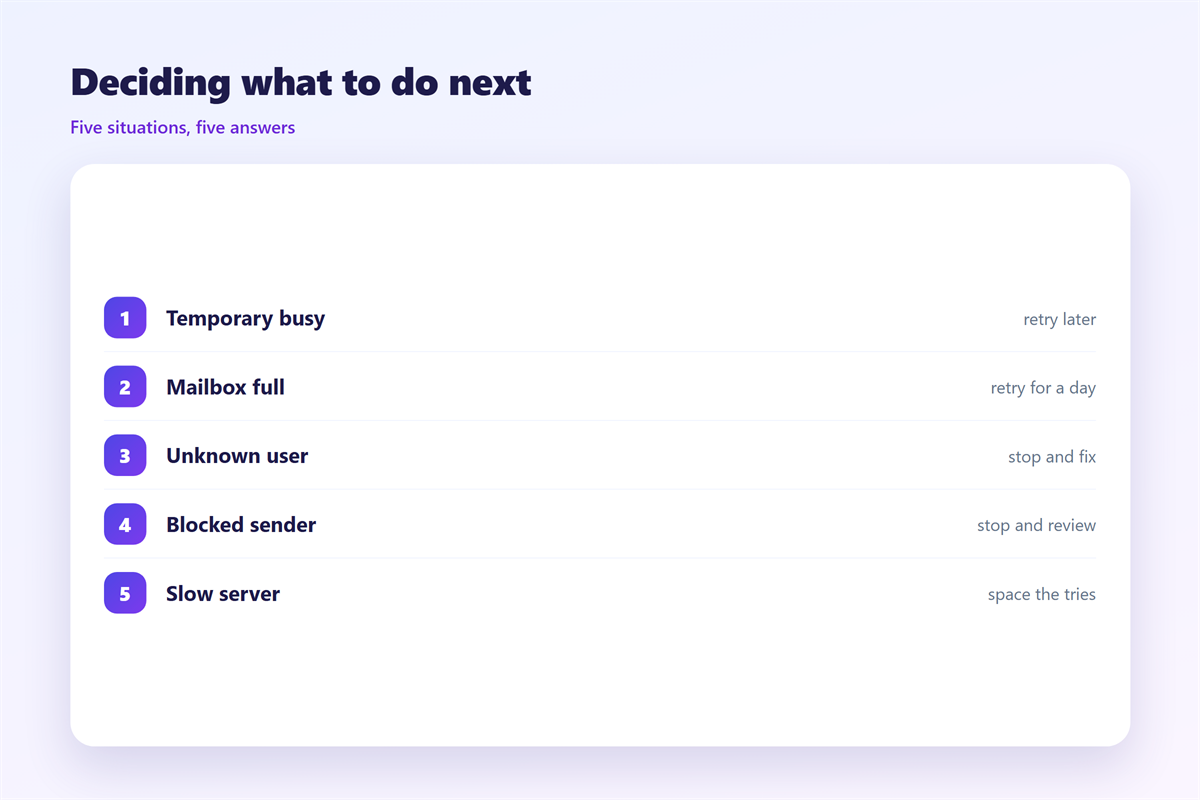
A 5xx reply means the server refused for good. Retrying it usually hurts your reputation.
A 4xx reply means try again later. The mailbox was busy or the link dropped.
A timeout sits in the middle. The message may have arrived already.
That last case is the dangerous one. A blind 邮件重试 can create a duplicate.
Read the first digit, then the words. The first digit usually decides your action.
A 4xx from one server is normal. The same code repeated everywhere is not.
Watch the pattern, not the single event. Trends tell you when to stop.
So match the 邮件重试 to the code. A generic rule misses that detail.
Keep the raw reply for a day. It is the only honest record you will have.
How to space 邮件重试 attempts
Do not retry in a tight loop. That pattern looks like an attack to a filter.
Use a growing gap instead. Wait a few minutes, then an hour, then several.
Spread the load across your queue. Five bursts a second will trip a rate limit.
Set a hard ceiling too. Six attempts over two days is usually enough.
Stop after the ceiling and report the failure. Silent giving up is the worst option.
Every sender needs a different budget. A billing alert deserves more tries than a digest.
Write the budget down. A rule nobody can read is a rule nobody follows.
Every 邮件重试 also costs a little reputation. Spend that budget with care.
When 邮件重试 creates duplicates
A duplicate is often worse than a delay. The reader sees two copies of the same note.
Give each message a stable identifier. The receiving side can then drop a repeat.
Mark the message before the first send. A record prevents a second attempt.
Check the outbox before you resend by hand. Many duplicates start with a worried click.
A short hold before the first try helps. It gives you time to cancel.
When to stop and rewrite
Some failures need a new message, not a new attempt. A bad address will never accept mail.
Check the address before the next 邮件重试. One typo explains many hard failures.
A blocked sender needs a different fix. Retrying only confirms the block.
A wrong 邮件重试 can bury a good address. Some servers block after too many tries.
Rewrite, then send once. That is often faster than a long retry chain.
Tell the sender what happened. A short note beats a silent failure.
Remove dead addresses from the list. A clean list needs fewer retries.
Sending safely
Keep a record of every attempt. The log answers questions later.
Separate marketing and transactional mail. They deserve different rules.
Watch your bounce rate after each change. A small rise can signal a real problem.
Pause the whole queue during an outage. A storm of retries helps nobody.
Warm a new address slowly. A fresh domain has little trust to spend.
Keep an eye on the queue length. A growing queue is an early warning.
Whitelist your own test address. A simple test catches a broken rule.
A short checklist
Before you enable any rule, test it. Send to a bad address and watch.
Confirm the gap grows. Confirm the ceiling holds.
Confirm a duplicate cannot slip through. Confirm the log records it all.
Then leave it alone. A stable rule beats a clever one.
Common mistakes
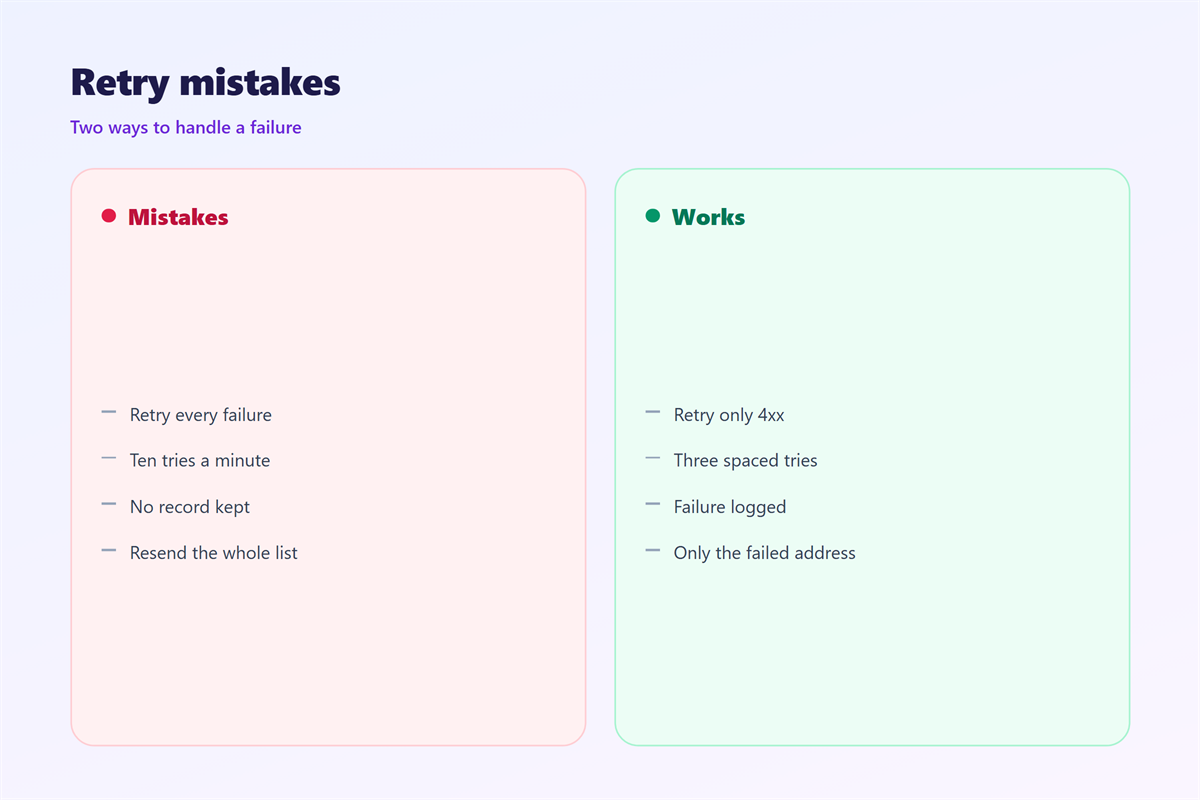
One mistake is retrying everything. It floods a server that is already busy.
Another is retrying nothing. A short outage then loses real mail.
A third is hiding the log. Nobody can fix what nobody can see.
A fourth is copying a rule blindly. Every sender has a different pattern.
Review the rules twice a year. Old settings drift out of date.
Related reading
邮件重试 works best with the other delivery tools. The early checks in our notes on 邮件发送失败 catch problems before they happen. The meanings in 邮件错误代码 tell you which reply to trust. The split described under 邮件退信 explains hard and soft failures. The waiting described under 邮件队列 is where a retry actually happens.
FAQ
Should 邮件重试 always be automatic?
Only for transient errors. A hard failure needs a human decision.
How many attempts are safe?
Five or six over two days. More attempts rarely change the outcome.
Can a retry look like spam?
Yes, if it is fast and repetitive. Slow the pace and watch your reputation.
What happens after the last 邮件重试?
Log it and notify the sender. A quiet failure is the one people never forgive.
References
- IETF RFC 5321: Simple Mail Transfer Protocol
- Google: Email sender guidelines
- Wikipedia: Simple Mail Transfer Protocol
评论
还没有评论,来说两句吧。
评论功能已关闭。