 小影邮箱
邮箱后缀是什么?What the Domain After @ Says
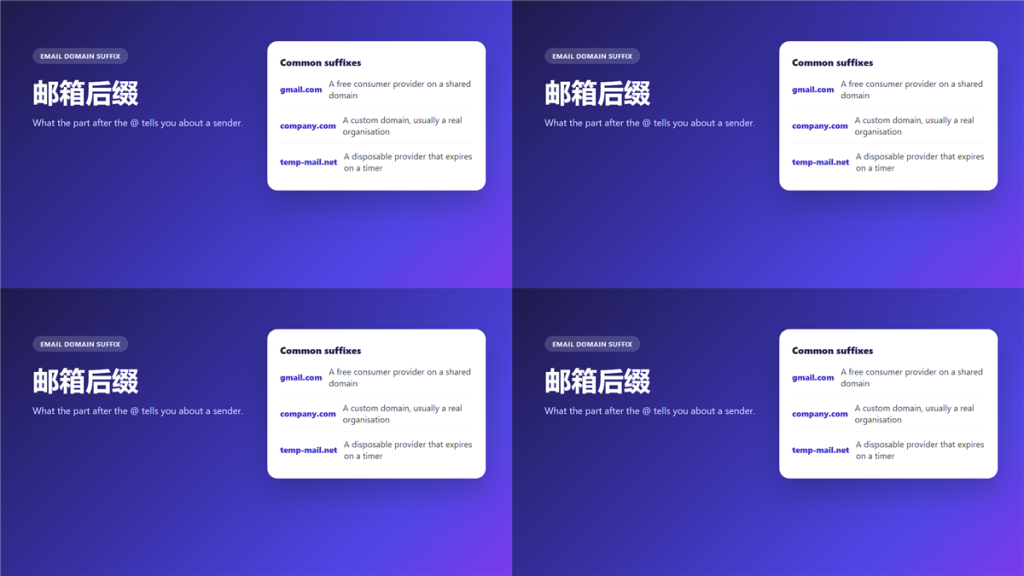
What 邮箱后缀 actually tells you
邮箱后缀 is the part after the @, and it is the only part of an address that a sender cannot invent freely. The local part is chosen by whoever registered the mailbox, and the domain has to exist.
A supplier once wrote to me from an address ending in a free provider while claiming to represent a company with its own website. The message was friendly, and the 邮箱后缀 was the whole tell.
Key Takeaways
- 邮箱后缀 is the domain that follows the @ sign.
- Free providers are shared by millions, so the domain says little.
- A corporate suffix should match the company website exactly.
- Disposable suffixes rotate, and many expire within hours.
- Lookalike domains sit one character away from a brand.
- Country suffixes narrow the origin, not the intent.
The five 邮箱后缀 families
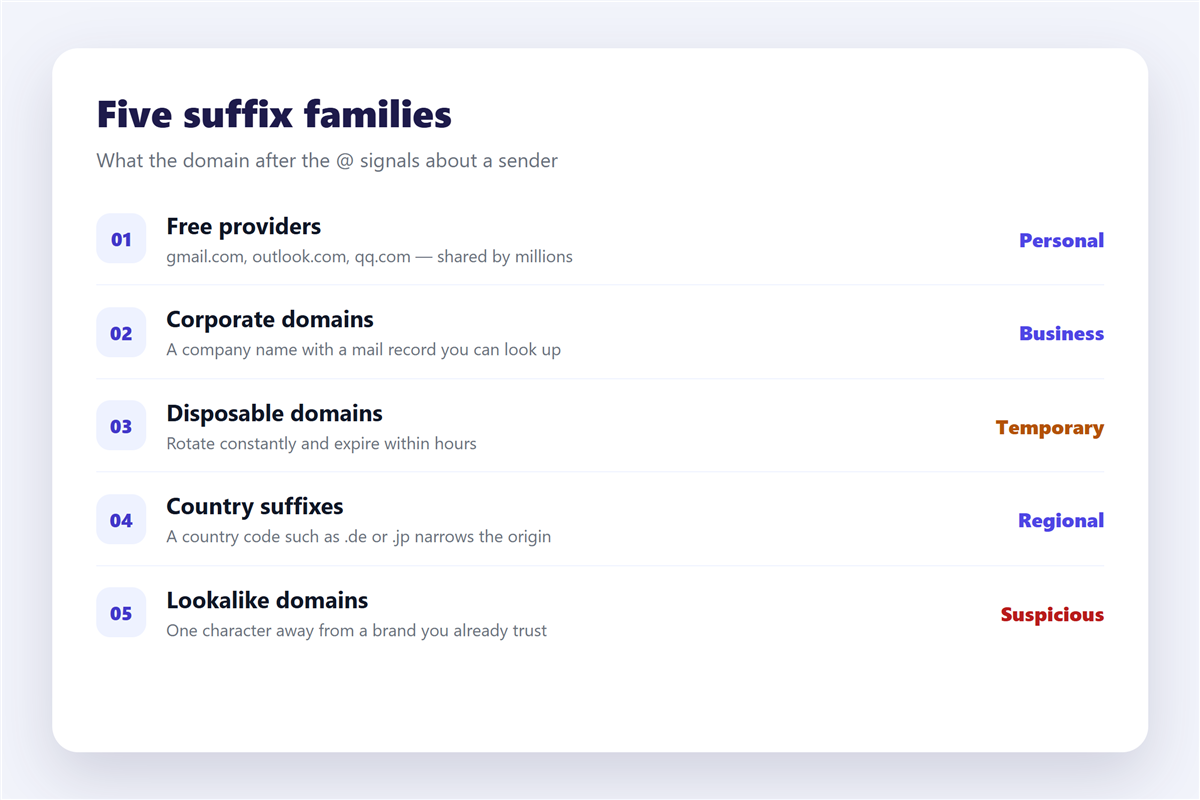
Almost every address sorts into one of five groups, and each group carries a different amount of information.
Free providers
Addresses ending in gmail.com or outlook.com belong to a provider with hundreds of millions of users. Therefore the suffix proves almost nothing about the person, and it proves a great deal about the provider.
Corporate domains
Here the suffix should match the organisation website exactly, character for character. Notably, a difference of one letter is the most common impersonation trick in business mail.
Disposable domains
These rotate constantly, because the value of the service is that the address stops working. Consequently a suffix you have never seen before may be a signup tool or a throwaway, and the line between the two is genuinely thin.
Country suffixes
A country code such as .de, .jp or .uk narrows where the domain is registered. However, registration location is not the same as where a person lives or where a server runs.
Subdomains and lookalikes
A suffix can contain extra labels, so mail.example.com is a subdomain of example.com. In contrast, mail-example.com is an entirely separate domain that anyone can buy.
How to read a 邮箱后缀 in three checks
- Read the last two labels and compare them with the official website.
- Look for a hyphen, a doubled letter or a swapped pair inside the brand name.
- Check whether the domain resolves at all, because some throwaway domains never publish a website.
If the suffix passes all three checks and the mail still feels wrong, the headers will settle it, and the field-by-field guide is in 钓鱼邮件. For the grammar of the whole address, including the local part, see 邮箱地址格式.
Why a custom 邮箱后缀 changes the trade
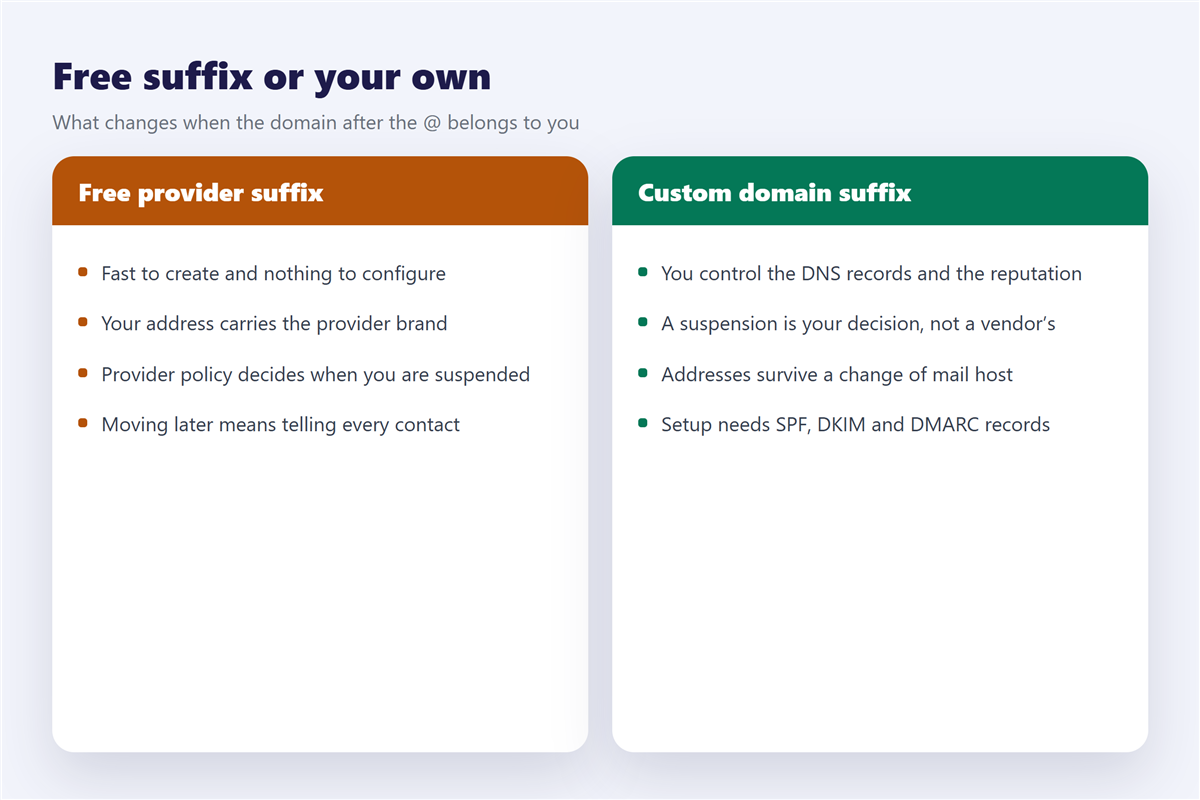
Owning the domain moves control of the suffix from a vendor to you.
Because the suffix is yours, it survives a change of mail host and keeps its reputation across migrations. In addition, you decide when an address is retired, rather than waiting for a provider policy to change. The setup needs DNS records, and the details are in 邮箱域名.
The cost is administrative. Someone has to renew the domain, keep the authentication records correct, and close addresses when people leave. That work is the reason many small teams stay on a free suffix, and the trade-offs are compared in 邮箱多账号.
邮箱后缀 and trust signals
Receivers treat the suffix as one input among many, and it is rarely decisive on its own.
Authentication records attached to the suffix carry more weight than the age of the domain, for example. Meanwhile, a brand new domain that sends ten thousand messages in its first week is judged on that pattern rather than on its name. The records that matter are explained in 邮件认证.
Two suffixes need special handling. A disposable domain is fine for a signup and wrong for an account you intend to keep, which is the argument in 虚拟邮箱. A subdomain is fine for sending and confusing for humans, so keep the visible address short, as described in 邮箱小号.
Frequently asked questions
Can two people share one 邮箱后缀?
Yes, and on free providers millions do. The suffix identifies the mail system, not the person.
Does a corporate 邮箱后缀 prove the sender is an employee?
No. It proves only that someone controls a mailbox on that domain, which is why the rest of the message still matters.
Is a country 邮箱后缀 safer?
Not inherently. It narrows registration, and fraud uses local domains precisely because they look familiar.
What if the 邮箱后缀 belongs to a brand I know?
Then compare the spelling against the official site. One changed character is the entire technique.
评论
还没有评论,来说两句吧。