 小影邮箱
邮箱地址格式怎么看?Parts, Rules and Common Mistakes
What 邮箱地址格式 actually covers
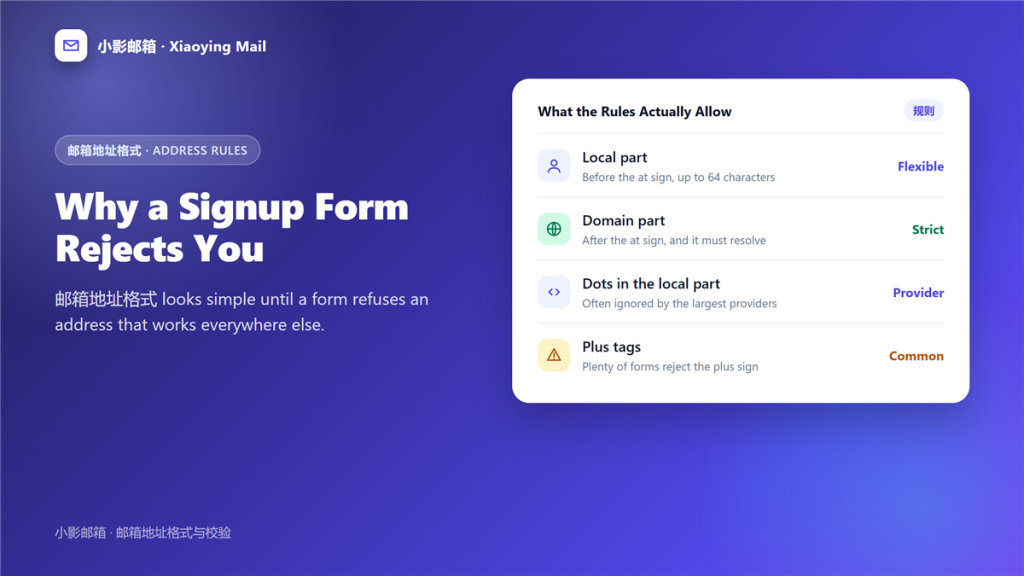
邮箱地址格式 is usually described as a naming rule, and it is really a delivery rule. It decides which mailbox receives a message and which server is asked to deliver it.
A reader once lost an afternoon to a signup form because a trailing space had travelled with her address through three copy and paste steps. The address looked correct on screen, and the format was still wrong in a way no human eye could catch.
Key Takeaways
- 邮箱地址格式 is the local part, the @ sign and the domain.
- Exactly one @ is permitted, and no spaces anywhere.
- Letters, digits, dots, underscores, hyphens and a plus sign are legal.
- A dot cannot start, end or double up in the local part.
- The local part stops at 64 characters.
- A valid 邮箱地址格式 can still be undeliverable.
- Disposable addresses follow exactly the same rules.
The three parts of 邮箱地址格式
Read an address from left to right and the structure falls out immediately.
The local part
Everything before the @ belongs to the mailbox, and its meaning is defined by the receiving server rather than by any global standard. Therefore two providers can hand the same string to two different people, which is why an address is only meaningful together with its domain.
The @ sign
The @ separates the mailbox from the server, and exactly one is allowed. Notably, a second @ created by a careless forward is the most common reason validation fails.
The domain
Everything after the @ must be a real domain with a working mail record. Consequently, a flawless local part attached to a domain that does not exist will never receive anything.
Which characters a 邮箱地址格式 allows
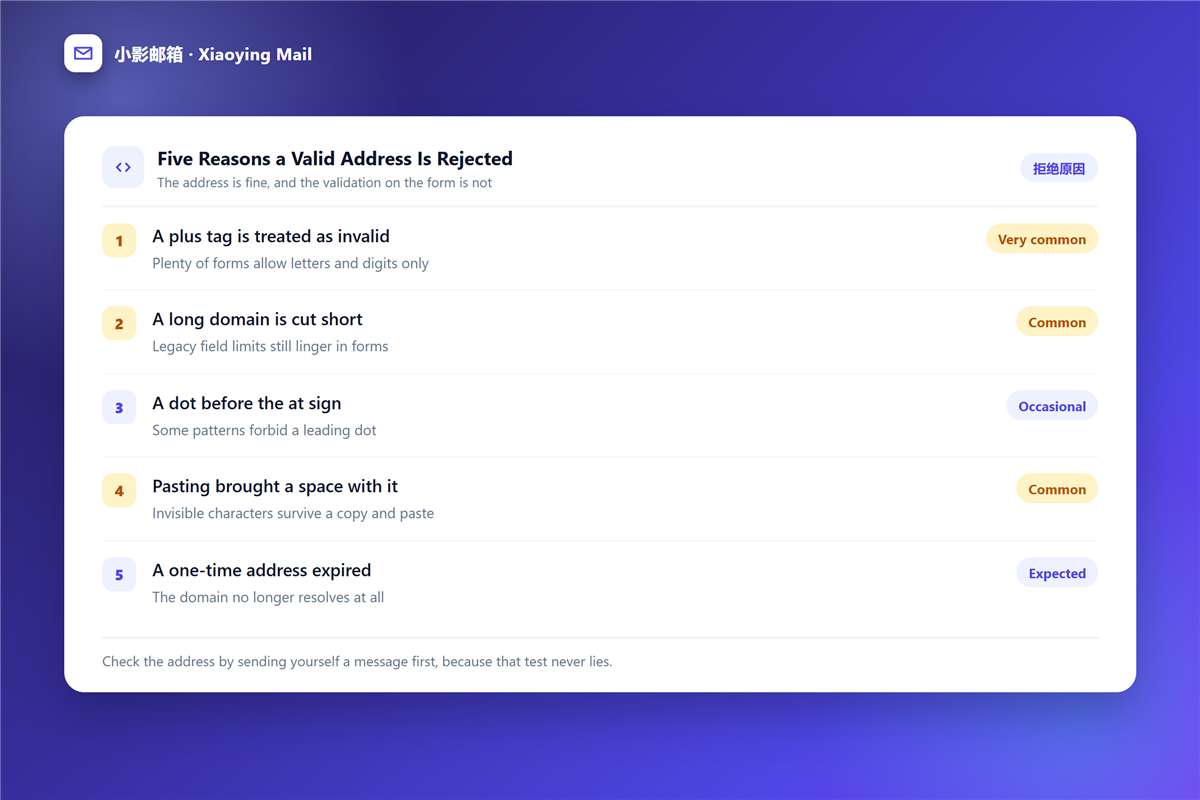
The standard is more permissive than most signup forms suggest, and the exceptions are the interesting part.
- Letters A to Z, in either case.
- Digits 0 to 9.
- Dots, provided they do not lead, trail or double up.
- Underscores and hyphens.
- A plus sign, which most providers treat as a tag separator.
Because many servers ignore everything after a plus sign, [email protected] and [email protected] usually reach the same inbox. In particular, that trick is worth knowing before you open a second mailbox. If you use a domain you own, confirm the mail records first, as described in 邮箱域名.
How long a 邮箱地址格式 can be
Two limits apply, and both are lower than people assume. The local part may not exceed 64 characters, and the whole address may not exceed 254. Furthermore, most providers tighten that further at signup, where 30 to 64 characters is a common ceiling.
Length matters because truncation is silent. An over long address can be dropped by an intermediate server without any error reaching the sender.
Why a valid 邮箱地址格式 gets rejected
When a form refuses an address that looks fine, the cause is almost always one of three things.
A hidden space
Spaces are illegal everywhere in an address, and pasted text carries them invisibly. Additionally, a full width @ typed on a Chinese keyboard produces the same silent failure.
A misspelled domain
gmial.com is a perfectly legal 邮箱地址格式 and a perfectly useless one. Therefore validation passes while the mail still disappears, which sits behind most complaints that an address looks right but nothing arrives.
A duplicate separator
Two @ signs, or a trailing dot after the domain, both fail. However, some clients accept them at entry and only fail at send time, which makes the error far harder to trace.
Disposable addresses use the same 邮箱地址格式
There is no separate syntax for a temporary address. It follows the same three part structure, the same character rules and the same length caps. The difference is ownership, because the domain belongs to a provider that can stop receiving at any moment. Consequently, passing validation says nothing about how long the address will keep working. The boundaries are covered in 匿名邮箱, and the practical timing in 临时邮箱.
A three step check before you trust an address
- Count the @ signs. Exactly one, with both sides non empty.
- Read the domain aloud. Most typing errors survive a quick glance.
- Send a test message. A bounce is more informative than any format check.
If the address came from a contact list rather than from typing, first confirm that it was not edited in transit. For bulk work, the routine in 邮箱联系人 is quicker than checking entries one by one.
Frequently asked questions
Is 邮箱地址格式 case sensitive?
The local part is technically case sensitive and practically not, and domains never are.
Can a 邮箱地址格式 use Chinese characters?
Only through the internationalised encoding. Typing Chinese characters directly into a signup field usually fails.
How many recipients can one 邮箱地址格式 reach?
One address targets one mailbox. Visibility across several recipients is a separate question, answered in 邮件抄送. For the wording of a first message, see 邮件礼仪.
References
- Wikipedia: Email address
- RFC 5322: Internet Message Format
- RFC 3696: Application Techniques for Checking Email Addresses
评论
还没有评论,来说两句吧。