 小影邮箱
邮箱注册怎么做?Choices That Are Hard to Undo
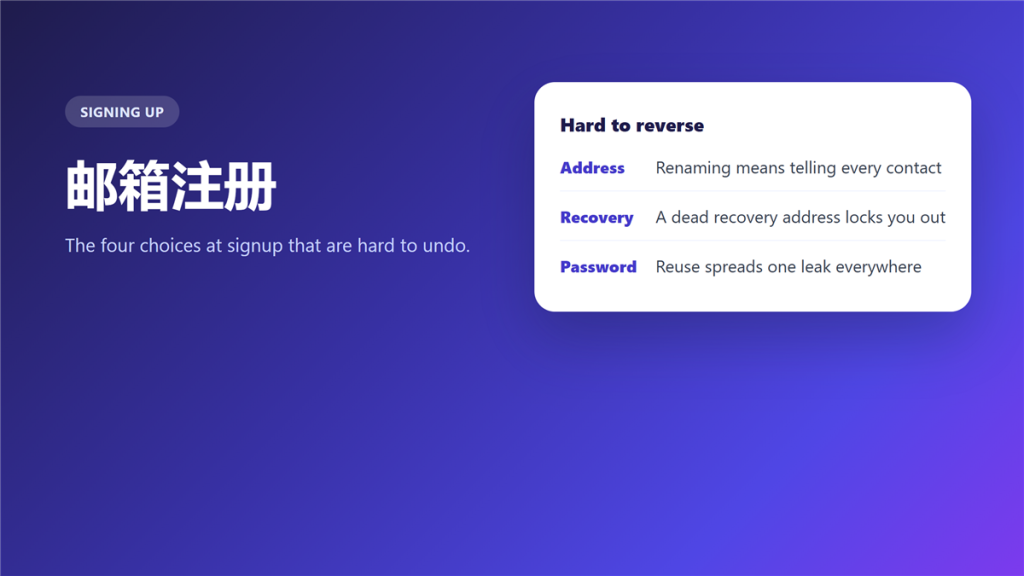
What 邮箱注册 decides for you
邮箱注册 takes two minutes and settles questions you will live with for years. The address you type, the recovery route you pick and the password you set are all far harder to change than to get right once.
A friend registered a business address at midnight using an old phone number she was about to give up. Two years later that 邮箱注册 came back to her as the only obstacle between her and a tax portal she could not open.
Key Takeaways
- 邮箱注册 is quick, and its consequences are not.
- The recovery route matters more than the password.
- A unique password per account is the baseline.
- Turn on the second factor at signup, not after the first scare.
- Permanent and disposable addresses do different jobs.
- Check whether the account can be exported before you commit.
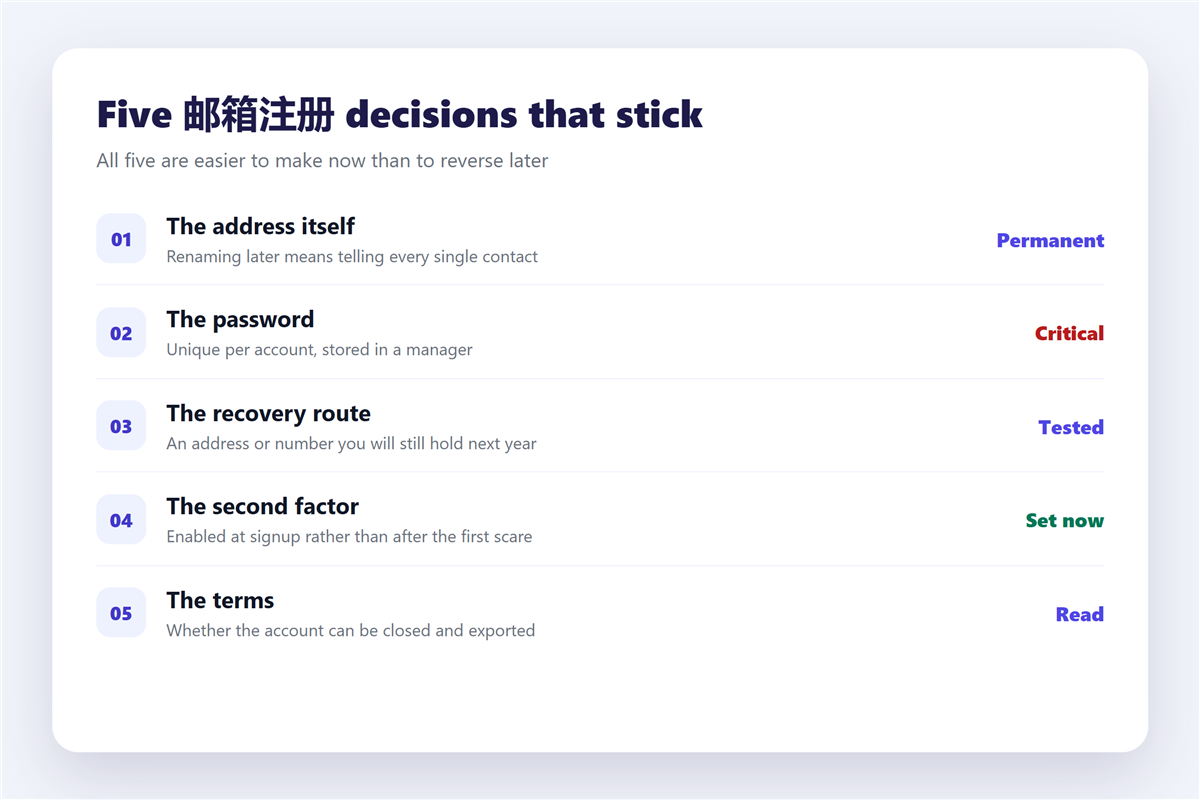
Five 邮箱注册 decisions that stick
- The address itself, because renaming means telling every contact.
- The password, which has to be unique to this account.
- The recovery route, which must still work in a year.
- The second factor, enabled at signup rather than later.
- The provider terms, including whether mail can be exported and the account closed.
Of the five, the recovery route is the one people get wrong most often. Therefore it is worth testing it in the same week rather than in the same year. The rules behind the password are in 邮箱密码, and the options for the second factor are compared in 两步验证.
Why recovery is the real risk in 邮箱注册
A forgotten password is recoverable. A dead recovery address is not.
Because most providers send the reset link to a backup address or a phone number, that backup becomes the single point of failure for everything behind the account. Notably, an old university address that expires in June will quietly take your access with it. If a leak is the worry rather than a lockout, the response steps are in 邮箱泄露.
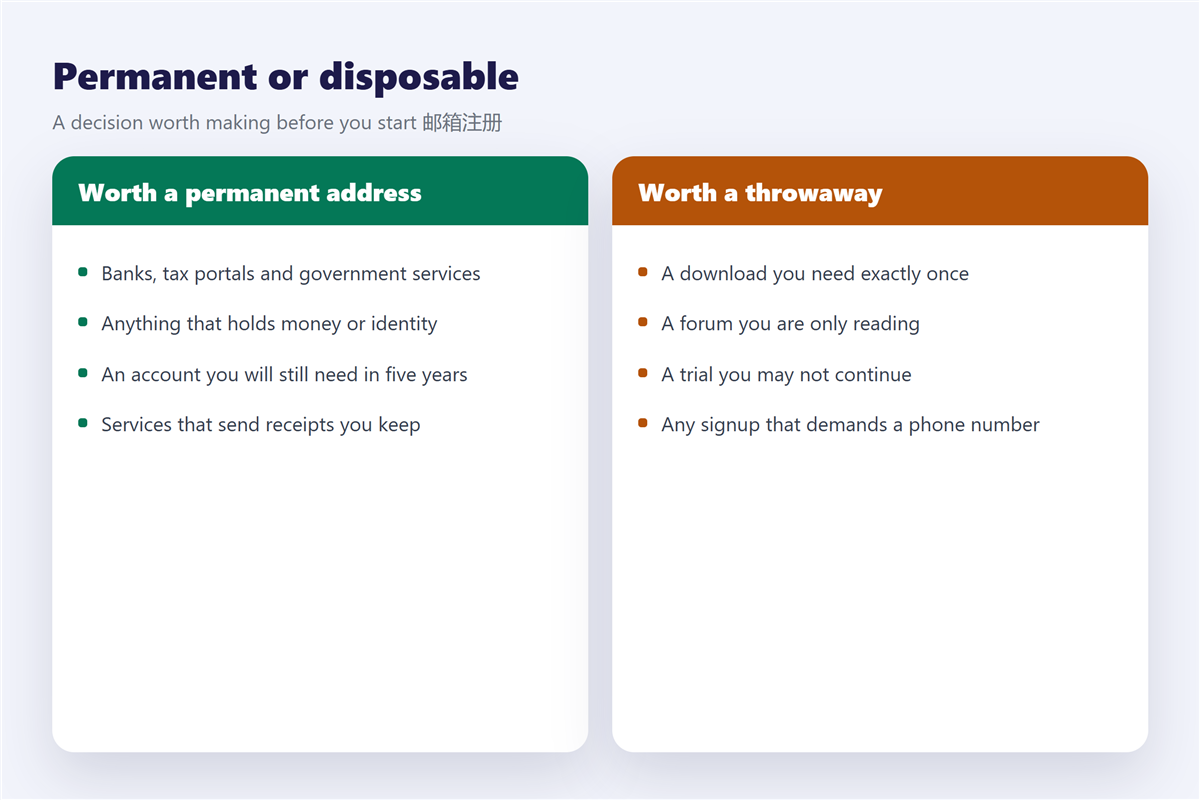
Permanent address or disposable one
The choice should follow what the account will hold, not what the signup form happens to demand.
Where a permanent address pays
Anything that holds money, identity or a long running subscription deserves one. In addition, the earlier you need the account, the more a stable address is worth.
Where a throwaway is enough
A one time download, a forum you only read or a trial you may abandon does not justify a permanent address, and a temporary mailbox fits better. The practical guide is in 临时邮箱. When you need a lasting address without a lasting identity, the middle option is described in 虚拟邮箱.
What to check before you finish 邮箱注册
Four checks take a minute and save an afternoon later.
First, read the address back aloud, because a typo at this stage is permanent. Second, confirm the provider offers export, since a mailbox you cannot leave is a mailbox you cannot safely use. Third, note whether the signup demands a phone number, because some services quietly refuse certain number ranges. Fourth, confirm the address follows the rules the provider enforces, which the structure guide in 邮箱地址格式 explains.
Frequently asked questions
Can I change my address after 邮箱注册?
Some providers allow it and most do not. Treat the address as permanent while you type it.
Is a free provider fine for 邮箱注册?
For personal use, usually. For anything customer facing, a domain of your own is safer.
How many addresses does 邮箱注册 require?
Two is often enough: one for identity and money, one for everything else.
Should 邮箱注册 use my real name?
Only where the service has a legitimate need for it. Elsewhere a plain, unmemorable label is fine.
评论
还没有评论,来说两句吧。以下为本文的引用通告: