 小影邮箱
邮件免责声明怎么写?The Fine Print
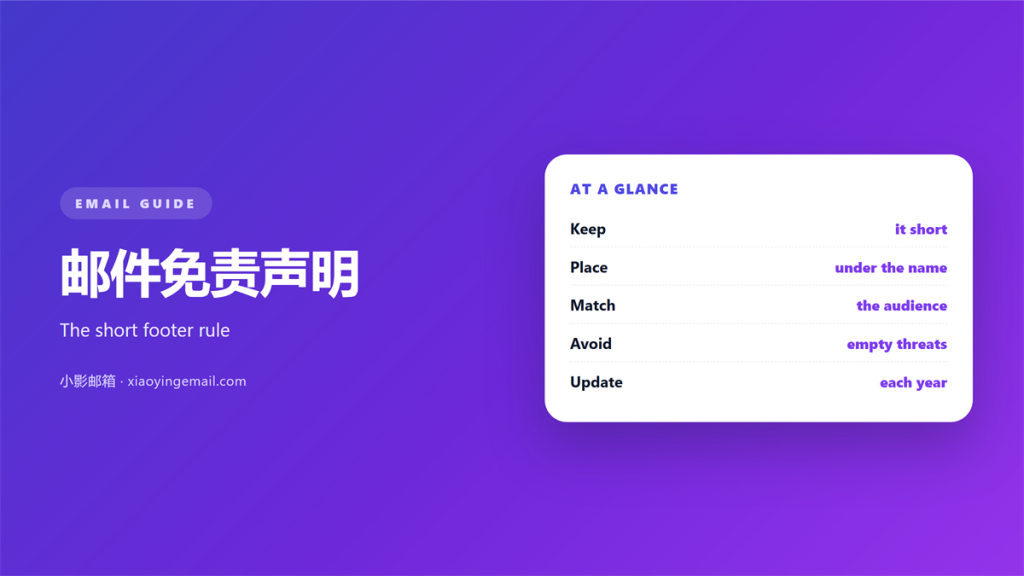
Key Takeaways
- 邮件免责声明 is a short note at the foot of a message.
- A 邮件免责声明 must match what you really do.
- Short plain wording beats dense legal phrasing.
- Match the words to the risk you really face.
- Review the text as your work changes.
What 邮件免责声明 really means
邮件免责声明 is the fine print that sits at the bottom of an email.
People often add it out of habit and never read it again.
A good one explains a fact the reader cannot see for themselves.
A weak one simply repeats what everyone already knows.
Readers notice length before they notice meaning. A long note signals that something is being hidden.
It is not a shield that erases all liability. A court weighs conduct and context, not just words.
So treat it as a label, not a legal force field. It shapes expectations more than it wins cases.
The line between help and noise is thin. Clarity is what keeps you on the right side.
Write for a reader who is in a hurry. Short plain sentences beat long legal phrasing.
Every extra clause is one more thing to maintain. Keep only what earns its place.
A useful 邮件免责声明 answers a real question. It never tries to hide a problem.
Where a 邮件免责声明 helps
There are two clear cases where a 邮件免责声明 does real work.
For a private note
Some messages carry a fact that could be misused later.
A short line can warn the reader that the note is private. It asks them not to forward it onward.
It cannot stop a careless reader, but it can set the right expectation.
That single line is cheap and quick. It costs almost nothing to add.
For an automated reply
Mailing lists and ticket desks send mail on their own.
A footer can explain that no one reads that address. It can point to a better way to reach a human.
That saves a reader from waiting for a reply that will never come.
Think about who reads the mail first. A brand new client may read it very differently.
Here the 邮件免责声明 is genuinely useful. It prevents a real and common confusion.
So ask what confusion the note removes. If the answer is nothing, cut it.
Where a 邮件免责声明 adds new risk
A badly written note can hurt more than it helps.
Vague wording
Loose phrases promise things you cannot deliver. They invite a reader to expect far more than you meant.
A line that claims confidentiality may not match how you store mail. That gap is the real problem.
Words copied from a template can contradict your own policy. A sharp reader will notice the clash.
Too much text
A wall of fine print pushes the message down the page. Most readers simply scroll past it.
Long blocks also lift the spam score of a message. Filters tend to dislike heavy boilerplate.
So a bloated 邮件免责声明 can hide the point and hurt delivery at once.
Keep the note to a few lines at most. If it needs a scroll, it is too long.
Writing a 邮件免责声明 people trust
Good wording follows a few plain rules.
Say one clear thing rather than five vague ones.
Use the same plain language you use in the body. A sudden change of tone can look fake.
Tell the reader what to do, not just what to avoid. A clear next step helps everyone.
Place it where it does not fight the message. The end of the mail is its natural home.
Keep the format plain and readable. A single small line usually beats a grey block.
Good wording keeps a 邮件免责声明 honest and short. It earns trust instead of suspicion.
Test it on a colleague before you roll it out. A fresh reader spots the odd phrase fast.
Then check how it looks on a phone screen. Most people read mail on a small device.
Keep one version for the whole team. Everyone then says the same thing.
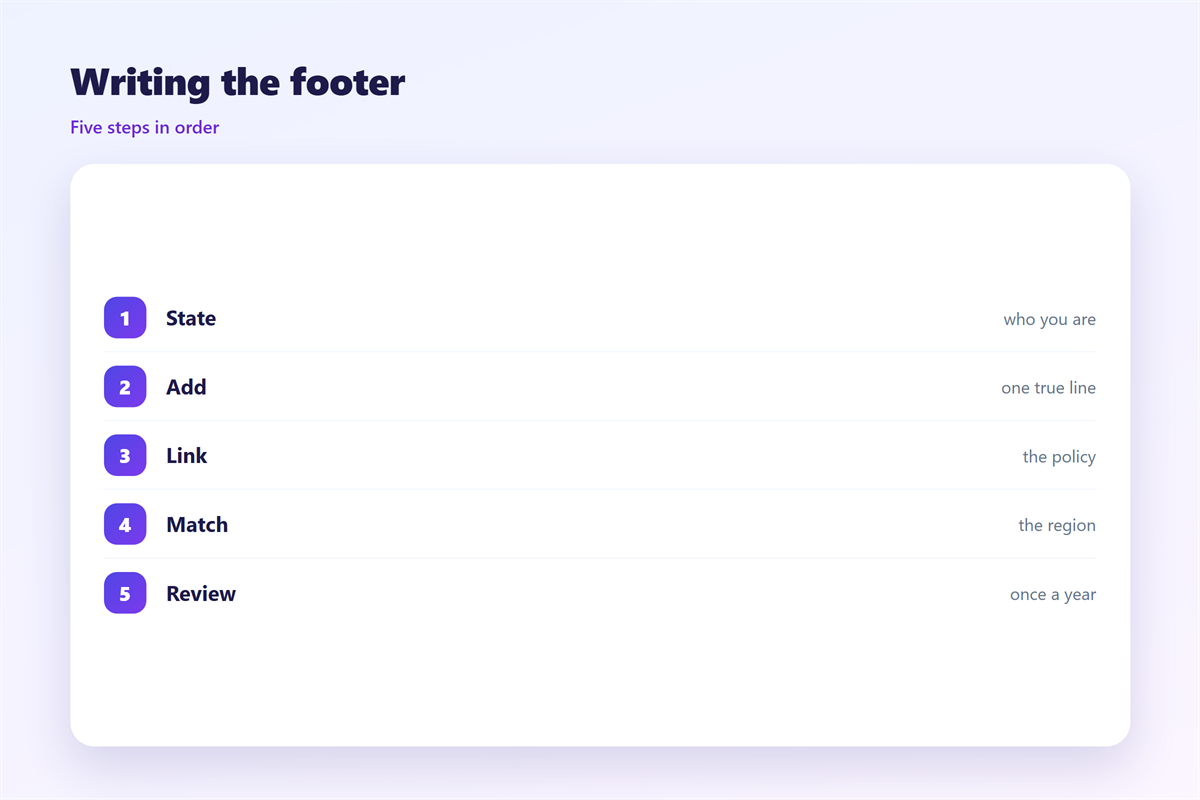
Keeping 邮件免责声明 current
A note written once can drift out of step with reality.
Set a simple review each year. A regular check catches stale promises early.
Know what gives a message real legal weight. The rules are set out in 邮件法律效力.
See how a closing block should be built. The basics are covered in 邮件签名.
Keep the wording consistent across the team. The shared rules live in 邮件签名规范.
Decide what the last lines should carry. The options are described in 邮件页脚.
Then keep the note as short as it can be. A living 邮件免责声明 is clearer than a fossil.
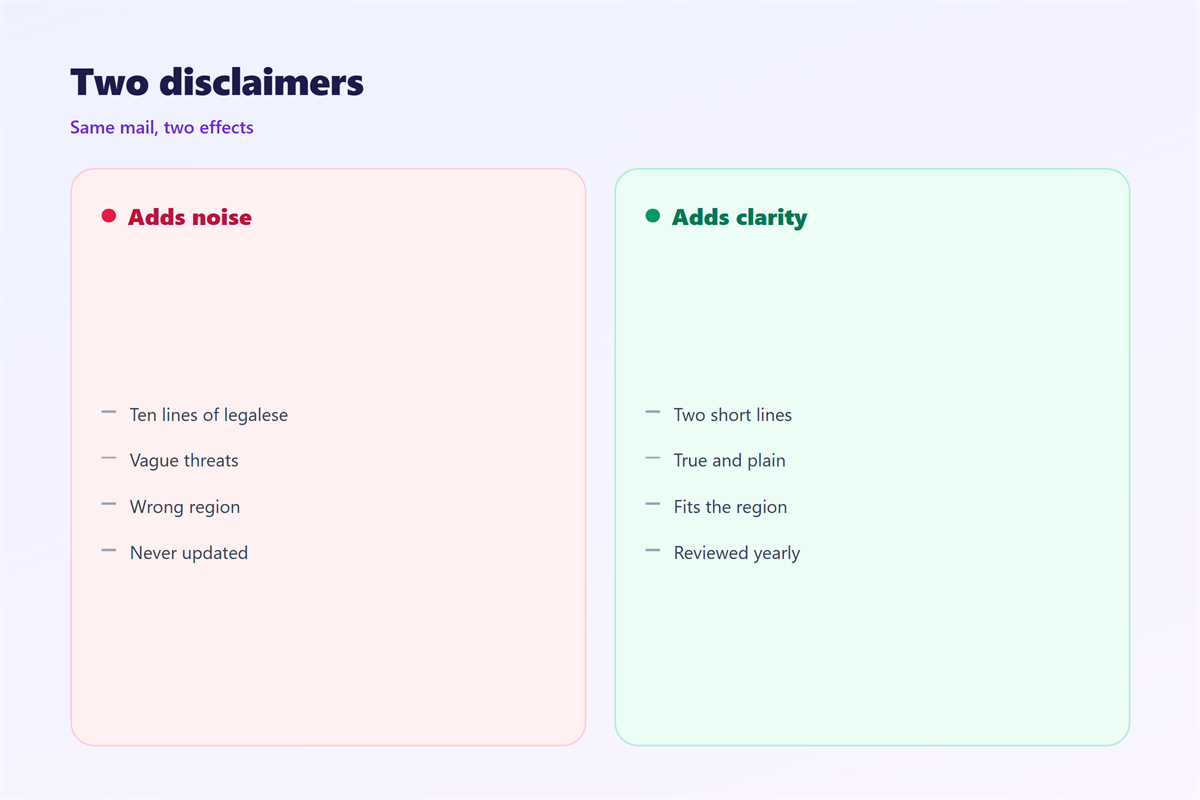
What to keep out
Some phrases do more harm than good.
Read the note aloud before you save it. An awkward phrase is easier to hear than to see.
Drop any claim you cannot back with a real process.
Avoid threats that you would never enforce. They only make the message sound hostile.
Cut legal jargon that a normal reader cannot parse. Plain words carry the same weight.
Remove duplication with the body of the message. Repeating the same point adds noise.
Skip anything that only protects the writer’s ego. A reader can smell insincerity quickly.
A lean 邮件免责声明 is easier to trust. It says only what it must.
FAQ
Is a 邮件免责声明 legally binding?
Not by itself. It sets expectations, but conduct and context still decide the outcome.
Does it protect a confidential note?
Only partly. It warns the reader, yet it cannot stop a determined person from sharing.
How long should the note be?
As short as possible. A few clear lines beat a long block of fine print.
Where should the 邮件免责声明 sit in the mail?
Near the end, below the body. That is where a reader expects to find it.
References
- EFF: Email privacy and encryption
- IETF RFC 5322: Internet Message Format
- Litmus: Email design research
评论
还没有评论,来说两句吧。
评论功能已关闭。