 小影邮箱
邮件标题党怎么避?Titles Without Tricks
Key Takeaways
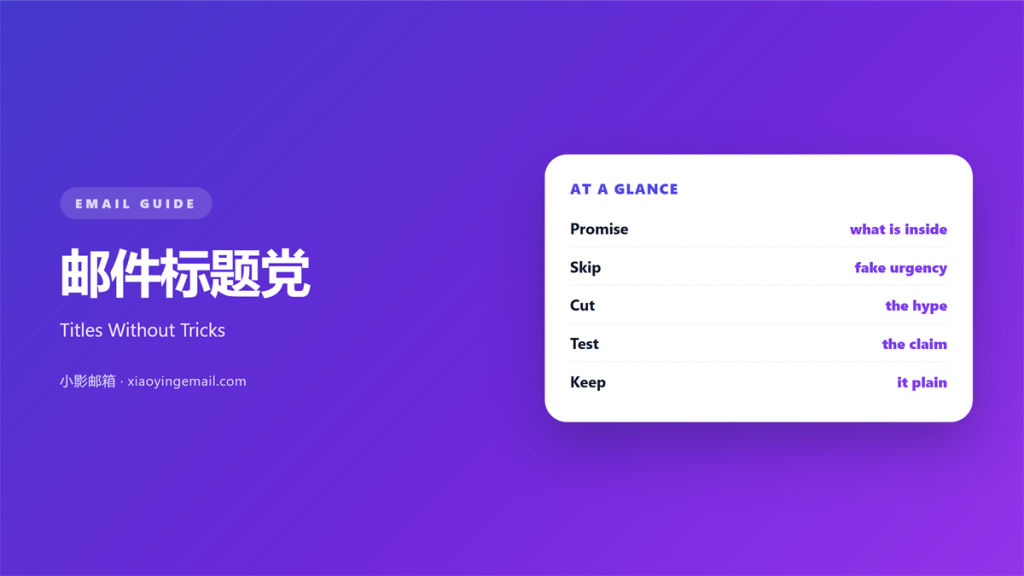
- 邮件标题党 promises more than the mail delivers.
- It wins one open and loses the reader behind it.
- Fake urgency and vague hints are the usual forms.
- Write the subject after the body, not before.
- Check the preview text against the first line.
What 邮件标题党 means
邮件标题党 is a subject line that oversells the message.
The words promise a reward the mail does not contain.
Sometimes the promise is a discount that does not exist.
Sometimes it is a warning about an account that is fine.
Sometimes it is a vague hint with no answer inside.
The open rate may rise for a day.
The trust falls for much longer.
That trade is almost never worth it.
邮件标题党 is a debt the next mail has to pay.
Why 邮件标题党 costs you
The first cost is attention that turns into annoyance.
A reader who feels tricked stops reading the next mail.
The second cost is the complaint button.
Complaints damage the reputation of the sending domain.
That damage lowers delivery for every future mail.
The third cost is the unsubscribe.
One trick can remove a reader who once opened everything.
Good 邮件标题党 avoidance protects all three.
It also keeps the open rate honest.
An honest open rate tells you what actually works.
A reader who trusts the subject opens the next one faster.
The open is not the goal
An open is a step, not a result.
The goal is a reply, a click, or a purchase.
A trick raises the step and lowers the result.
Measure the whole path, not the first number.
When 邮件标题党 appears
邮件标题党 appears when a team is measured on opens.
A weekly target pushes writers toward stronger words.
It appears again when the mail has no clear point.
A weak offer hides behind a loud subject.
It also appears when a template is copied without thought.
Old wording keeps the old tricks alive.
Watch for it near a campaign deadline.
Pressure is where the shortcuts start.
Four common shapes
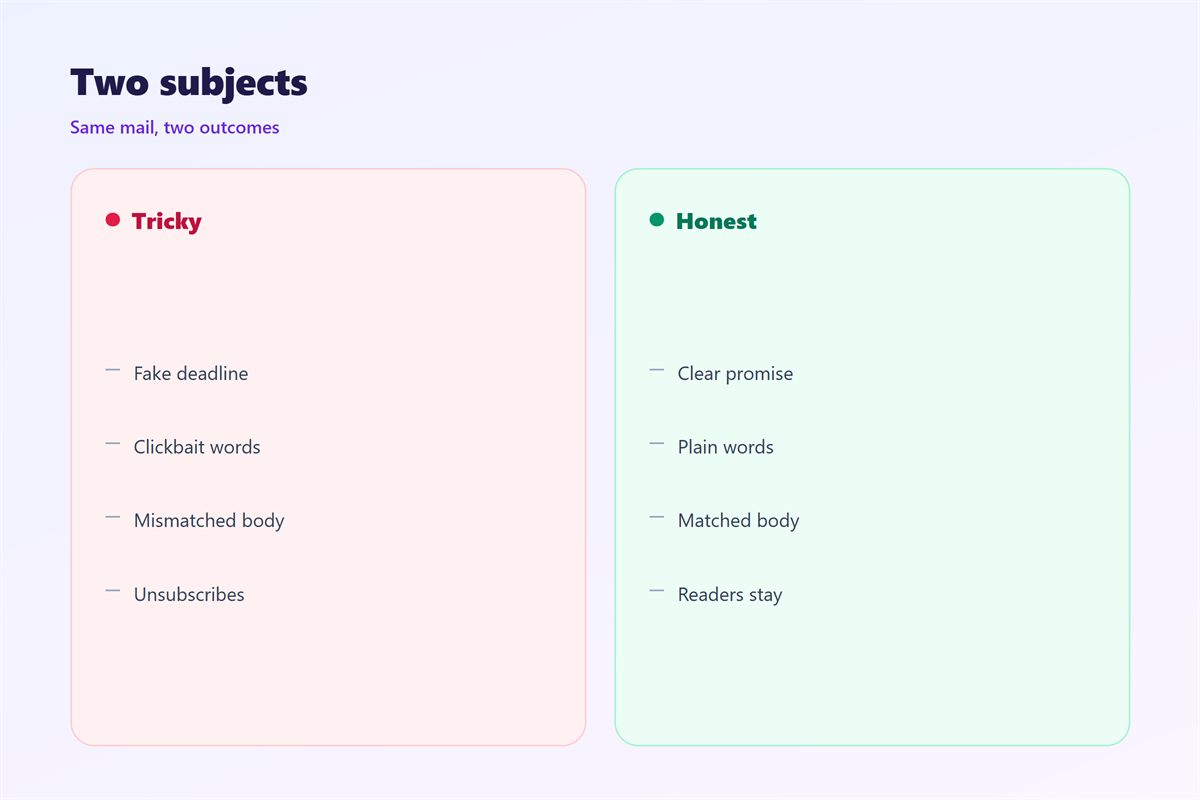
The first shape is fake urgency.
The second is a personal line that is not personal.
The third is a question the mail never answers.
The fourth is a reply marker added to look like a thread.
Each one buys a click with a small lie.
When 邮件标题党 hurts
邮件标题党 hurts most when the list is small.
Every reader is a person you might meet again.
It hurts when the brand is still unknown.
Trust has to be built before it can be spent.
It hurts again in a transactional mail.
A receipt with a tricky subject looks like a phishing attempt.
And it hurts when the same trick repeats.
The second time, the reader recognises the pattern.
After that, the mail goes straight to the bin.
Tricks also train the reader to look for the exit.
邮件标题党 and trust
Trust is the gap between the promise and the mail.
A narrow gap keeps readers comfortable.
A wide gap teaches them to expect disappointment.
So keep the subject close to the first line.
If the subject says “three fixes”, show three fixes.
If it names a date, use that date inside.
Say the plain thing
A plain subject is easy to defend and easy to repeat.
It also survives forwarding without embarrassment.
Ask whether you would say the line out loud to a client.
If not, rewrite it before sending.
How to avoid 邮件标题党
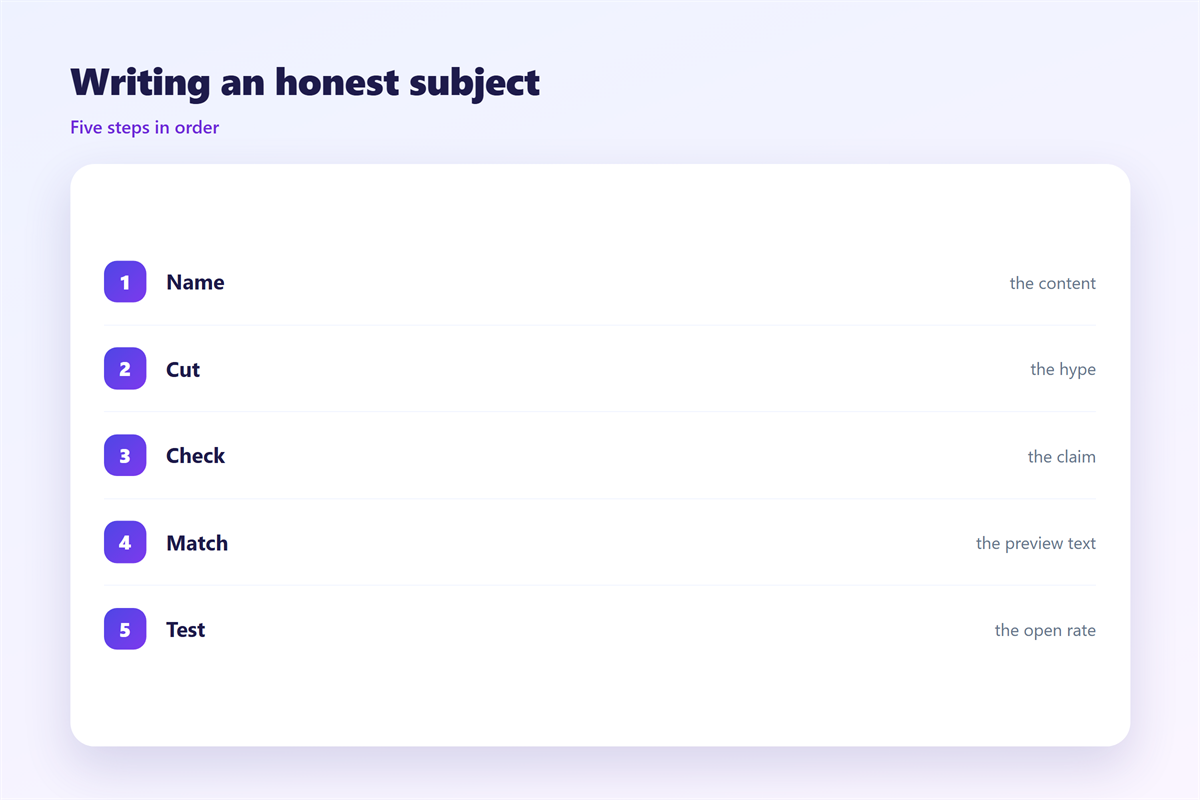
Write the body first and the subject last.
Then pick the most useful fact in the body.
Put that fact in the subject with no decoration.
Use a number only when it is exact.
Use a name only when the reader knows it.
Keep the line under fifty characters where you can.
Skip capitals, extra punctuation, and fake reply markers.
Then read the subject and the first line together.
They should feel like one sentence split in two.
If they argue, the subject is the problem.
Keep a short list of approved openings for the team.
Test it on a colleague
Show the subject without the mail.
Ask what they expect to find inside.
Then show the mail and ask if it matched.
Two honest answers are worth more than a test send.
Repeat this before every campaign.
邮件标题党 in preview text
The preview text is the second half of the promise.
Many senders repeat the subject there.
That wastes the only free space you have.
Use the preview to continue the thought.
Add the detail the subject could not hold.
Then check both lines on a phone.
Some clients cut the preview after forty characters.
Put the useful words at the start.
Avoid 邮件标题党 in both places at once.
If the pair still reads well when shortened, ship it.
Keeping 邮件标题党 out of drafts
A short review stops most tricks before they ship.
Keep one rule on the wall: promise only what is inside.
The subject itself is covered in 邮件标题.
The line beside it appears in 邮件主题行.
The second line is explained in 邮件预览文本.
The result you should track is the 邮件打开率.
Then review the last twenty subjects each quarter.
Mark the ones that overpromised.
Note the reason in one line next to the draft.
邮件标题党 returns whenever nobody checks.
FAQ
Is every strong 邮件标题党 dishonest?
No. A strong line can still be true. The test is whether the mail delivers it.
Do tricky subjects still raise opens?
For a while. Then complaints and unsubscribes remove the gain.
Can I use urgency?
Yes, when it is real. State the actual end date, not a vague countdown.
What about emoji in the subject?
One is fine if it fits the brand. Three look like a warning.
评论
还没有评论,来说两句吧。
评论功能已关闭。