 小影邮箱
邮件水印怎么做?Marking Confidential Mail
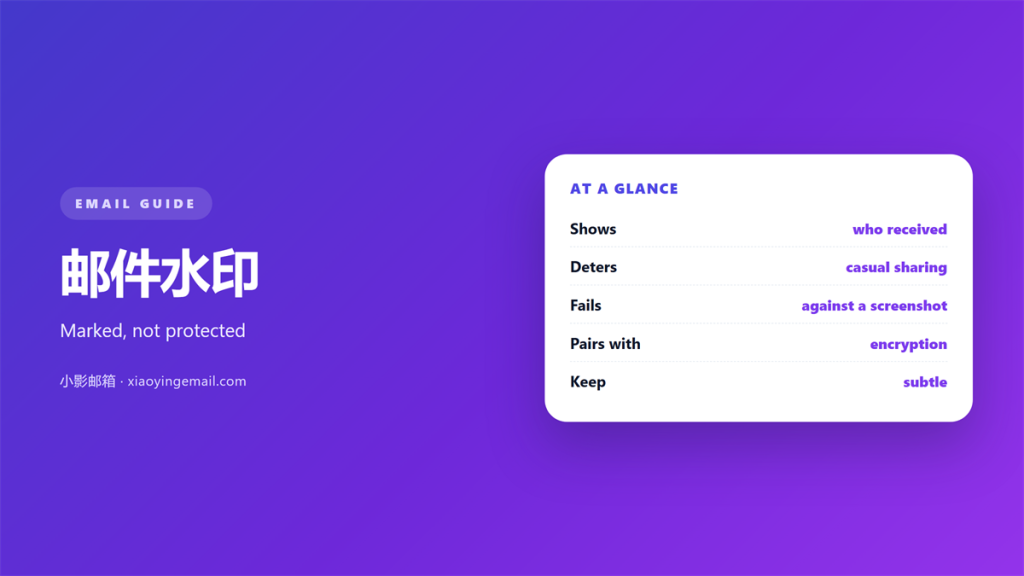
Key Takeaways
- 邮件水印 marks a document as restricted.
- A visible mark warns. A hidden mark traces.
- Neither one stops a determined reader.
- A watermark is a policy, not a lock.
- Mark only what you would defend later.
What 邮件水印 actually are
邮件水印 is a mark placed on a message or a file. It states a status. Common words are confidential, internal and draft.
The mark can be visible or hidden. A visible one sits on top of the content. A hidden one changes a few pixels and stays unseen.
The purpose is not secrecy. A watermark does not stop a copy. It changes what a reader does next.
Think of it as a label. A label records a decision the sender already made.
Why 邮件水印 are used
Two goals drive most 邮件水印. The first is deterrence. The second is attribution.
Deterrence works on honest people. A clear marker reminds them the file is not public. They think before they forward.
Attribution works after a leak. A unique variant points back to one copy. The trail is useful in a review.
Cost is the third reason for many teams. A watermark is cheaper than a full access system. It fits documents that leave the building often.
Neither goal needs a heavy tool. A single line of text covers the first goal well.
Visible marks versus invisible 邮件水印
A visible mark is easy and cheap. Add a line at the top, or a faint word across the page. Readers understand it at once.
A hidden mark is technical. Each recipient gets a slightly different file. The difference survives a copy of the text.
The two solve different problems. Use the visible one for a policy. Use the hidden one for an investigation.
Visible marks also survive a format change. A hidden mark may not. That difference decides which one you trust.
Most teams need only the first. The second adds cost and upkeep.
Building a 邮件水印 policy that holds
Start with a short rule. Name the documents that need a mark. Then name the words to use.
Apply the rule at the source. A mark added by hand gets forgotten on a busy day.
Keep the wording plain. Confidential beats a paragraph of legal text. Readers skip long warnings.
Say what the mark means as well. A short note explains what a reader may do with the file.
Train the habit, not only the rule. A person who marks without thinking is the goal. That takes a short reminder, not a long manual.
When a 邮件水印 becomes theatre
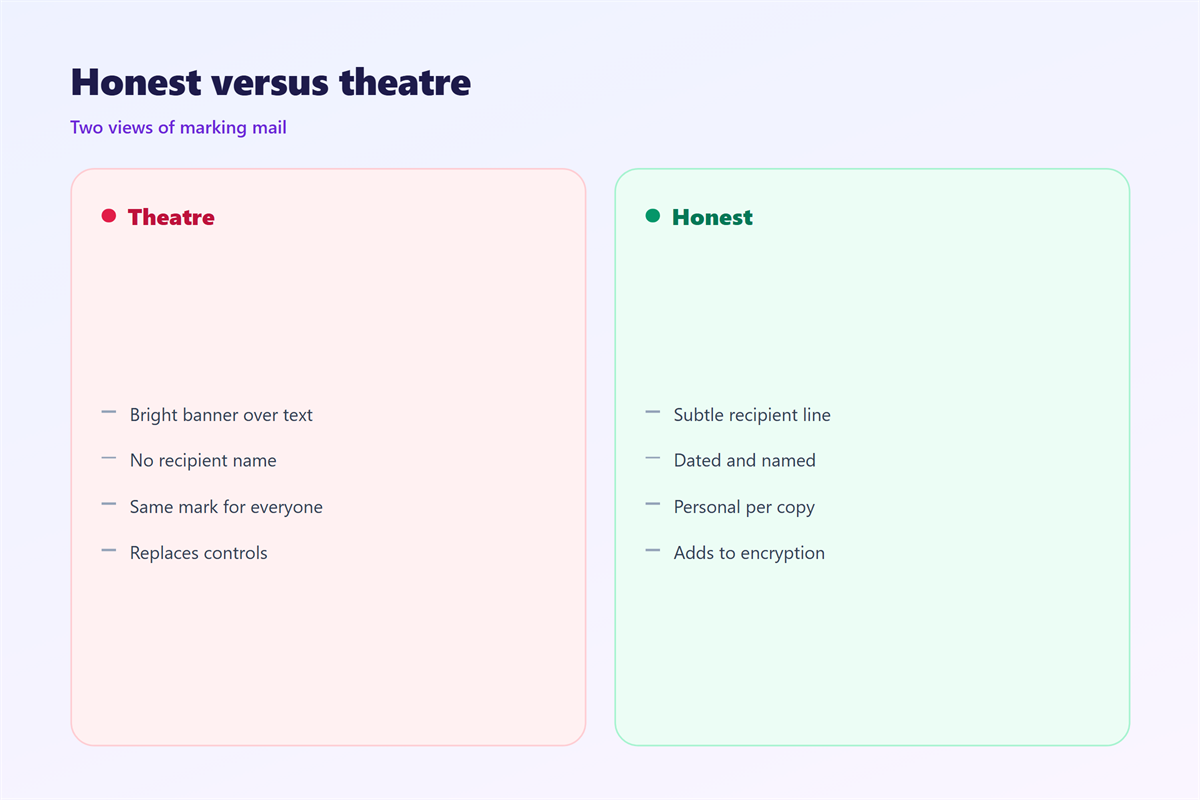
Some marks mean nothing. The file goes to a hundred people. Everyone can forward it freely.
A mark is theatre when it replaces a real control. Access lists do the actual work. A watermark only asks for care.
The test is simple. Ask what changes if a reader ignores the mark. If the answer is nothing, the mark is decoration.
Empty marks also train people to ignore the real ones. That is the hidden cost of decoration.
A clear mark also needs a clear owner. Someone must answer when a reader asks what it means.
Where 邮件水印 fail
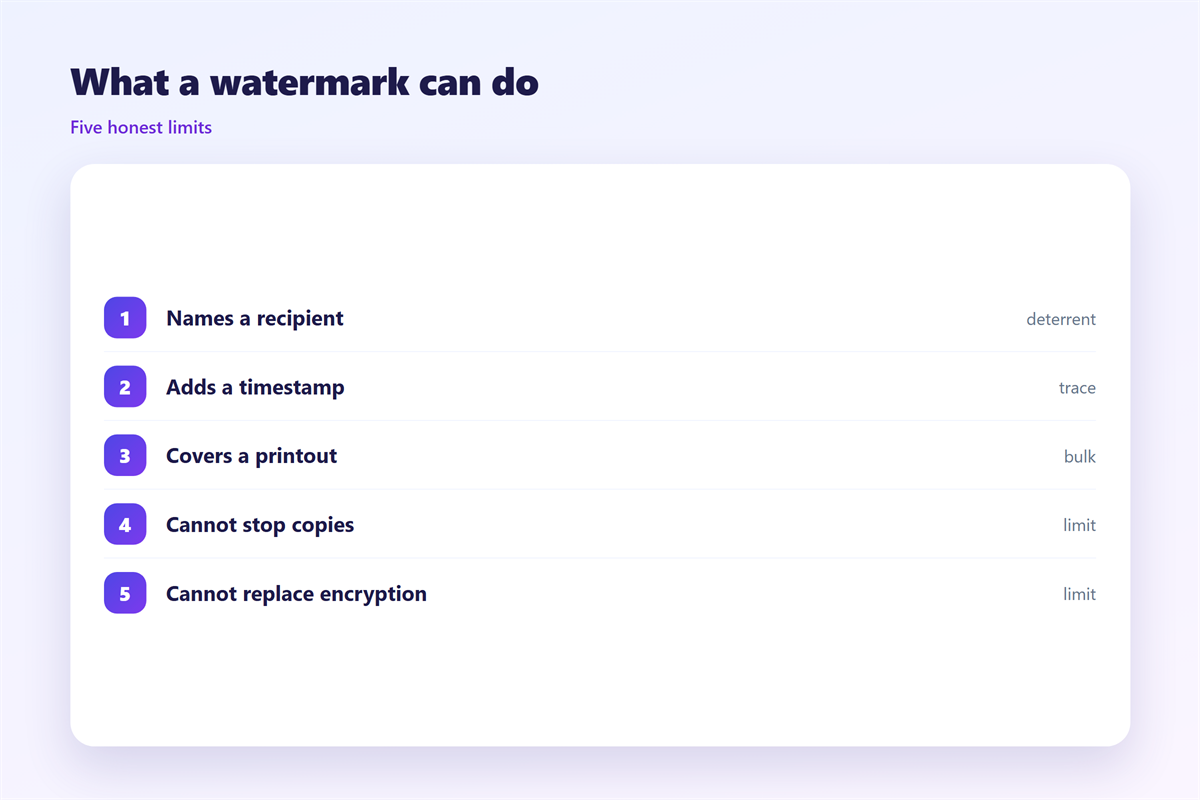
邮件水印 fail against a camera. A photo of a screen carries no hidden data. The mark then protects nothing.
They fail again in a re-type. Anyone can copy the text into a new file. The hidden trail stays behind.
They fail a third time in print. A paper copy leaves the system. The mark travels as ink, not as data.
None of this makes marks useless. It sets their real limits.
Marks that travel with a file
A mark lives in two places at once. It sits in the file, and it sits in the reader’s mind. Only the second one changes behavior.
Files move through many hands. A forwarded copy loses the original context. The mark is often the last reminder left.
Keep the wording stable across a project. A phrase readers learn once works for every file.
Review the wording when the policy changes. A stale mark teaches the wrong lesson.
Keep the mark close to the first line. A reader who opens a file sees the top of it first.
A print header and a file mark should match. Two different words look like two documents.
Testing your 邮件水印
Send one marked file to yourself. Then open it on a phone. Then print it.
Check three things. The mark is readable. The layout still works. The hidden copy, if any, still matches the log.
Keep a sample of marked files. A small library shows new staff what good looks like.
Test each 邮件水印 on a real document, not on a blank page. The mark also sits beside other controls. The protection in our notes on 邮件加密 is a stronger layer, and the identity check under 邮件证书 proves the sender. The file itself is covered in 邮件附件, while the reader’s view depends on 邮件格式.
FAQ
Does 邮件水印 stop forwarding?
No. It changes behavior, not ability. A reader can still forward the file. The mark only asks them to pause first.
Is an invisible mark legal?
It depends on the region and the context. Tell recipients that marks are used. A clear policy removes most doubt.
Can I add a mark to a PDF?
Yes. Most PDF tools support a text or image mark. A faint diagonal word is the usual style.
Why use 邮件水印 at all?
Because a small mark sets a tone. A 邮件水印 tells a reader this file is controlled. It is a reminder, not a lock.
评论
还没有评论,来说两句吧。
评论功能已关闭。