 小影邮箱
邮件署名怎么写?A Sign-Off That Closes
Key Takeaways
- 邮件署名 is the block that closes a message.
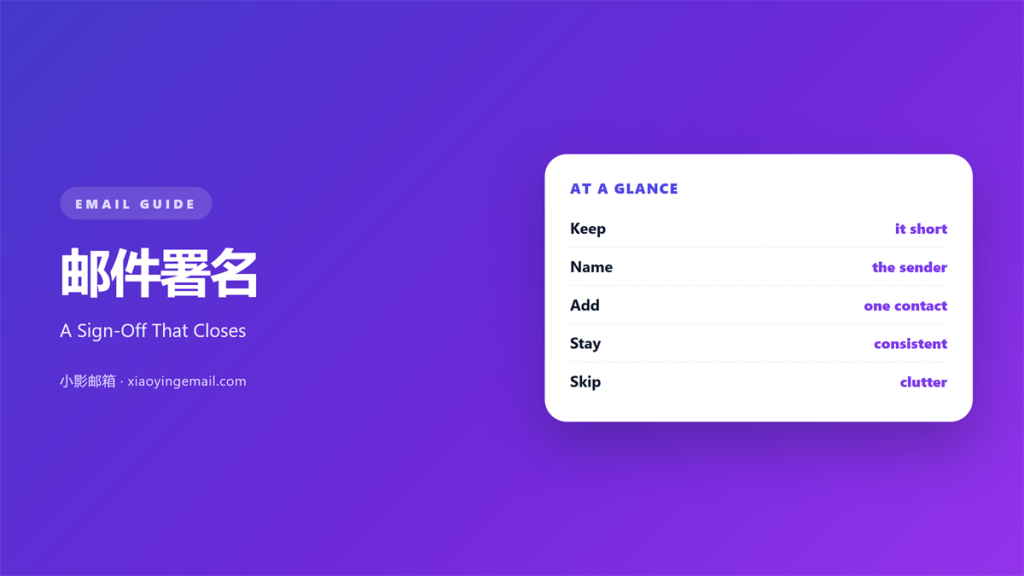
- Keep it short and the same on every send.
- A name, a role and one contact line are enough.
- The sign-off word sets the final tone.
- A steady block helps readers find you fast.
What 邮件署名 means
邮件署名 is the closing block at the end of an email.
It comes after your last sentence and nothing else.
The block holds your name and a little more.
It often includes a role and a contact line.
Some blocks add a company and a phone number.
A sign-off word usually sits just above it.
Words like “Best” and “Thanks” open the block.
Together they tell the reader who wrote this.
The signature is a small and quiet part.
Yet it stays on every message you send.
So a plain and steady block works best.
邮件署名 is a habit, not a decoration.
Build it once and reuse it for years.
Why 邮件署名 matters
A reader often needs to reach you again.
The block gives the name, role and route.
Without it, the reader may search and wait.
A steady block also builds a small trust.
The reader learns your name and your team.
Over time the block becomes your mark.
Good 邮件署名 keeps that mark clear.
It also closes the message with care.
A message without a block can feel abrupt.
So the block earns its few short lines.
It costs little and returns a lot.
Name and role first
Lead with your name on the first line.
Put your role on the next line.
The reader then knows who is speaking.
Skip the role only when it is obvious.
When 邮件署名 helps
A clear block helps in almost every case.
Use it for a note to a new contact.
Use it for a request across teams.
Use it for a message to a client.
Use it when you expect a reply.
Each case rewards a block that is easy to read.
The reader saves time and answers sooner.
It also keeps your tone consistent.
邮件署名 on a phone
A phone screen shows only a thin column.
A long block there pushes the cost up.
Keep the block to three short lines.
Then it stays easy to read on any screen.
When 邮件署名 hurts
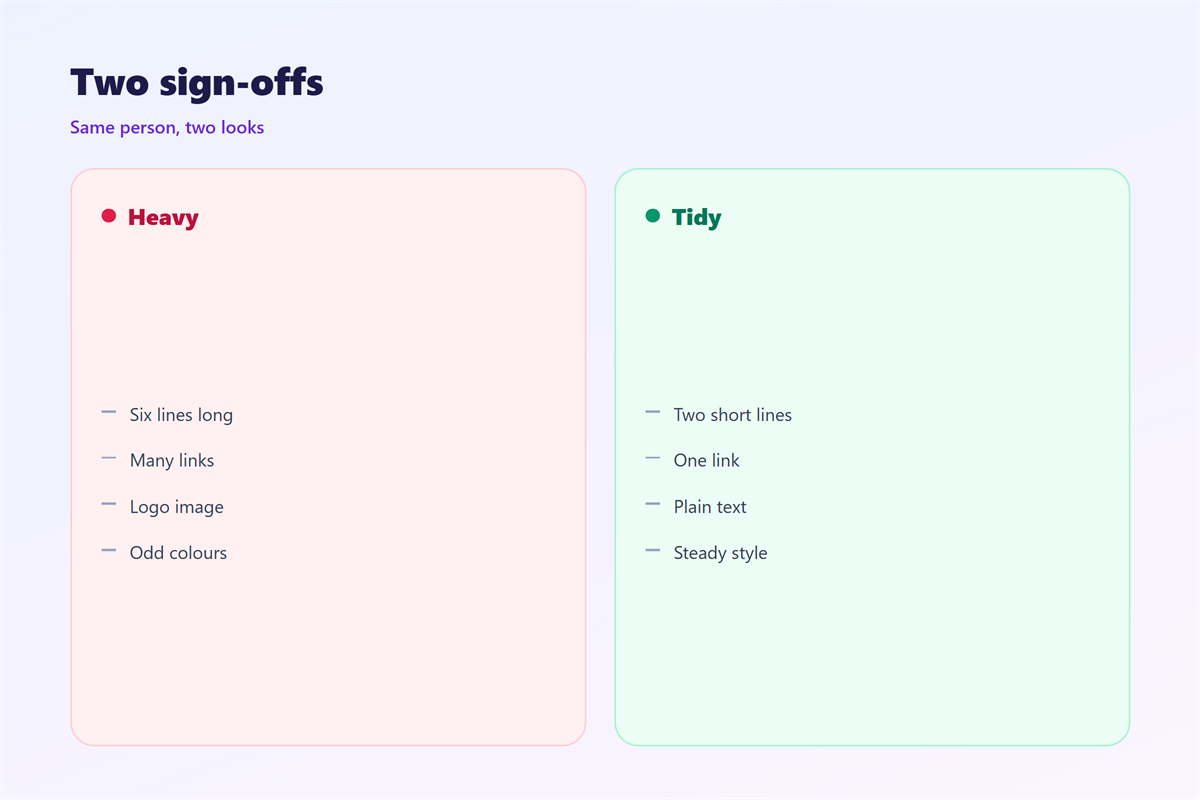
A block that runs too long hurts the reader.
Ten lines of text push the message down.
A large image can break the layout too.
Bright colours can look loud and unkind.
A quote that never changes looks careless.
Sarcasm in a sign-off rarely lands well.
So keep the block plain and short.
Cut any line that adds no route.
The reader should find you in one glance.
The three-line rule
One line for your name.
One line for your role and team.
One line for a single contact route.
More than three lines is usually too many.
邮件署名 in plain text
Plain text strips away every style cue.
No logo and no colour survive the trip.
Only the letters of the block remain.
So write the block in plain letters first.
A simple dash can set the block apart.
Keep the lines short and even.
Then the block looks the same everywhere.
Test it in a plain text client once.
If it reads well there, it is safe.
The plain version is the real version.
Build the block around that plain view.
How to write 邮件署名 well
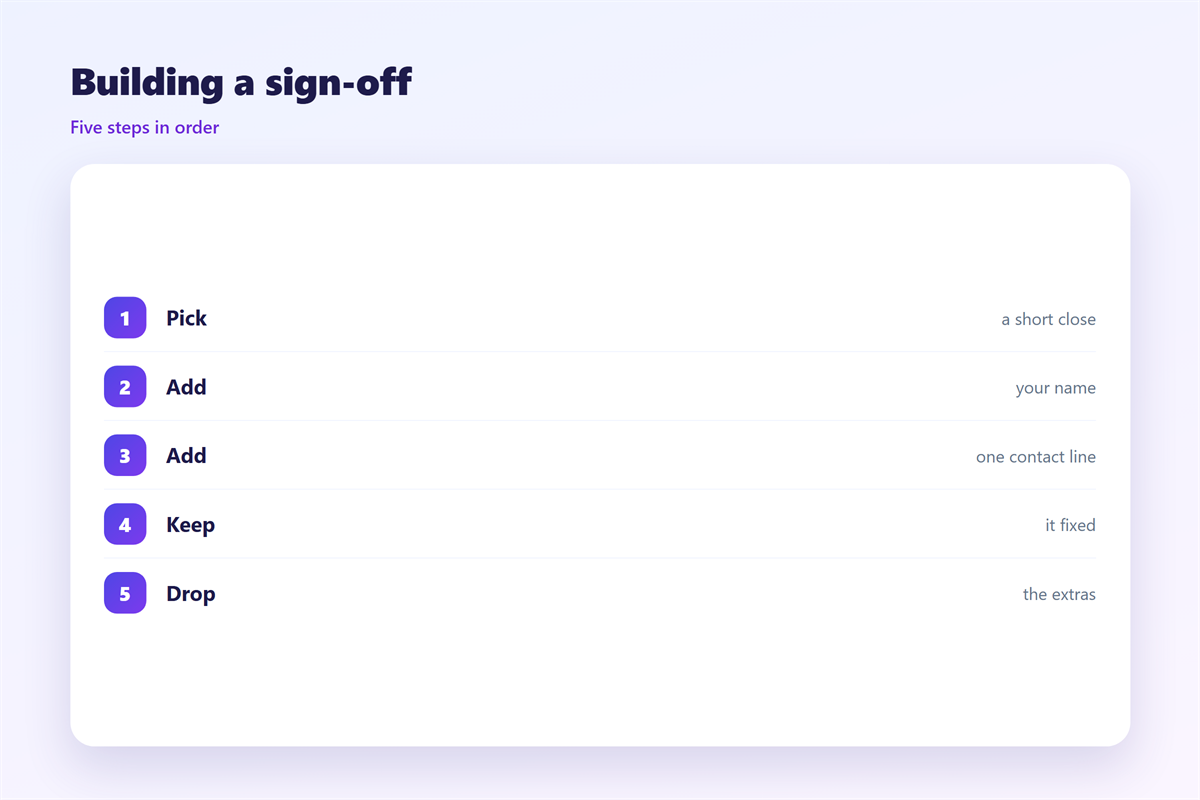
Write the block as three short lines.
Put your name on the first line.
Add your role and team on the next.
Finish with one contact route.
Use the same block on every message.
Match the sign-off word to the reader.
“Best regards” fits a formal note.
“Thanks” fits a quick and friendly one.
“Best” sits between the two.
Pick one and keep it steady.
A good 邮件署名 is easy to scan.
The reader finds your name at once.
Next, check the block on a phone.
If it wraps, trim a line.
Aim for a block that stays calm and short.
邮件署名 and trust
A steady block builds slow trust.
The same name and role over time feel solid.
A block that changes each week looks careless.
A clear route also invites a reply.
The reader is more likely to write back.
So the block supports the whole message.
A block that never changes feels dependable.
The reader comes to trust that steady mark.
Keep it honest and free of hype.
Skip the slogans and the long quotes.
Let the reader see a real person.
A calm block ends a message well.
Keeping 邮件署名 consistent
Consistency turns a good block into a habit.
Pick one block and hold it across the team.
What belongs in a signature sits in 邮件签名.
The shared rules for it appear in 邮件签名规范.
The final closing word is covered in 邮件结束语.
The opening name and title live in 邮件称呼.
Agree on a house block for everyone.
Then keep the same block on every message.
A team that agrees on 邮件署名 looks more reliable.
FAQ
What should a 邮件署名 contain?
A name, a role, and one contact route are enough for most people.
Should 邮件署名 include a logo?
Only if it stays small. A plain text block often works better.
Where does 邮件署名 sit in the message?
Just below the sign-off word and above nothing else.
Can I use a different block for clients?
Yes, but keep the same name and role for clear recognition.
评论
还没有评论,来说两句吧。
评论功能已关闭。