 小影邮箱
邮件开头怎么写?First Lines That Land
Key Takeaways
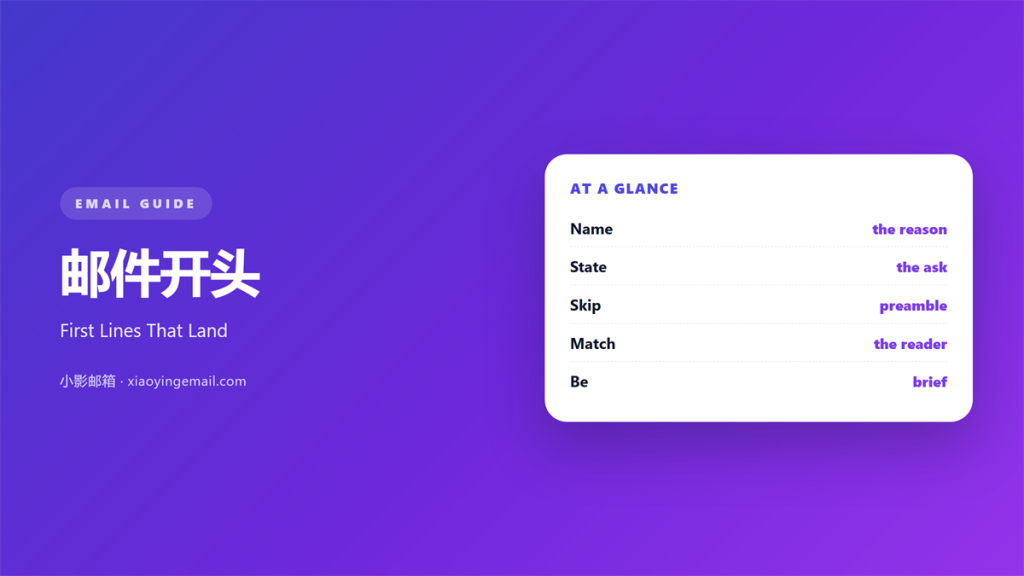
- 邮件开头 is the first line the reader sees.
- Name the reason you are writing at once.
- A clear ask belongs in the opening too.
- Skip the small talk with a busy reader.
- A steady opening sets the tone for the rest.
What 邮件开头 means
邮件开头 is the first line of your message.
It follows the greeting and starts the body.
The reader meets it before anything else.
A strong opening states the reason to write.
It also names the action you need.
Most readers read only the first few lines.
So the opening carries a heavy load.
A vague start loses the reader fast.
A clear start keeps the reader with you.
The opening is short, often one line.
Yet it decides whether the rest is read.
邮件开头 is worth a moment of care.
Write it last and read it first.
Why 邮件开头 matters
The opening sets the reader’s expectation.
It tells them if the note is urgent.
It tells them if the note is short.
A clear opening saves the reader time.
The reader knows at once what you want.
Good 邮件开头 also protects your tone.
A calm start keeps the whole note calm.
A rushed start can sound demanding.
So the first line is a kind of promise.
Keep that promise simple and plain.
Reason, then ask
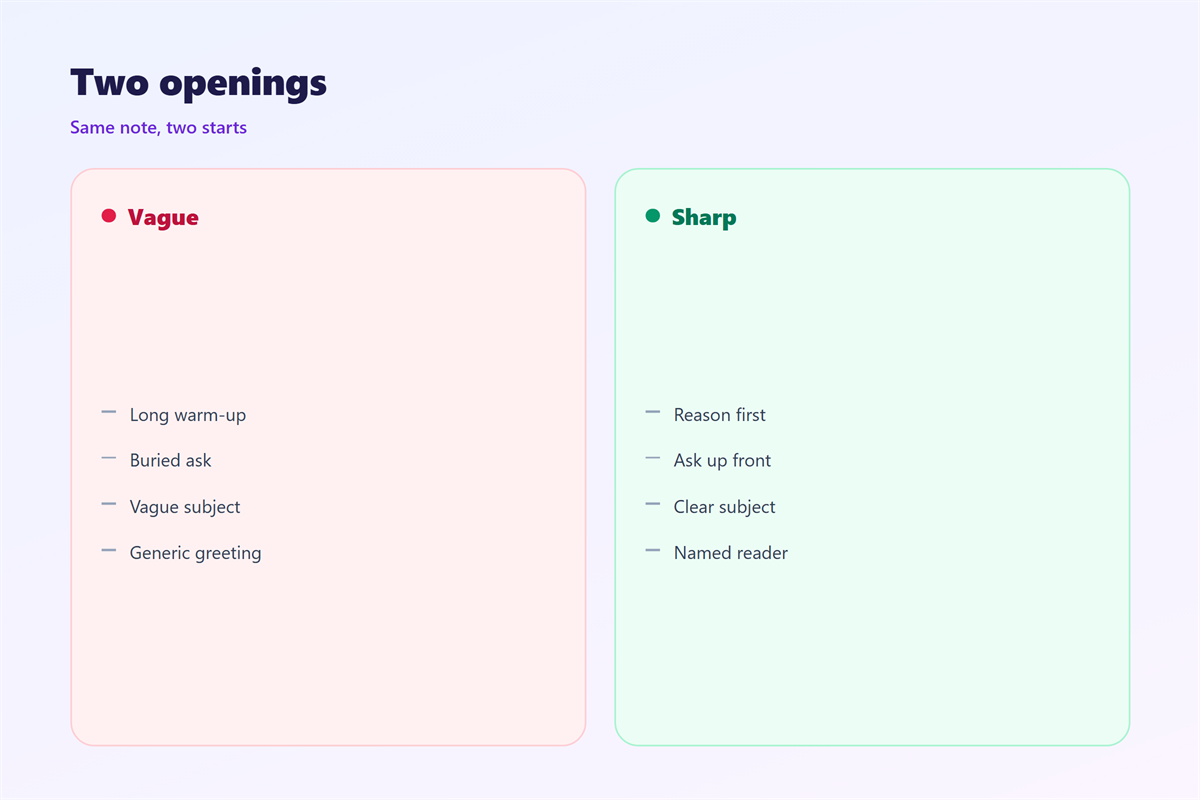
Start with the reason you are writing.
Then add the ask in plain words.
Two short lines can carry both.
The reader then knows exactly what to do.
When 邮件开头 helps
A clear opening helps in almost every case.
Use it for a note to a stranger.
Use it for a request with a deadline.
Use it when many people are copied.
Use it when the reader is busy.
Each case rewards a line that states the point.
The reader spends less time guessing.
A short opening also respects their time.
A short line also works well in a group thread.
Others can see the point without scrolling.
That keeps the whole thread on track.
邮件开头 on a phone
Many readers open mail on a phone.
Only the first line may fit the preview.
Put the reason in that first line.
Then the reader sees it before tapping.
When 邮件开头 hurts
A weak opening hurts in a few ways.
“Just touching base” says nothing at all.
Small talk can push the ask out of view.
A buried request may never be read.
A too-casual start can sound careless.
A too-formal start can sound stiff.
So match the opening to the reader.
Keep it plain and to the point.
The reader should never have to hunt.
The one-line rule
Aim to state the point in one line.
Add a second line only for the ask.
If you need a third, rewrite the first.
Short openings win more replies.
邮件开头 in plain text
Plain text keeps the opening honest.
No style can hide a vague first line.
No colour can soften a blunt one.
So the words must do all the work.
Write the opening as plain words first.
Then it survives every client.
Avoid fancy dashes and odd symbols.
They can break in a basic reader.
A simple sentence travels best.
The plain version is the real version.
Test the opening in that plain view.
A plain line also loads fast on a slow phone.
So the reader sees the point without waiting.
How to write 邮件开头 well
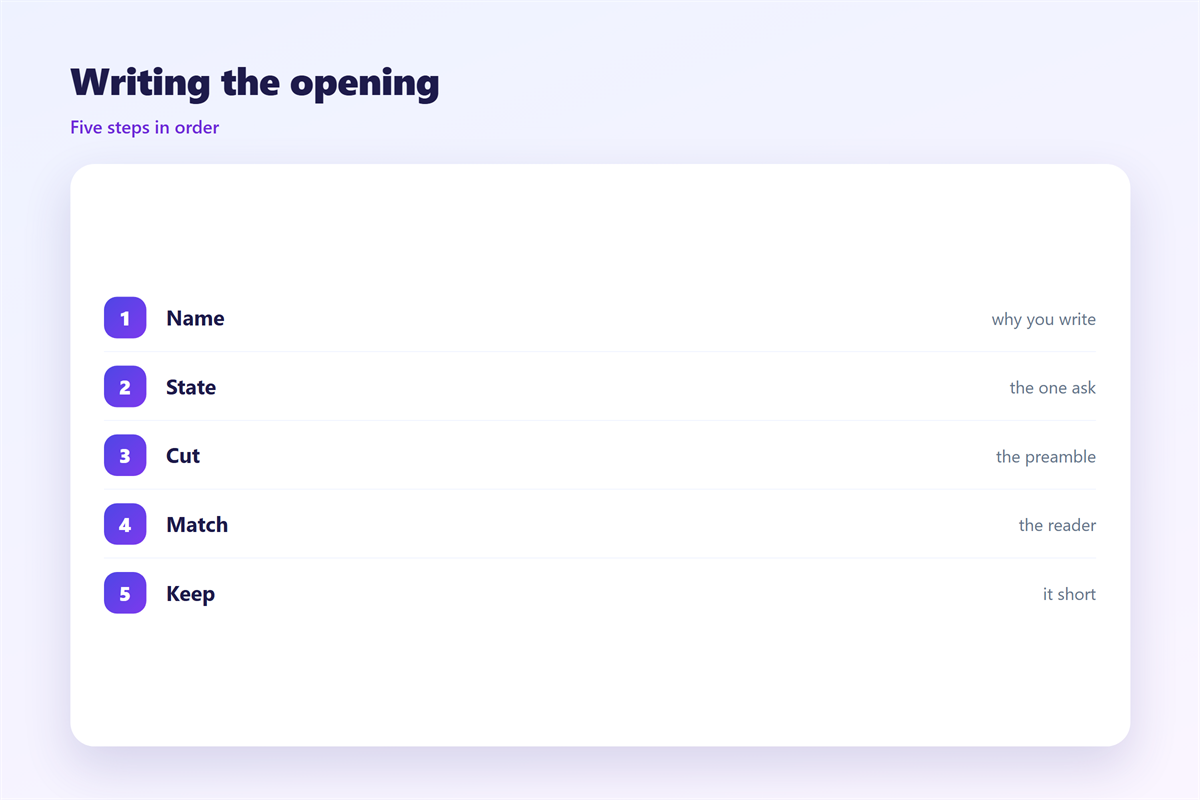
Write the note first and the opening last.
You then know the real point to state.
Put the reason in the first line.
Put the ask in the second.
Keep both lines short and clear.
Name a person if one is needed.
Give a date if one matters.
Use a plain verb and skip the filler.
A good 邮件开头 is easy to answer.
The reader knows the next step at once.
Read the opening as a stranger would.
Cut any word that adds nothing.
Next, check it in a narrow preview.
If the point is hidden, move it up.
Aim for a first line that lands at once.
邮件开头 and trust
A clear opening builds a small trust.
The reader feels the writer respects time.
A steady opening also sets a habit.
Readers learn your style over time.
They then open your mail with ease.
So keep the opening honest and plain.
Skip the hype and the long warm-up.
Let the first line carry the point.
A steady opening also saves your own time.
You write the first line once and reuse it.
A calm opening earns a calm reply.
That is the whole goal of the start.
Keeping 邮件开头 consistent
Consistency turns a good start into a habit.
Pick a house opening and hold it across the team.
Ready-made first lines appear in 邮件开场白.
A fitting hello is covered in 邮件问候语.
A short self-introduction sits in 邮件自我介绍.
The way to address a reader lives in 邮件称呼.
Agree on a few opening lines for the team.
Then keep the same style for every message.
A team that agrees on 邮件开头 writes faster and clearer.
FAQ
What makes a strong 邮件开头?
State the reason you are writing, then the ask, in plain words.
How long should the opening be?
One or two short lines are enough for most messages.
Can I start with small talk?
Rarely. With a busy reader, put the point in the first line.
Does 邮件开头 change for a friend?
Yes. A friend can take a warmer line, but keep the point clear.
评论
还没有评论,来说两句吧。
评论功能已关闭。