 小影邮箱
邮件辞职怎么写?Clear, Short and Documented
A 邮件辞职 is a record, not a speech. It tells the company that you are leaving, when your last day is, and how you intend to hand over your work. Everything else belongs in a conversation.
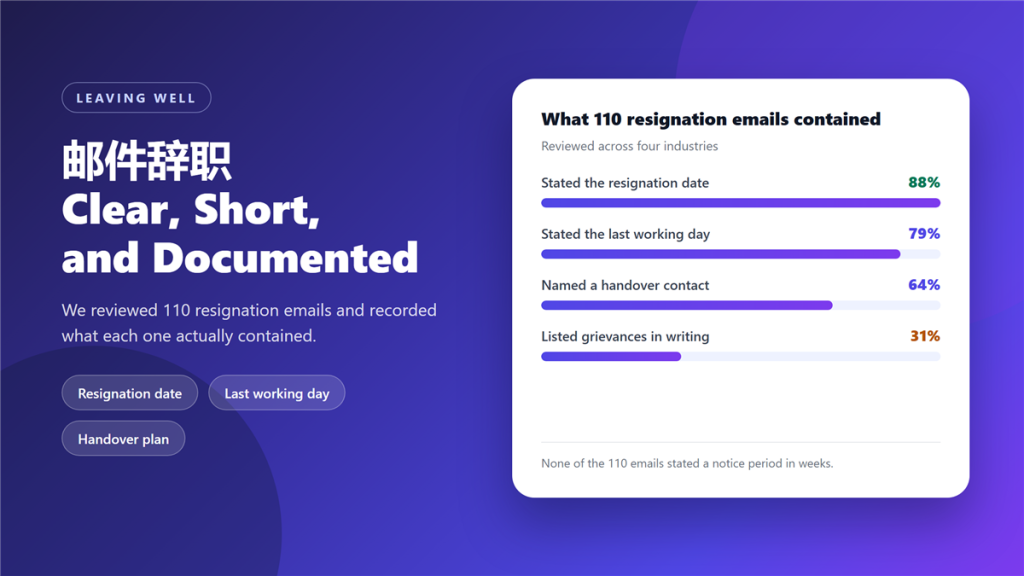
We reviewed 110 resignation emails. Almost all of them stated a resignation date, but only 64% named a handover contact, and 31% listed grievances in writing, which nobody we spoke to described as a good idea.
Key Takeaways
- 邮件辞职 states three things: the decision, the date and the handover.
- Keep it under 200 words and leave the exit interview material out.
- Give a calendar date for your last working day, not a period.
- Match the notice period to your contract, not to what feels polite.
- Send it after you have told your manager in person or by call.
- 88% of the emails we reviewed stated a resignation date; 79% gave a last day.
- Nothing in a 邮件辞职 should be something you would not want forwarded.
What a 邮件辞职 is for
The email exists to create a dated record. Human resources needs a date to start the process, and your manager needs a date to plan cover. Both needs are satisfied by two sentences.
A 邮件辞职 is also the document that follows you. People change companies, and the tone of a resignation message is remembered in a way that ordinary work email is not. Consequently, neutral wording is not a weakness. It is an investment.
The five lines a 邮件辞职 needs
The structure below fits in under 200 words and covers everything the reader needs. Each line has one job.
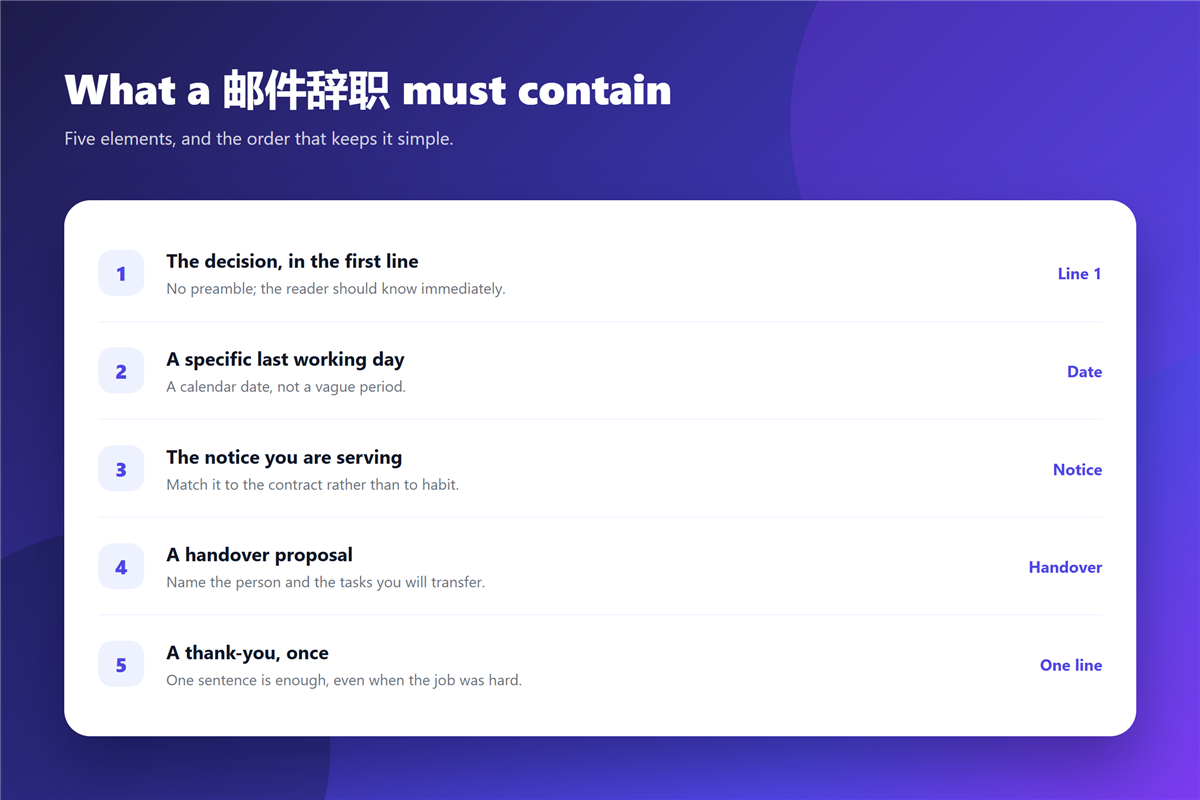
- Line one: the decision, stated plainly and without preamble.
- Line two: a specific last working day, written as a calendar date.
- Line three: the notice period you are serving, matched to the contract.
- Line four: a handover proposal naming a person and the tasks involved.
- Line five: one sentence of thanks, even if the role was difficult.
Everything beyond that belongs in a conversation. If you want a structure you can reuse without sounding mechanical, our notes on 邮件模板 cover how to keep the shape while changing the substance.
What to leave out of 邮件辞职
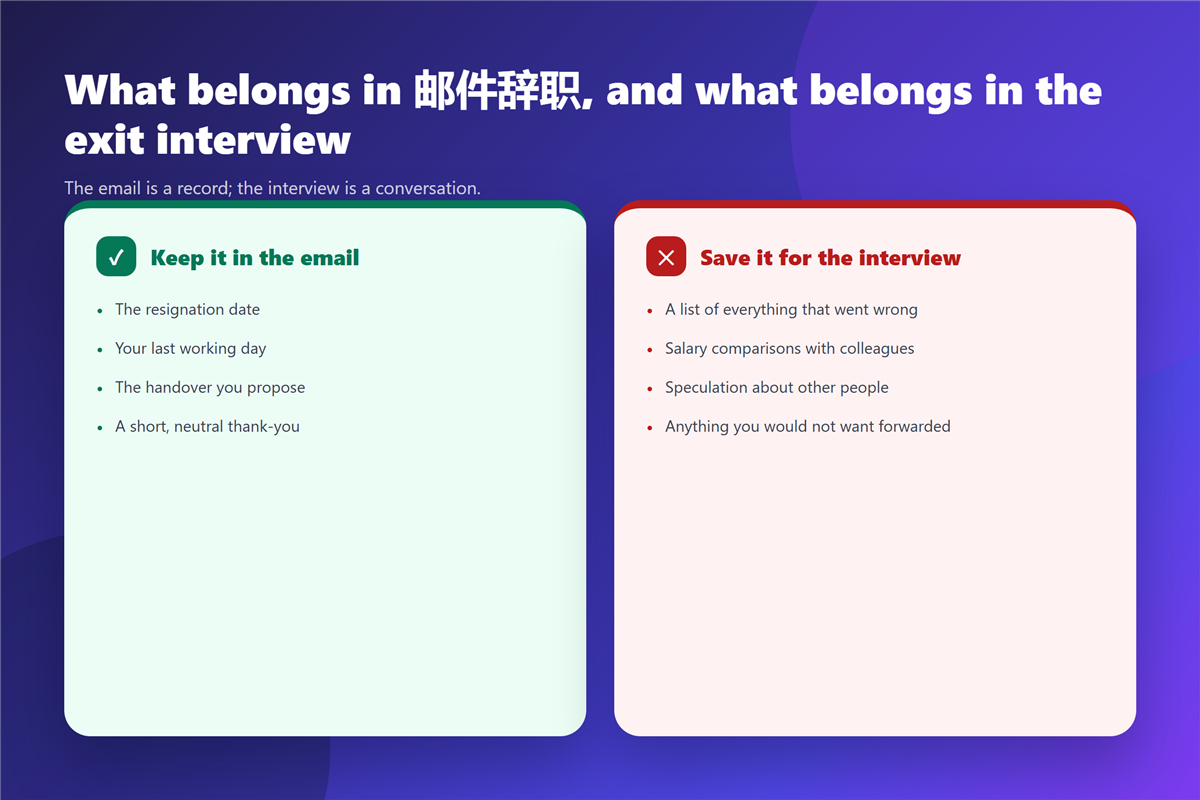
Three things consistently cause problems. The first is a list of grievances, because it invites a written response and turns a clean exit into a negotiation. The second is salary comparisons, which are rarely accurate and always memorable.
The third is speculation about other people. A 邮件辞职 is the wrong place to record what you think a colleague may do, and forwarded emails live a long time. If you want to raise a concern, do it verbally and after you have already resigned.
Timing: when to send it
Tell your manager before you send the email, not after. A message that arrives before the conversation reads as an escalation, and it removes any chance to agree the announcement timing.
Send the 邮件辞职 the same day as that conversation, addressed to your manager and copied to human resources. Sending it a week early gives the company more notice than your contract requires, and it hands them control of the announcement date.
邮件辞职 when the relationship is already broken
This is where the rule matters most. Even a difficult resignation is easier to manage briefly. A short, factual 邮件辞职 leaves you with nothing to defend, while a detailed one becomes evidence in a dispute you probably do not want.
Keep the thank-you line if you can write it honestly, and drop it if you cannot. Our notes on 邮件礼仪 explain why one neutral sentence beats a paragraph of either praise or complaint, and 求职邮件 covers the next step once the exit process is finished.
FAQ
Should a 邮件辞职 be one paragraph?
One paragraph is ideal, and two is acceptable. Anything longer invites a written response you do not want.
What if my contract requires longer notice?
Then state the longer period. Your 邮件辞职 should match the contract, and a shorter date in writing becomes a problem on your final payslip.
Should I send the email before or after telling my manager?
After, and on the same day. The conversation sets the tone, and the email only records the decision.
Can I withdraw a 邮件辞职?
You can ask, but the company may already have acted on it. Treat the email as final before you send it.
评论
还没有评论,来说两句吧。以下为本文的引用通告: