 小影邮箱
邮箱别名怎么用?One Inbox, Many Addresses
Key Takeaways
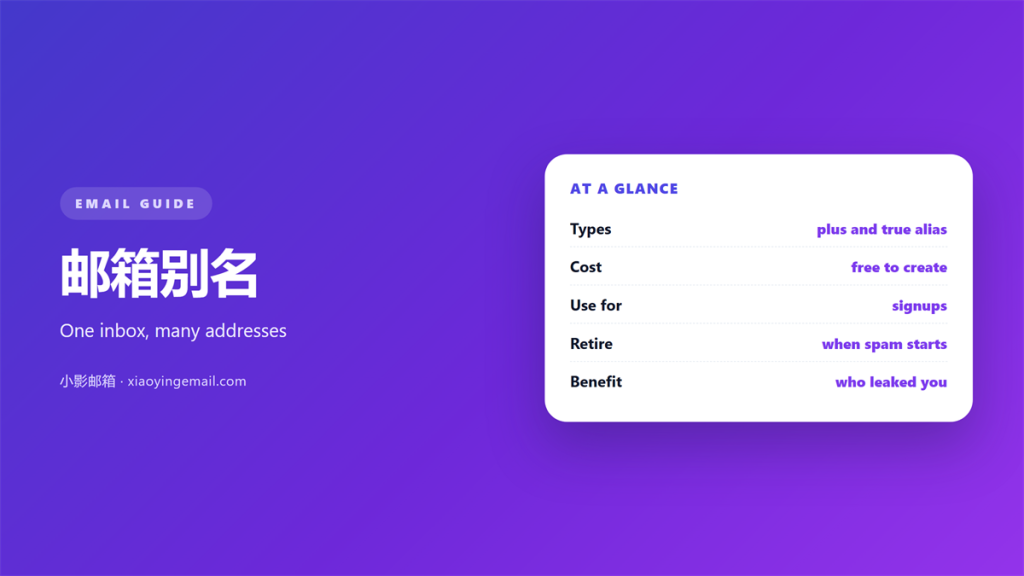
- 邮箱别名 is a second address that delivers into your main inbox.
- Plus-addressing is free and instant, while a true alias is cleaner but needs setup.
- Give each service its own alias so a leak points back to one signup.
- An alias you cannot retire slowly becomes permanent clutter.
- Test deliverability before you rely on an alias for anything important.
What 邮箱别名 actually is
邮箱别名 is an address that is not your main login, yet delivers straight into the same mailbox. You read everything in one place while the world sees a different name. Moreover, you can usually still send replies from your real address.
I started using them after one retailer sold my address to a list I never joined. The spam took months to fade. With an alias, that signup would have leaked a disposable name and nothing else.
Therefore, treat an 邮箱别名 as a label rather than a new mailbox. It changes what you hand out, not where the mail arrives.
How 邮箱别名 works in practice
Two mechanisms do most of the work, and they differ in how much control you get. Notably, the cheaper option is also the one more people already have.
Plus-addressing
Plus-addressing is the simplest 邮箱别名, because it appends a tag after a plus sign. The message to [email protected] still reaches [email protected]. It costs nothing and needs no setup. However, some forms reject the plus sign, and a few senders strip it, which is why it is not universal.
True provider aliases
A real alias is a separate address that the provider maps to your account. It looks clean, without a plus sign to give it away, and it can often be switched off later. Consequently, this is the better choice for anything long-lived.
Why 邮箱别名 matters
Privacy is the first reason. When a site leaks its database, the alias in the dump points to one service instead of to you. That turns a breach into a nuisance rather than an identity problem.
Control is the second reason. If one 邮箱别名 starts attracting junk, you retire it and the reliable mail keeps flowing. Furthermore, the pattern shows which signup leaked, because every service received its own name.
Six rules for naming 邮箱别名
Names are cheap, so a little structure goes a long way. I follow these rules on every new signup.
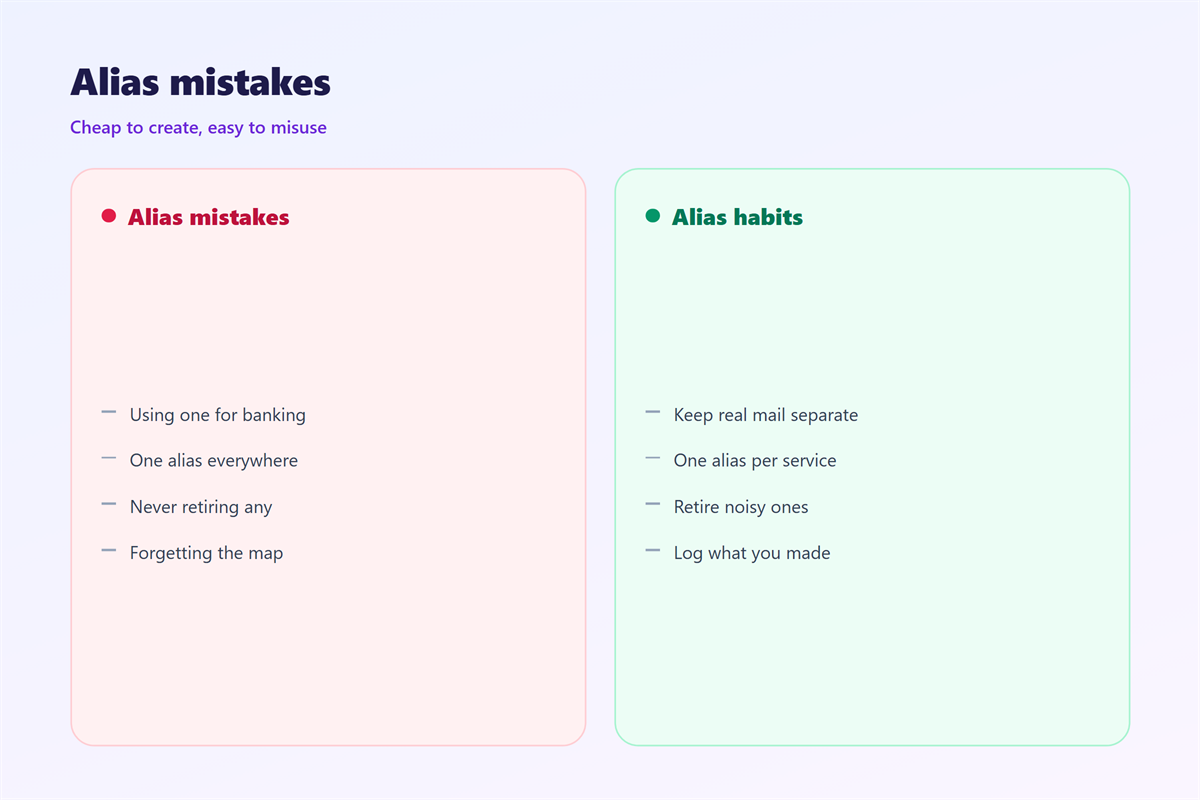
- Include the service name so the source is obvious.
- Keep one alias per service, never one per year.
- Avoid personal details that reveal your real name.
- Never reuse an alias you have already retired.
- Record the alias in your password manager.
- Leave room to delete it without losing the account.
The approach scales well. Teams that run many addresses benefit from the discipline behind our notes on 邮箱小号, where naming rules prevent clutter from building up quietly. A tidy scheme also makes it obvious when a name no longer serves a purpose.
Where 邮箱别名 goes wrong
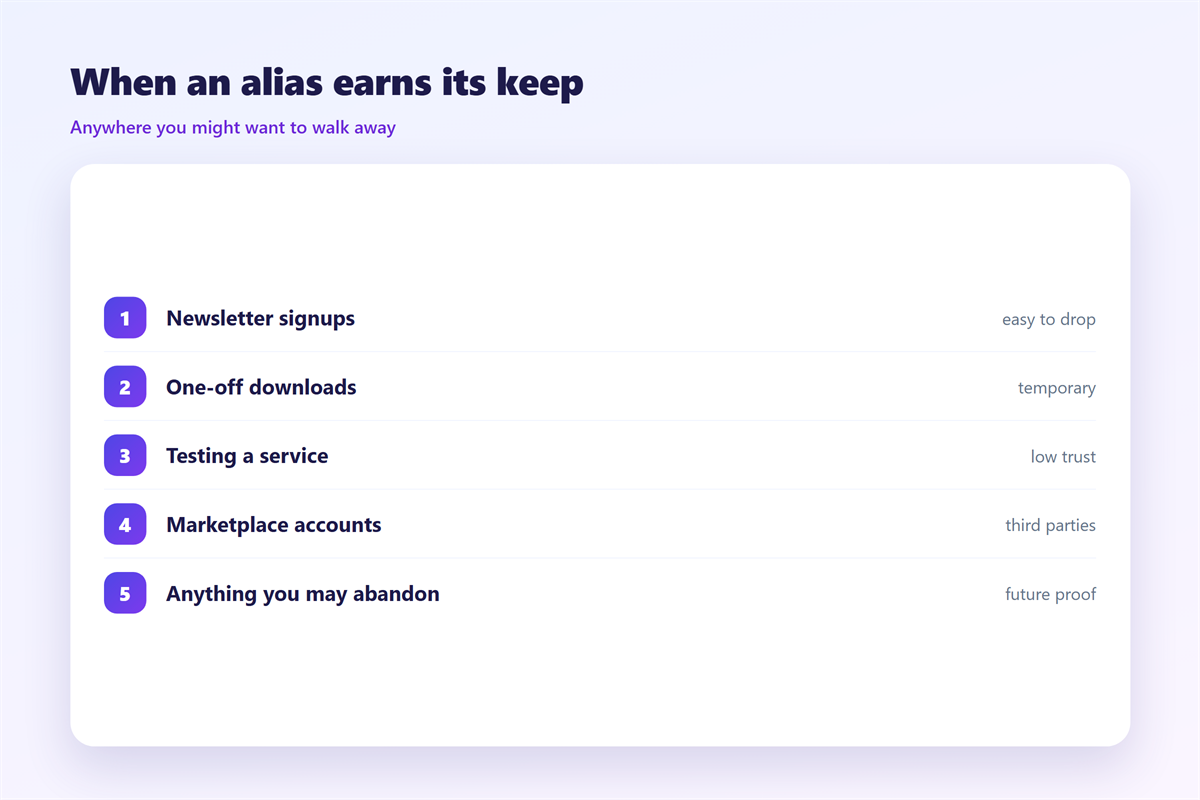
The first mistake is using an alias for a bank, a government service or an employer. These need to reach you for years, and an 邮箱别名 you forget to renew can cut off a critical message. In other words, keep your identity addresses separate from your disposable ones.
The second mistake is an alias that cannot be turned off. If the provider only allows adding, a leaked 邮箱别名 stays live forever, and the junk never stops arriving.
When an alias leaks
A leak is not an emergency, because the whole point is to limit the damage. Still, act quickly, retire the 邮箱别名 and then check whether the account behind it needs a new password. That sequence keeps the blast radius small.
How to retire an 邮箱别名
Before you delete anything, redirect the mail for a month. Update the service to your new address, then disable the old 邮箱别名 instead of removing it outright. Additionally, watch for password reset messages that still land in the old place.
| Action | When to do it | Why it helps |
|---|---|---|
| Update the account | Before deleting | Avoids lockout |
| Keep mail flowing | For one month | Catches missed logins |
| Disable, do not delete | After the check | Reversible if needed |
| Record the change | Same day | Keeps the list honest |
Check deliverability before you rely on it
Some services silently drop mail sent to an alias, so send a test message first. If it arrives and the reply works, the 邮箱别名 is safe to use. Otherwise, pick a different address before you commit.
Address choices are hard to undo once an account exists, which is why planning at 邮箱注册 time saves trouble later. If you run several identities, the structure in our guide to 邮箱多账号 keeps them from collapsing into one. A forward can also stand in for an alias, and our 邮件转发 notes cover the trade-offs.
FAQ
Is 邮箱别名 the same as a second mailbox?
No. A second mailbox has its own storage and password, while an alias shares the inbox you already use.
Do aliases hide my real address?
They hide the address you type into forms. However, a reply or a linked account can still reveal your main address.
Can I send from an 邮箱别名?
Often yes, if the provider allows a custom from address. When it does not, you can still receive on the alias and reply from the main one.
How many aliases should I keep?
As many as you can name and track. Beyond that the list becomes a chore, so retire the ones you no longer read.
References
- IETF RFC 5233: Sieve Subaddress Extension
- Wikipedia: Email address
- Wikipedia: Disposable email address
评论
还没有评论,来说两句吧。
评论功能已关闭。