 小影邮箱
邮件勒索怎么处理?When a Message Threatens You
Key Takeaways
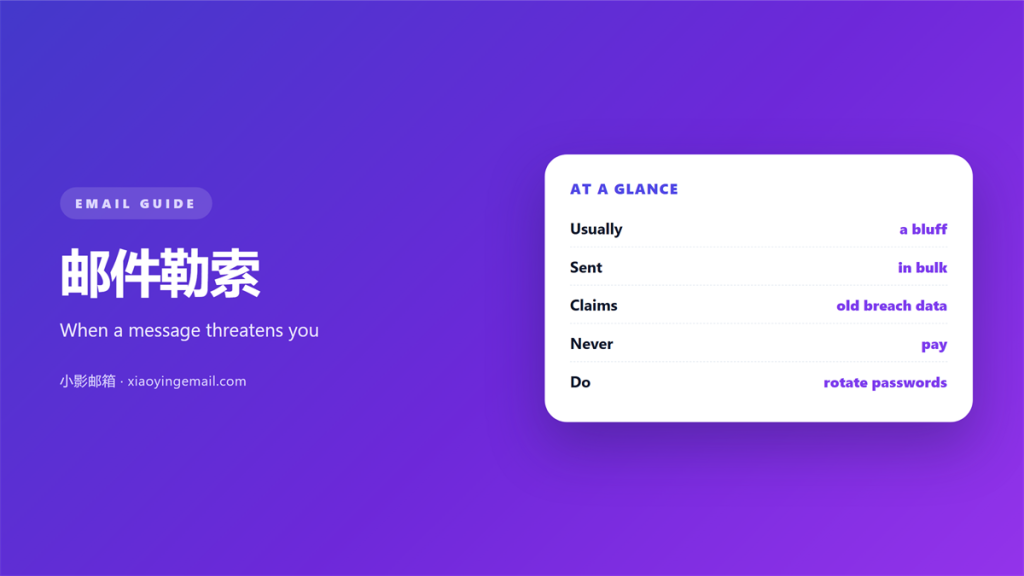
- 邮件勒索 is usually a bulk bluff sent to thousands of addresses at once.
- A real secret in the message does not prove the sender holds anything more.
- Old passwords shown as proof often come from public breach dumps.
- Never pay and never reply, because both confirm the address is live.
- Change reused passwords first, then report the message.
What 邮件勒索 usually is
邮件勒索 is a message that demands payment by threatening to expose something. Most versions claim to have recorded you, stolen your files or read your mail. The threat is written to feel personal, however the same text usually reaches thousands of people.
I have received three of these in five years. Each one opened with a password I had used in 2014, which felt alarming until I recognised it in an old breach list. Notably, the sender never proved anything beyond that single leaked line.
Therefore, the first task with any 邮件勒索 is not to decide whether to pay. It is to work out whether the claim is true at all.
How 邮件勒索 messages are built
Two shapes dominate in 邮件勒索, and telling them apart changes your response. Moreover, the language in each one tends to give the bluff away.
The bulk bluff
The bulk version is generic. It quotes a leaked password, sets a deadline, and names a cryptocurrency. It cannot describe your files, your contacts or your habits. Consequently, a bluff that fails to name one private detail is almost certainly mass-mailed.
The targeted claim
The targeted version is rarer and more careful. It may mention a real project, a real client or a real document title. Even then, the details often come from a public page or an old 邮箱泄露, so the message is not proof of access.
Why 邮件勒索 works on fear
Fear compresses the time you have to think. A short deadline and a frightening claim push people toward a fast payment before they check anything. In other words, the pressure is the weapon, not the evidence. I notice the wording grows more urgent as the deadline shrinks, and that haste is itself a clue.
Shame does the rest. Many 邮件勒索 texts threaten to reveal an embarrassing secret, and the fear of exposure keeps victims quiet. That silence protects the sender, because one public report can warn hundreds of people.
Five rules for when 邮件勒索 arrives
A short routine keeps a frightening message from turning into a bad decision. I keep this list visible, because the panic fades slowly.
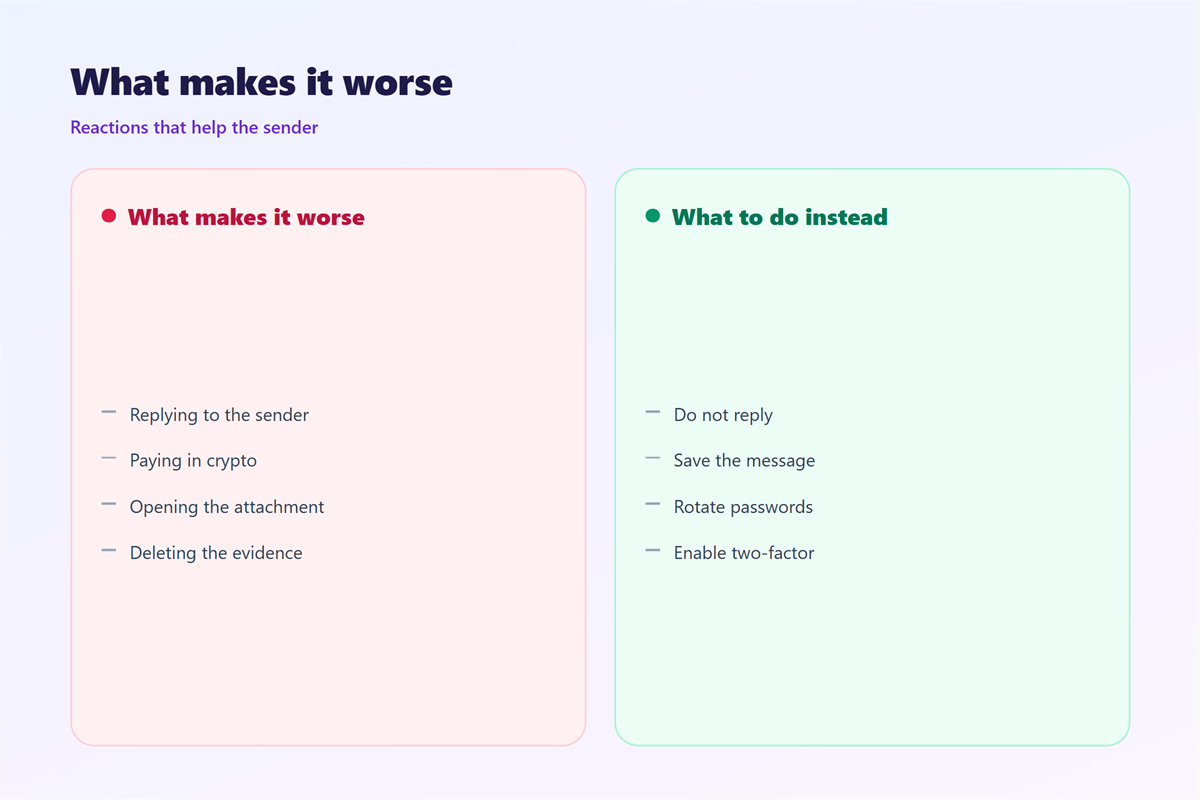
- Do not reply, and do not pay, at any point.
- Check the quoted password against known breach lists.
- Change that password everywhere it was reused.
- Save the full message with its headers before deleting it.
- Report it, then stop rereading the threat.
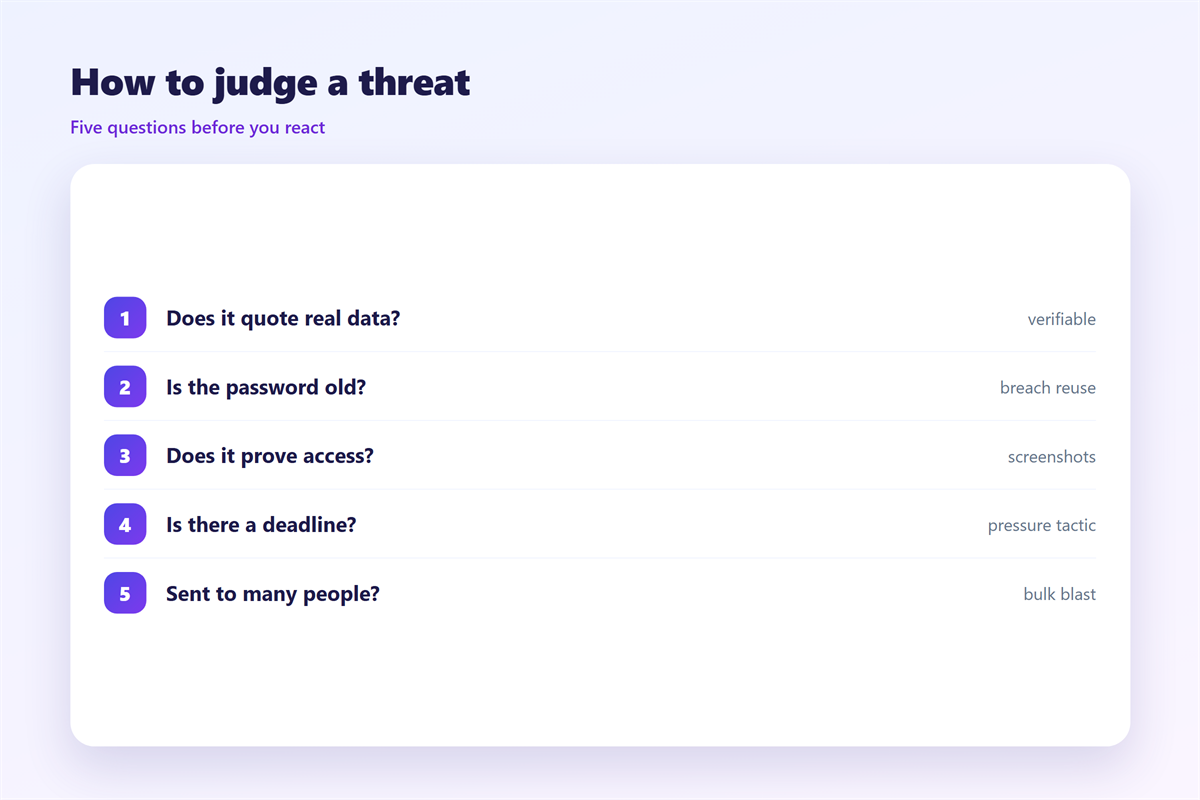
The order matters in any 邮件勒索 case. Verification comes before action, and reporting comes before cleanup. The same instinct applies to the messages covered in our 钓鱼邮件 guide, where a calm header check replaces panic. A 垃圾邮件 filter hides most of these, yet it will not catch every one.
Where 邮件勒索 reasoning fails
The common error when reading 邮件勒索 is treating one true detail as proof of everything. A leaked password is evidence of an old breach, not of a live intruder watching your screen.
A second error is paying to protect a secret that was never threatened. In most cases the sender holds no files and no video, so a payment simply marks you as a target for the next round.
Old passwords in the text
An old password feels like proof, yet it is the cheapest thing to obtain. Breach dumps circulate for years, and a list can be matched to your address in seconds. Therefore, a quoted password shows where the data came from, not what the sender can do right now.
How to test a 邮件勒索 claim
Testing a 邮件勒索 claim is mostly about looking outward. Search the exact wording, because these scripts are reused and often appear in public warnings. Additionally, check whether your address appears in a breach service, which explains where the detail came from.
| Claim | What it really means | Your move |
|---|---|---|
| Old password shown | Data from an older breach | Change reused passwords |
| Files I supposedly stole | Usually a bluff | Do not pay |
| Webcam footage | Almost always false | Keep the evidence |
| Deadline and wallet | A pressure tactic | Report and ignore |
Evidence and reporting
Keep the message and its headers, because they help a report and cost you nothing. Send the details to your provider and to the relevant fraud authority. If the sender names a specific leak, treat the 邮箱密码 you reused as compromised and rotate it at once. A broader 邮箱泄露 check will confirm what else moved in the same dump.
FAQ
Should I ever pay a 邮件勒索 demand?
No. Payment rarely ends the contact, and it confirms that you respond to pressure. It also funds the next round of messages.
They quoted my real password. Are they inside my mail?
Not necessarily. A quoted password usually comes from an old 邮箱泄露, so treat it as a signal to change reused credentials rather than as proof of access.
Will deleting the message make it stop?
Deleting does not notify the sender, so it changes nothing on their side. Report the message first, then delete it for your own peace of mind.
Can a filter block these messages?
Filters catch many of them, however a new script often slips through at first. Your own routine is the more reliable defence.
评论
还没有评论,来说两句吧。
评论功能已关闭。