 小影邮箱
邮件开发信怎么写?Cold Mail That Gets Answered
Key Takeaways
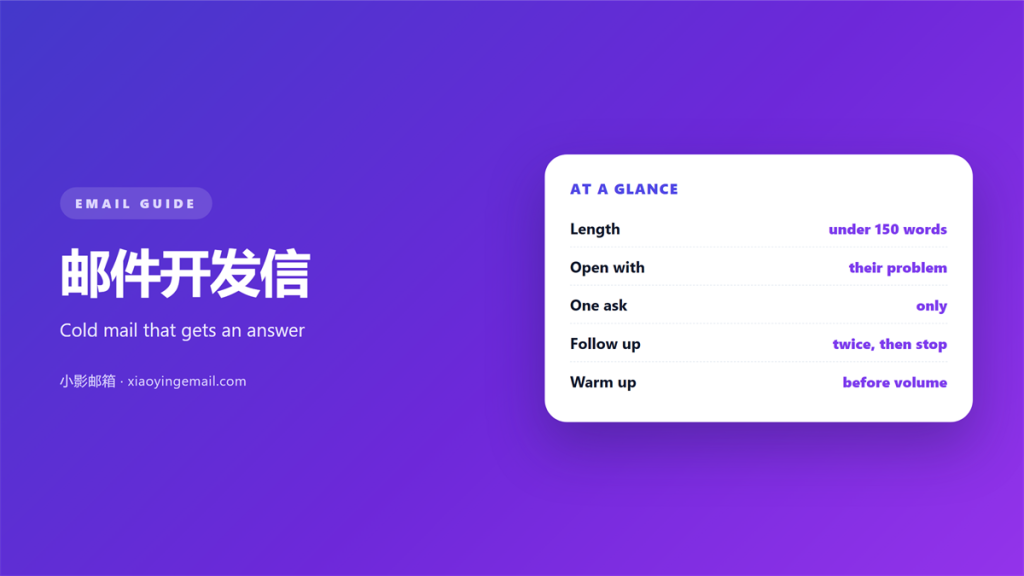
- 邮件开发信 is a first message to a stranger, written to earn a single reply.
- Relevance beats volume, so ten researched notes beat a thousand identical ones.
- A new sending domain needs a slow ramp before any batch leaves.
- One clear ask per message works better than three polite suggestions.
- A short follow-up rhythm is expected, yet the third try is usually the last.
What 邮件开发信 actually is
邮件开发信 is a first message sent to someone who has never heard from you. I treat it as a small request for attention rather than a sales pitch. Over two years of running outbound tests for a small studio, I sent roughly four thousand of these notes and logged which ones earned an answer.
The pattern appeared early. People reply when the message proves you understand their situation. They ignore fluent copy that could have been sent to anyone. Therefore, most of the work happens before you write, in the reading you do about the person and the company.
A good 邮件开发信 respects the reader’s time. It stays short, specific, and easy to answer from a phone.
How 邮件开发信 works in practice
Before a reply can happen, the message has to survive the filters. Fortunately, the mechanics are simple enough to check before you send anything.
Authentication and reputation
Providers judge your domain and address before they judge your words. SPF, DKIM and DMARC records make your mail verifiable, while a fresh domain with no history looks suspicious on day one. I ramp every new domain slowly.
Placement and the inbox
Even a careful 邮件开发信 can land in the promotions tab or the spam folder. Moreover, the first send to a cold list rarely reaches the primary inbox, which is why a warm introduction or a shared contact changes the odds so much. A short 邮件开发信 that readers recognize from a mutual connection arrives in a very different place.
Why 邮件开发信 earns replies slowly
Reply rates for cold mail are low by nature, often in the low single digits. That is not a reason to give up, but it is a reason to keep the list small and the targeting sharp. Consequently, the hours saved on volume should be spent on research instead.
Notably, the reply usually does not come from the first message. It comes from the second or third, after the reader has seen your name more than once. In other words, the follow-up carries much of the result, even though most senders stop far too early. That single habit, done well, separates a working 邮件开发信 from a wasted one.
A six-point checklist before you send 邮件开发信
I keep this list beside the compose window. It takes two minutes and catches most of the mistakes I used to make.
- Name the reason you are writing in the first line.
- Prove you researched the company with one concrete detail.
- State a single, low-commitment ask.
- Keep the whole message under 150 words.
- Read the subject and the first line as a pair.
- Confirm your sending records before the batch goes out.
| Failure | What the reader sees |
|---|---|
| Product-first opening | A pitch with no reason |
| Fake personal line | Copy that fits anyone |
| Volume over thought | More spam, worse placement |
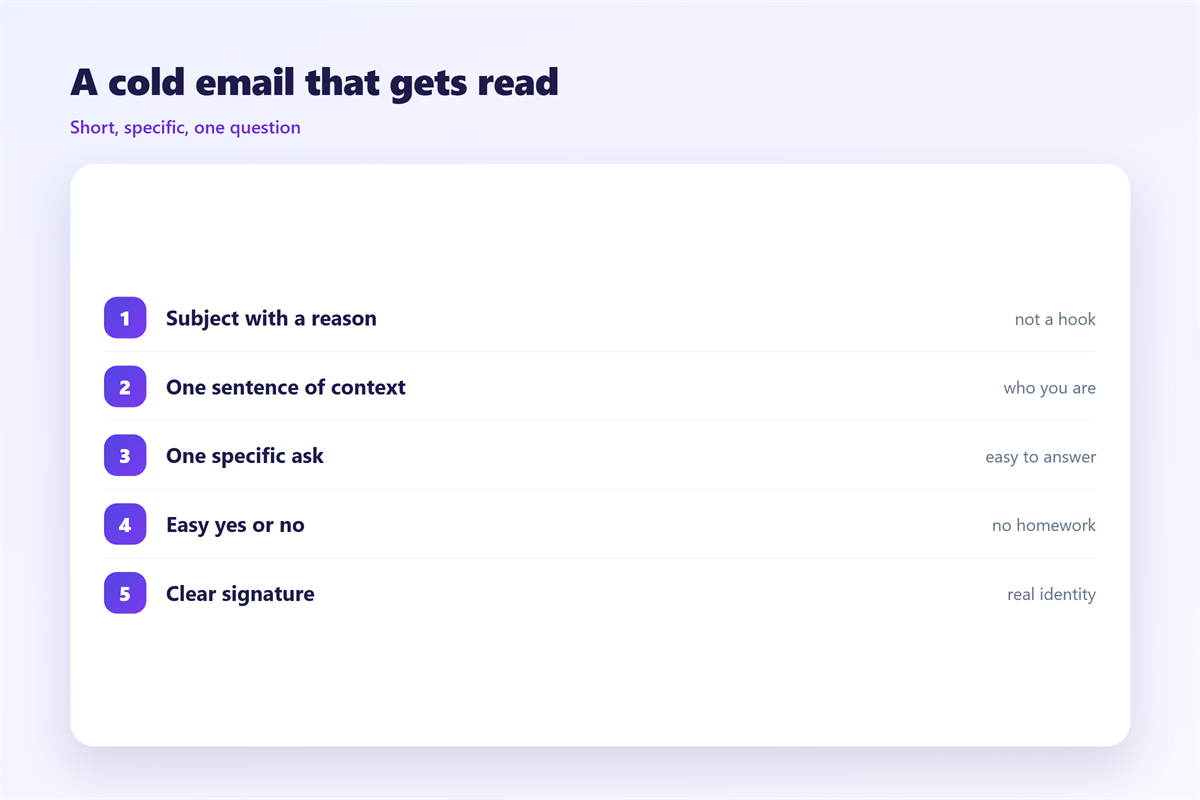
The ask deserves special care. A request for a short call is heavier than a request for a yes or no answer. Moreover, an easy question gets an easy reply, and that reply is the only thing you actually need. Our notes on 邮件标题 cover the line that decides whether the message is opened at all.
Where 邮件开发信 goes wrong
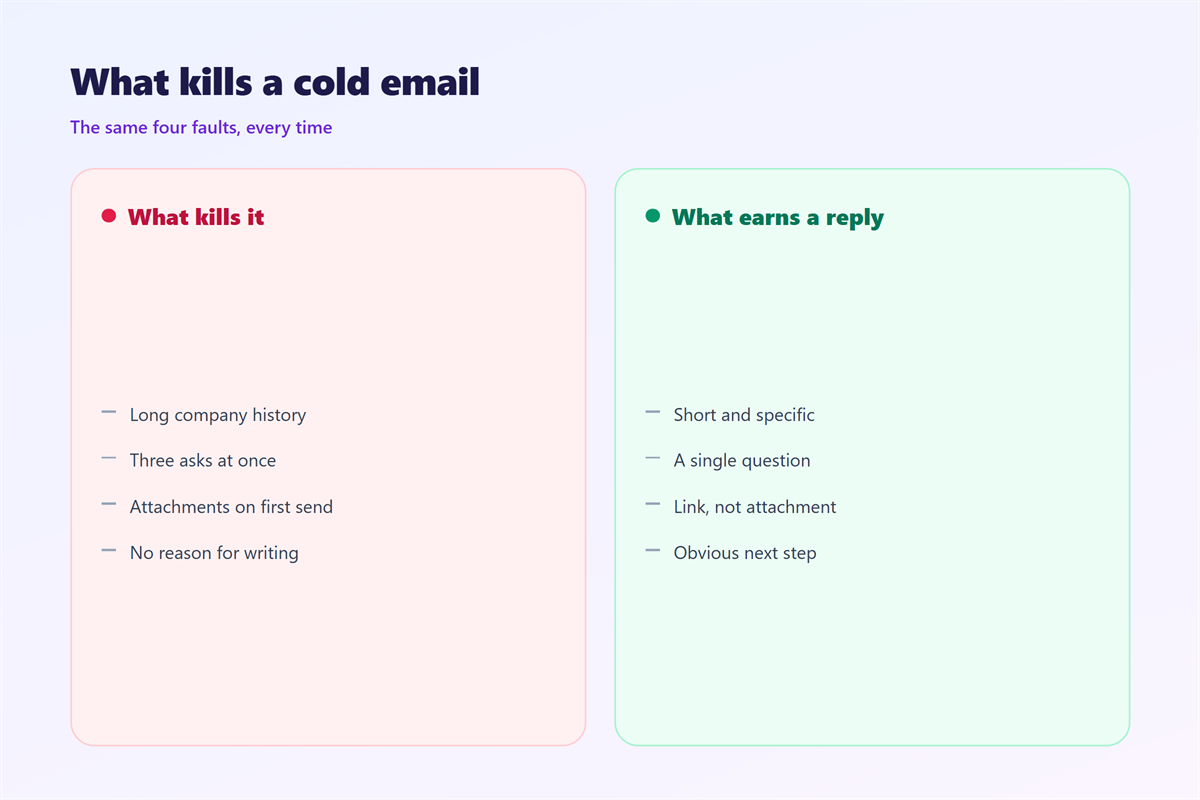
Three failures repeat. The first is a message that talks about the sender’s product for three paragraphs before it mentions the reader. The second is a false personal line, such as a compliment that would fit any company in the industry.
The third is volume used as a substitute for thought. When replies are low, the instinct is to send more, yet a larger batch from the same domain only damages the 邮件开发信 record you depend on. As a result, the next campaign performs worse than the one before it.
Attachments and heavy images cause a quieter problem. A first message with a file attached is more likely to be filtered, and a tracked link can look like bulk mail.
How to get 邮件开发信 right
Start with a list you can defend. Twenty names you actually researched will teach you more than two thousand scraped addresses, and the smaller list is easier to send from safely. Then write the message for one reader, not for a segment.
Keep a follow-up plan ready before the first send. Two short reminders, spaced a few days apart, are enough for most cases. Consequently, you never improvise a nudge, and you can stop cleanly after the third attempt without guessing whether to persist.
Write the reminder in advance
A good reminder adds one new piece of information instead of repeating the first note.
Measure the right number
Track replies, not opens. Opens are noisy, so a reply is the only signal that clearly reflects interest. As a result, even a small reply rate is useful evidence for the next 邮件开发信 you write.
Once the message is clean, the surrounding program matters as much as the text. Our guide to 邮件营销 explains permission and pacing, the walkthrough on 邮件跟进 covers the timing of each reminder, and for a hiring context the structure in 求职邮件 is worth copying.
FAQ
Is 邮件开发信 legal?
In many regions it is lawful when the message is relevant and includes a way to opt out. However, the rules differ by country, so check local requirements before a large campaign.
How many follow-ups should I send?
Two is a good default. A third can work, but beyond that the return drops and the risk to your 邮件开发信 reputation rises.
Does a plain text message perform better?
Often, yes. Plain text looks like a personal note and carries fewer tracking elements, so providers treat it more gently.
Should I use a tracking pixel?
I would not use one on a first message. It adds little that a reply does not already tell you, and it can signal bulk mail.
评论
还没有评论,来说两句吧。
评论功能已关闭。