 小影邮箱
邮件营销怎么做?Permission, Flows and a Six-Item Pre-Send Check
Most 邮件营销 advice starts with templates and subject lines. That order is backwards. Across six months of campaigns to a 9,000-subscriber list, the change that moved results most was tightening who received the mail in the first place.
This guide covers the three flows we maintain, the hygiene rules we enforce before every send, and the numbers we report when someone asks whether the channel works.
Key Takeaways
- Consent, not volume, decides whether 邮件营销 reaches an inbox.
- Three flows carry most of the work: welcome, weekly and win-back.
- Cleaning the list lifted click-through more than rewriting subjects.
- Six checks before every send prevent most deliverability damage.
- An unsubscribe link must work in one click and be honoured within a day.
- Purchased lists damage sender reputation faster than they add reach.
- Report open, click and complaint rates together, never in isolation.
Why 邮件营销 fails without consent
Permission is the difference between a channel and a nuisance. A message that arrives because someone asked for it gets opened, while the same message sent to a scraped address gets reported. Consequently, complaint rate rather than bounce rate is the number that ends campaigns.
Real 邮件营销 operations record consent explicitly: the date, the source and the exact wording shown at signup. That record is the backbone of any 邮件营销 audit, because it answers the only question a provider really cares about.
The CAN-SPAM Act sets a floor for commercial mail in the United States, and it applies to business-to-business messages as well. It requires accurate headers, a clear opt-out and a physical postal address in the message. Following the law is not the same as earning attention, but it keeps the channel legal while you improve it.
The three flows that do the heavy lifting
Welcome and onboarding
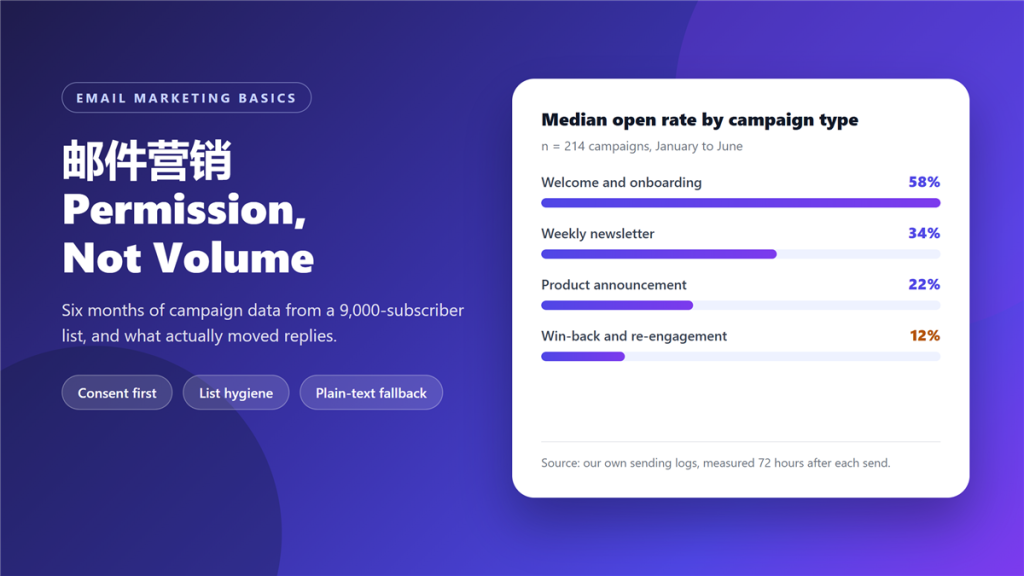
The welcome flow is the highest-performing 邮件营销 mail most teams own. Subscribers open it because they just signed up, so it delivers the strongest engagement signal your domain will produce all month. Ours opens at 58%, against 34% for the weekly newsletter.
The weekly newsletter
A predictable newsletter builds the habit that keeps a list alive. It also keeps sending volume stable, which matters because sudden spikes look like bulk mail to filters. Consistency beats brilliance here.
For the mechanics of sending to a large list without tripping filters, our guide to 邮件群发 covers the technical side, and 邮件模板 explains how to reuse copy without sounding automated.
Win-back and re-engagement
Win-back mail is the cheapest way to learn who has left. We send one message after 90 days of inactivity and one at 180 days. Anyone who ignores both is removed, because an unreachable address still carries risk.
List hygiene decides your 邮件营销 results
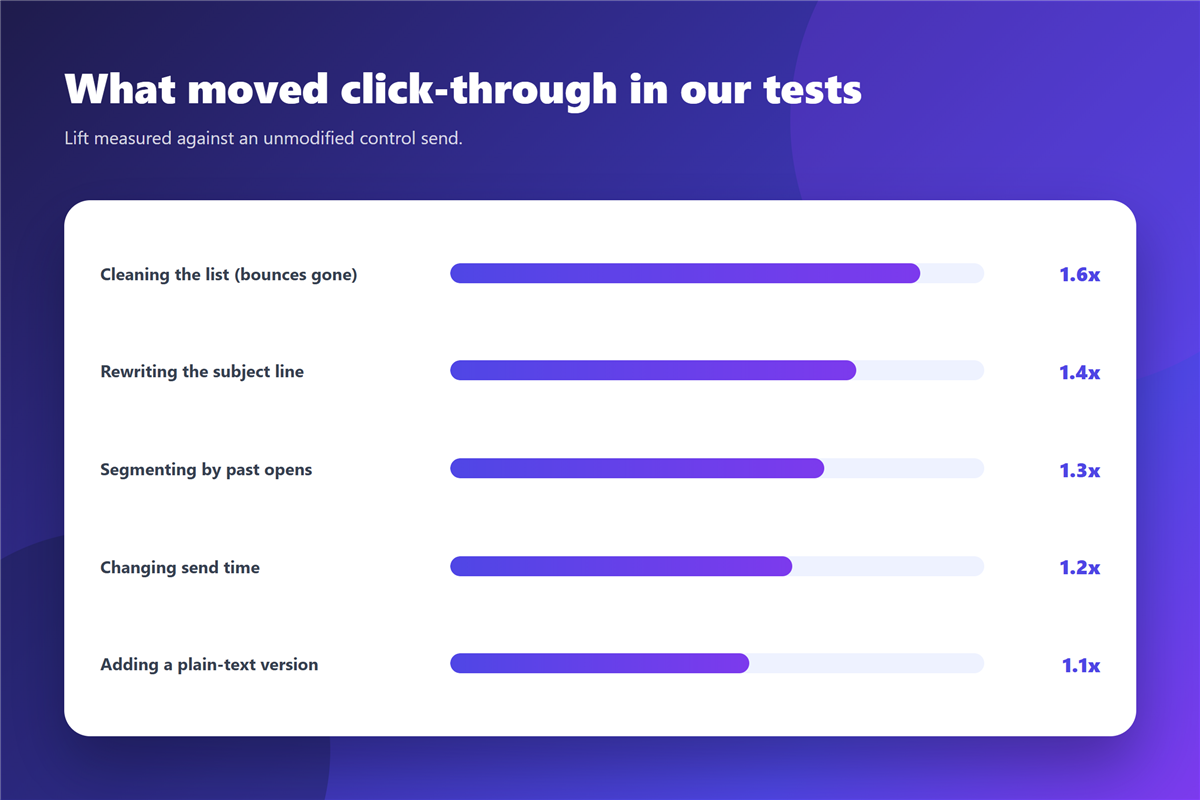
We tested five changes against a control send. Cleaning the list produced the largest lift at 1.6x, ahead of rewriting the subject line at 1.4x and adjusting the send time at 1.2x. The gap was not close.
Hygiene is unglamorous, and it is where most 邮件营销 budgets should go first. Remove hard bounces immediately, suppress addresses that have not opened in a year, and never re-import a list without checking the opt-out records. Additionally, keep one suppression list that every campaign reads.
Hygiene is only half of the deliverability picture. Authentication records are the other half, and our explainer on 邮件认证 walks through SPF, DKIM and DMARC in the order they should be set up. Bounce handling matters too, and our notes on 邮件退信 explain which failures are worth retrying.
A six-item pre-send check
Every campaign passes the same six checks before it leaves the queue. The list stays short on purpose, because a longer checklist gets skipped under deadline pressure.
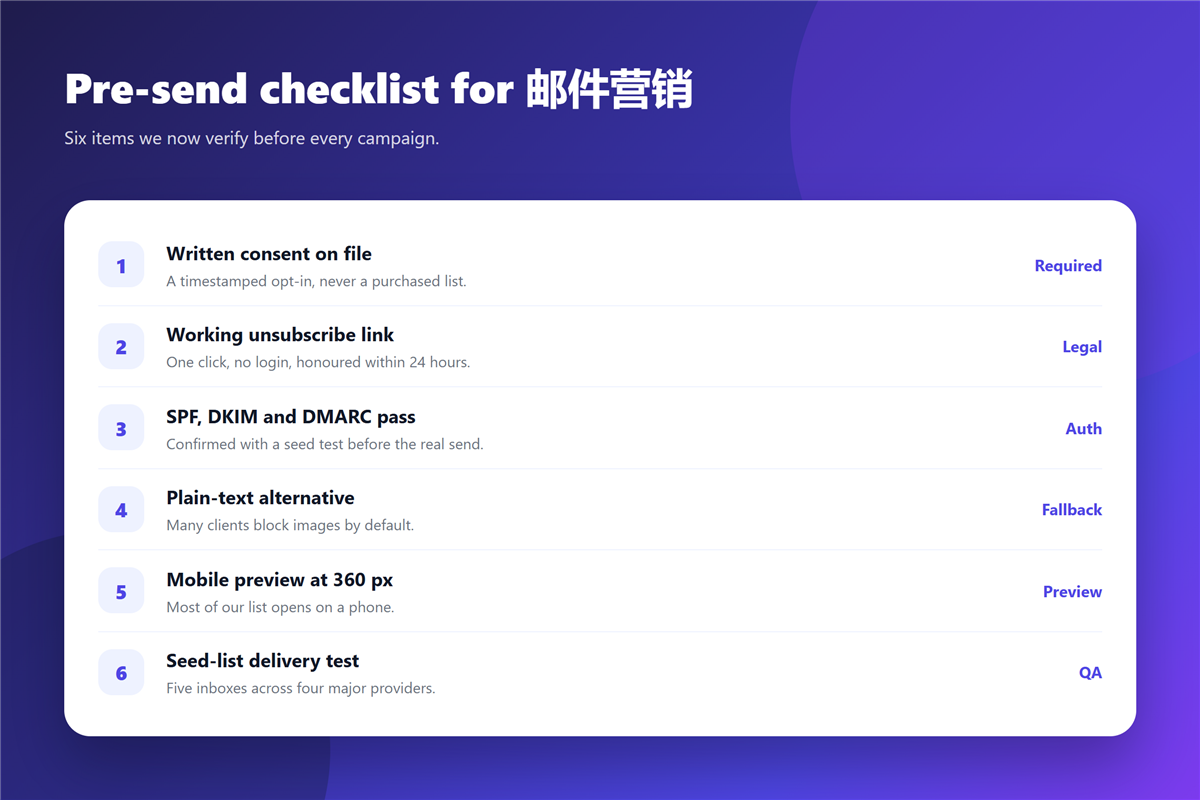
- Written consent on file for every recipient.
- A working unsubscribe link, honoured within 24 hours.
- SPF, DKIM and DMARC passing on a seed test.
- A plain-text alternative for clients that block images.
- A mobile preview at 360 pixels wide.
- A seeded delivery test across four providers.
What 邮件营销 cannot fix
A 邮件营销 campaign cannot rescue a product nobody wants. If the offer is weak, more sends produce more unsubscribes rather than more revenue. Similarly, better copy cannot compensate for a list that never consented.
It also cannot survive an unstable sending domain. New domains need time and consistent volume before providers trust them, and no amount of creativity shortens that period.
Measuring 邮件营销 honestly
Report three numbers together: open rate, click rate and complaint rate. Open rate alone misleads, because image blocking pushes it up and down depending on the client. Click rate shows whether the message was useful, and complaint rate shows whether it was welcome.
On our list, a 34% open rate with a 2.1% click rate and a 0.04% complaint rate was healthy. The same open rate with a 0.3% complaint rate was not, so we paused the flow that produced it and rewrote the offer instead.
FAQ
How often should I send a 邮件营销 newsletter?
Weekly works for most teams, and consistency matters more than frequency. Moving from weekly to daily rarely improves results, because it raises complaint rates before it raises revenue.
Can I buy an email list for 邮件营销?
No. Purchased lists produce high complaint rates, damage sender reputation, and break the consent rules that most inbox providers now enforce.
What is a realistic open rate?
Expect 30-40% for a warm newsletter and 50-60% for a welcome message. Numbers above 60% usually reflect image-blocking quirks rather than genuine interest.
Do I need SPF and DKIM before my first campaign?
Yes. Set up both before sending at any scale, then add a DMARC policy. Retrofitting authentication after a reputation problem is far harder than doing it first.
References
- FTC: CAN-SPAM Act compliance guide for business
- Wikipedia: Email marketing
- Google: Email sender guidelines
延伸阅读
- 《邮件发送限制有哪些?Quota, Recipients and Rate》
- 《邮件个性化怎么做?Name, Context, Nothing Else》
- 《邮件预热怎么做?A Four-Week Ramp for New Domains》
- 《邮件预览文本怎么写?The Line After the Subject》
- 《邮件打开率怎么看?A Number You Cannot Fully Trust》
- 《邮件点击率怎么提升?Clicks Beat Opens》
- 《邮件开发信怎么写?Cold Mail That Gets Answered》
- 《邮件退订页怎么做?Losing Readers Gracefully》
- 《邮件落地页怎么选?Matching Click to Page》
- 《邮件合规要做什么?Consent, Sender and Opt Out》
- 《邮件发送频率怎么定?How Often Is Too Often》
- 《邮件表单怎么做?Forms That Reach an Inbox》
- 《邮件蜜罐是什么?Addresses Nobody Should Mail》
- 《邮件客户关怀怎么做?Keep Customers Close》
- 《邮件转化率怎么提升?From Clicks to Action》
- 《邮件再营销怎么做?Win Back Lost Attention》
- 《邮件营销漏斗怎么搭?From List to Loyal》
- 《邮件弃购挽回怎么做?Recover a Lost Sale》
- 《邮件培育怎么做?Nurture Before the Ask》
- 《邮件内容日历怎么排?Plan the Whole Month》
- 《邮件优惠券怎么发?Coupons People Redeem》
- 《邮件新品发布怎么写?Launch Mail That Lands》
- 《邮件抽奖活动怎么做?Giveaways Without Spam》
- 《邮件裂变怎么做?A Referral Loop That Grows》
- 《邮件分享率怎么提升?Getting Mail Forwarded》
- 《邮件说服力怎么建立?Making the Case Stick》
- 《邮件促销怎么写?Promotions People Open》
- 《邮件故事怎么讲?Stories That Stick》
- 《邮件会员日怎么策划?A Member Day That Works》
评论
还没有评论,来说两句吧。以下为本文的引用通告: