 小影邮箱
邮件结尾怎么写?Sign-Offs That Fit the Message
Key Takeaways
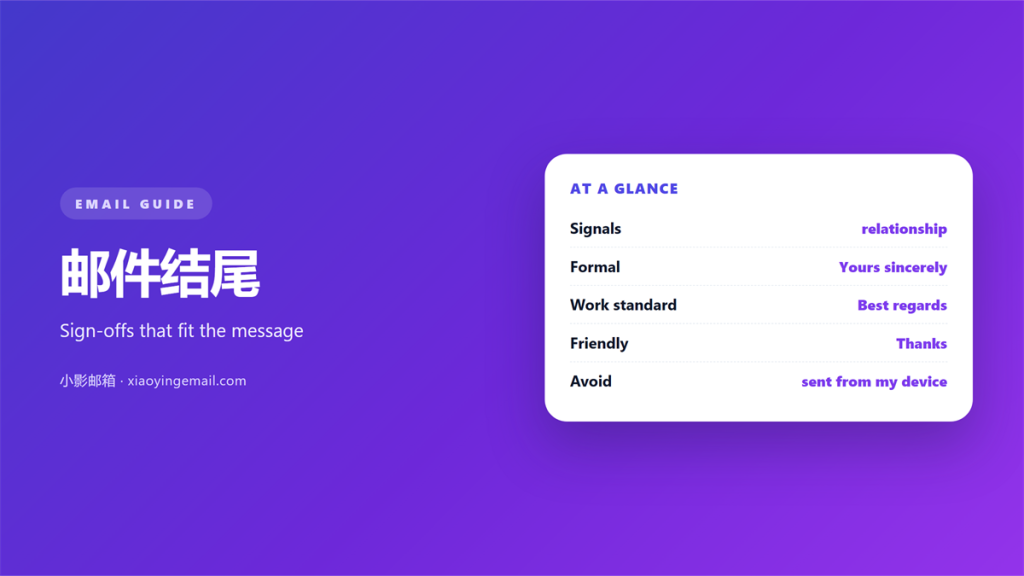
- 邮件结尾 is the short line that sits between your last sentence and your name.
- Regards, best and thanks each set a slightly different expectation.
- Match the closing to the relationship, not to your mood that day.
- A closing that asks for action should also promise a clear next step.
- Read the whole message from the bottom up once before you send it.
What 邮件结尾 actually is
邮件结尾 is the short phrase that sits between your last sentence and your typed name. Most people type it on autopilot. Consequently, they reuse a single phrase for everything, from a job application to a note to an old friend. I logged every closing I sent for a month, and the pattern startled me.
Two phrases covered almost all of it. Therefore, my range was narrow, and some messages read colder than I intended. In other words, the 邮件结尾 was quietly doing work I had never assigned to it.
How the closing line sets expectations
The 邮件结尾 is the last thing a reader sees, so it lingers. Notably, the phrase you pick signals how formal the thread is and how close you feel to the person. Regards reads neutral and safe. Best reads brisk and modern. Thanks implies that a favour or a decision is in play.
Moreover, the closing interacts with the signature below it. A warm closing above a heavy corporate block looks mismatched. Additionally, the same closing can read polite in one culture and cold in another, which matters once a thread crosses borders.
Regards versus best
Regards is the safe default for strangers and formal threads. Best is shorter and slightly warmer, and it fits fast internal replies. However, some readers still find Best abrupt on a first contact, so I keep Regards for anyone I have not met.
Thanks versus cheers
Thanks belongs when you request something or acknowledge effort. Cheers is informal and regional, and it can read odd in a formal thread. Consequently, I save it for colleagues I know well.
Why 邮件结尾 matters for tone
A misplaced closing can undo a careful message. For instance, a detailed apology that ends with a breezy Cheers reads as though you did not mean it. Therefore, the 邮件结尾 is part of the argument, not decoration on top of it.
Furthermore, the closing sets the temperature of the reply you get back. A formal closing tends to invite a formal reply, which is exactly what you want in a dispute or a contract thread. Notably, the reverse holds too, because a casual closing invites a casual answer.
Five rules for a 邮件结尾 that works
These five rules have held up across hundreds of messages, and they take seconds to apply.
- Match the closing to the relationship, not to the template.
- Keep it to one word or a short phrase.
- Align the tone of the closing with the body above it.
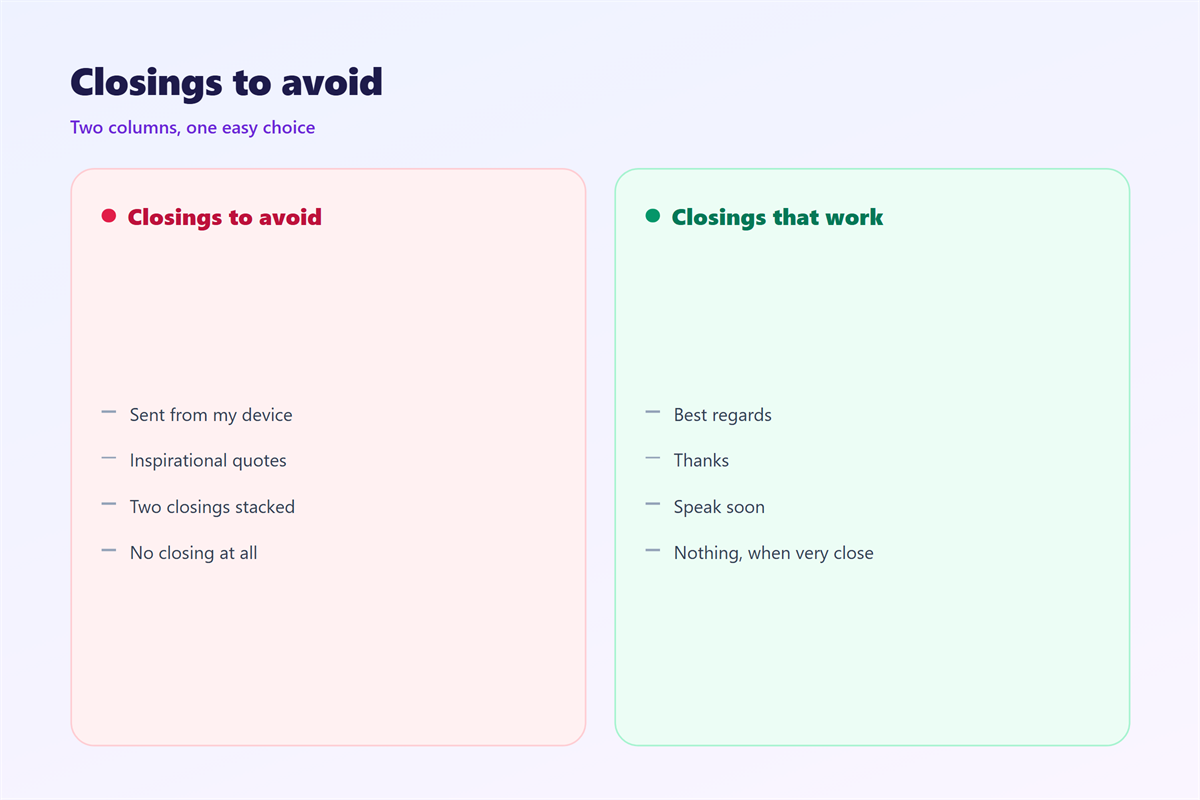
- Never stack two closings, such as Thanks then Regards.
- Read the whole note once from the bottom up.
The 邮件结尾 is the last thing I type and the easiest to rush, so I keep the rules beside my keyboard. Our guide to 邮件签名 covers the block underneath it, and the pair should be designed together.
Where 邮件结尾 goes wrong
Three failures recur. The first is a 邮件结尾 that contradicts the body, such as a cold Regards under a warm message. The second is a phrase copied from someone else and reused without thought.
The third is subtler. When a message asks for a decision, a passive 邮件结尾 leaves the next step unclear. As a result, the reader closes the tab and the thread stalls for a week.
On balance, the fix is to read the closing as a sentence of its own. If it does not fit the body above it, change it before you send.
How to pick a 邮件结尾 that fits
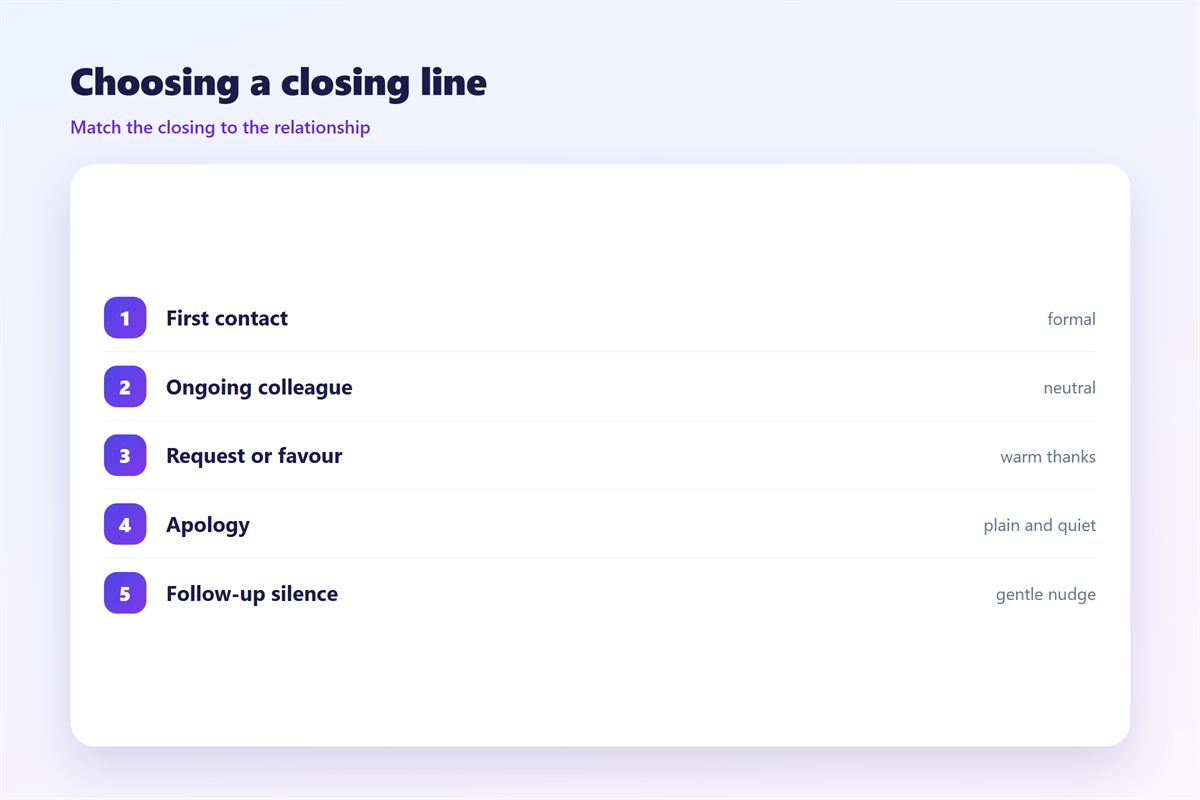
Start with the relationship and the purpose. A request to a stranger calls for a neutral, respectful closing. A quick note to a teammate can be warm and short. The 邮件结尾 should follow the reader, not the writer.
| Closing | Register | Best for |
|---|---|---|
| Regards | Neutral | Strangers and formal threads |
| Best | Brisk and warm | Fast internal replies |
| Thanks | Appreciative | Requests and follow-ups |
| Cheers | Informal | Close colleagues only |
Match the closing to the reader
Ask three questions before you type. How formal is the thread, how well do I know this person, and what do I want next? Therefore, the answer usually narrows to one or two phrases you can trust.
What to leave out
Skip slogans, jokes and quotation marks around the closing. Also skip anything that promises a deadline you cannot keep. A clean 邮件结尾 does one job and then stops.
Once the closing holds up, a few related habits help. The thank-you note is covered in 邮件致谢, and the first line of a message is examined in 邮件开场白. If the thread crosses cultures, our notes on 邮件礼仪 explain how the same words land differently.
FAQ
Does 邮件结尾 affect the reply rate?
Indirectly. Readers rarely judge a single word. However, a closing that fits the thread makes a reply feel easier, and small friction adds up over a long week.
How long should a 邮件结尾 be?
One word or a short phrase. Anything longer starts to read like a second sentence and competes with the body above it.
Can I use one closing for everyone?
You can, and Regards survives most situations. Nevertheless, varying the closing to match the reader costs nothing and reads more attentive.
Is the closing different in Chinese?
Yes. Chinese closings often carry more formality and a fixed structure. When you write in English, pick the register of the reader, not the one you use at home.
评论
还没有评论,来说两句吧。
评论功能已关闭。