 小影邮箱
邮件错误代码怎么看?SMTP Codes Decoded
Key Takeaways
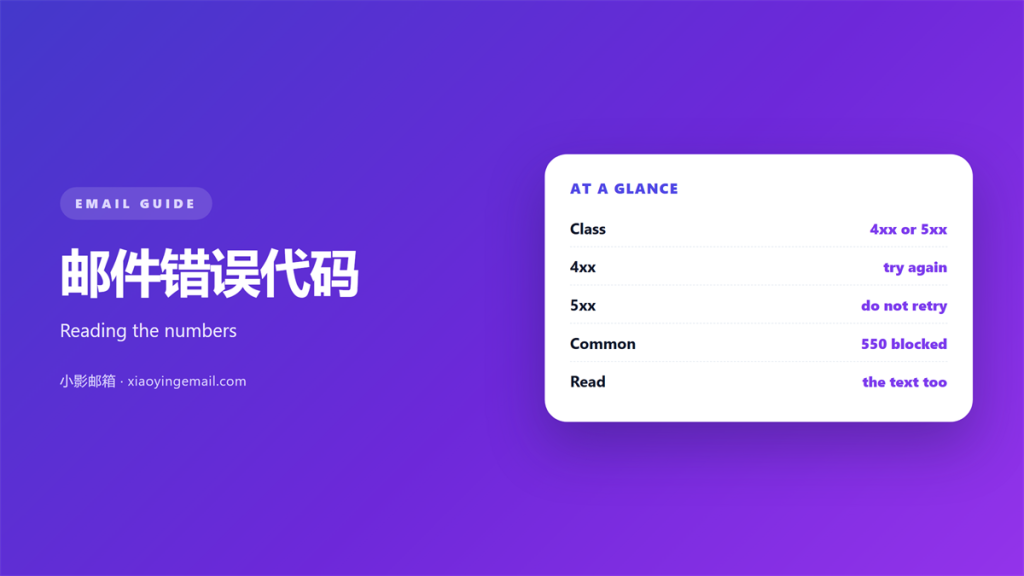
- 邮件错误代码 are short, numbered sentences from another machine, and they are worth learning slowly.
- The first digit gives the class: 4xx means try again, 5xx means do not.
- The text after the number names the problem far more precisely than the number alone.
- Most 邮件错误代码 you will meet come from a handful of causes: a bad address, a full mailbox, or a blocklist.
- Read the 邮件错误代码 before the message, and the message before you rewrite anything.
What 邮件错误代码 are telling you
邮件错误代码 are the server’s way of explaining a refusal in a single line. They appear in a bounce message, in a client’s error panel, or in a log, and they almost always follow the same shape: a three-digit number, then a short human-readable reason.
Learning to read them is not about memorising a table. It is about recognising which part of the sentence blames you and which part blames the recipient’s server, because only one of those is yours to fix.
A code is a symptom, not a diagnosis. The same number can come from a typo in an address or from a genuine blocklist entry, and the words after the number are what separate the two.
It also helps to notice who is speaking. A permanent refusal usually comes from the destination, saying it will not accept the message, while a failure with no reply at all often comes from your own side before anything ever left.
Reading a 邮件错误代码 in three parts
Every 邮件错误代码 breaks down the same way, and once you see the three parts you cannot unsee them.
Where a 邮件错误代码 begins: the class digit
The first digit sets the expectation. A four means a temporary condition that may clear on its own. A five means a permanent one that will not.
The second digit narrows the cause
Within the class, the middle digit groups the problem: syntax, connection, or mailbox. It tells you which layer to look at first.
The third digit and the text
The last digit refines the class further, and the sentence after it names the actual failure. In practice the text is the most useful part and the number is the index.
The 邮件错误代码 worth memorising
You do not need the whole registry. A handful of 邮件错误代码 cover almost everything a normal sender meets in a working week.
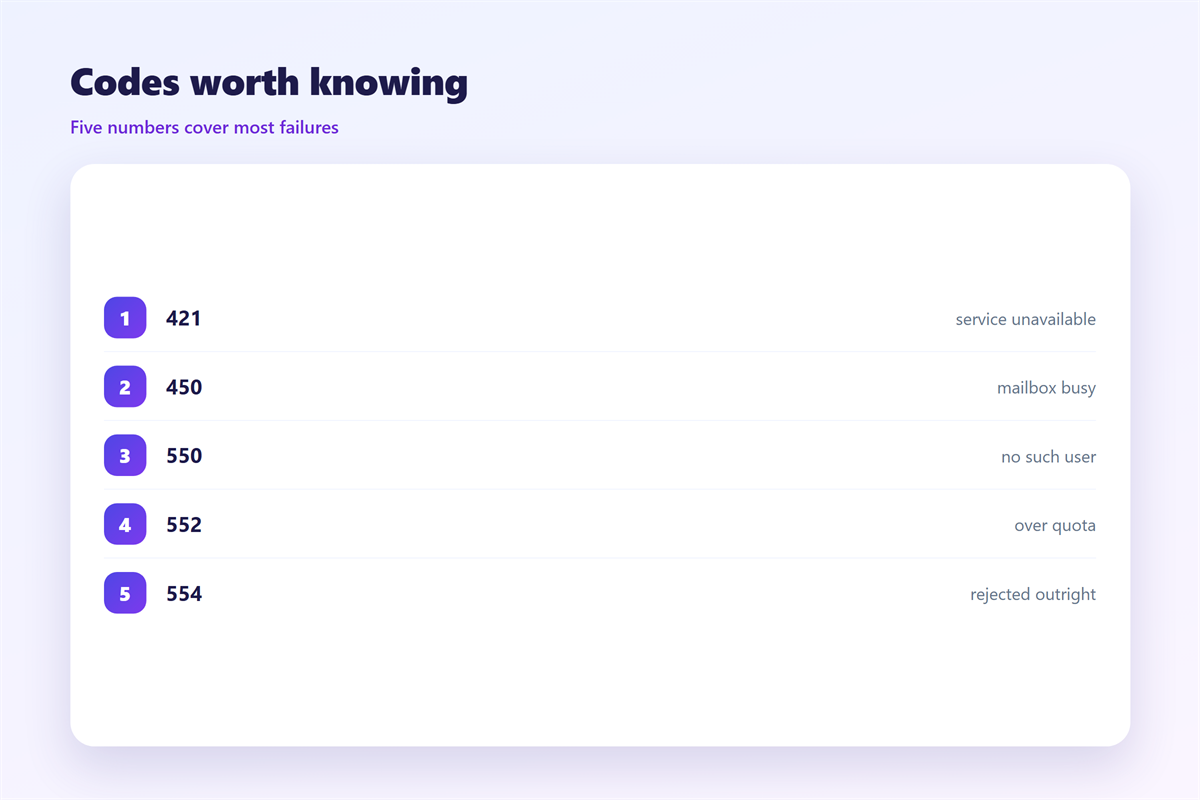
421 service not available means the server was busy or briefly unreachable, so retry later. 450 or 451 means a temporary failure at the destination, often greylisting. 550 is the blunt one: the mailbox does not exist or the message is refused outright. 552 means the mailbox is over quota, and 554 is a generic rejection from a filter.
A hard bounce is a 5xx you cannot argue with, which is exactly what 邮件退信 separates from the softer kind. When the failure happens before the server accepts anything at all, it belongs with 邮件发送失败 instead.
Between those, codes like 250 and 354 are not errors at all. They are the ordinary, polite replies that mean the server accepted a command and is ready for the next one, so seeing them in a log is a sign of health rather than trouble.
Retry, rewrite, or stop
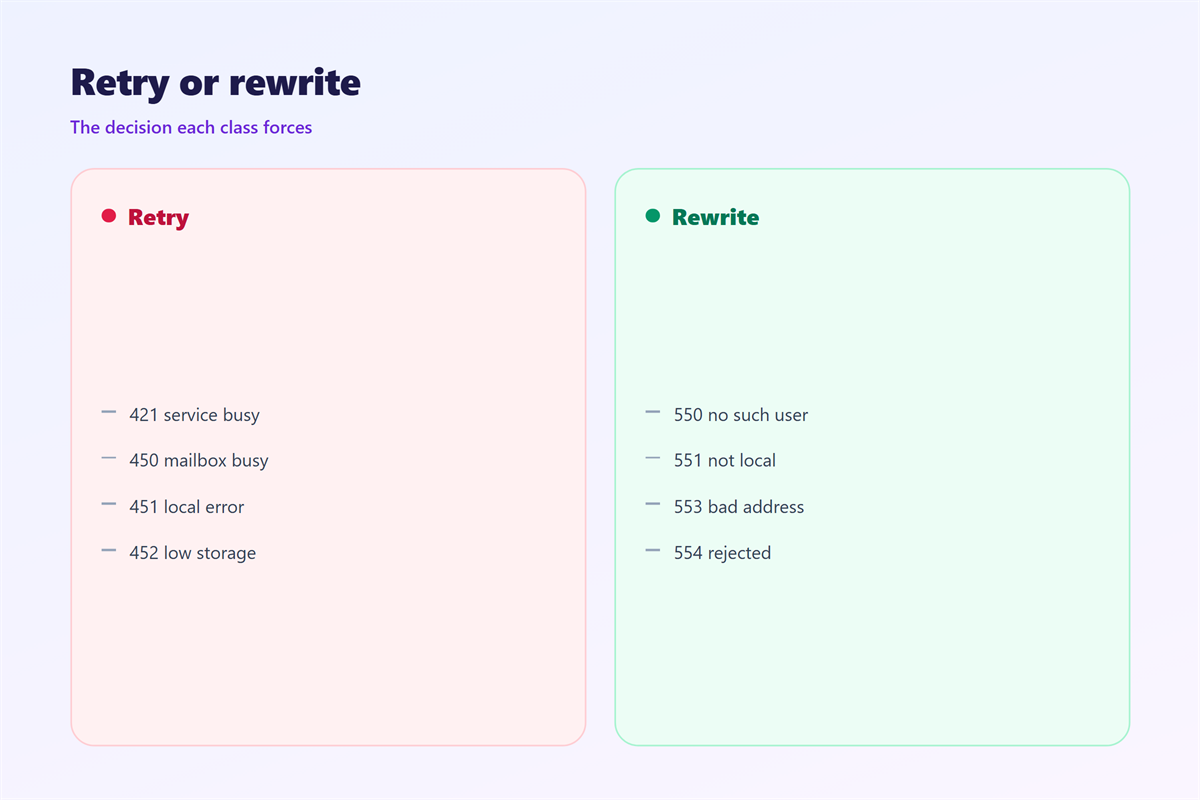
The class digit answers this faster than any troubleshooting page. A 4xx is a retry, ideally with a delay that grows each time. A 5xx is a rewrite, because repeating it unchanged wastes both servers’ time.
Two exceptions are worth knowing. A full mailbox returns a 5xx but often clears within a day, so patience is not laziness. And a temporary blocklist entry can look permanent while it is not, which is why the wording of the 邮件错误代码 matters more than the number.
When the same 邮件错误代码 keeps returning, the cause is usually upstream of the message: the sender, the sending domain, or the 邮件服务器 handling the handoff. 邮件延迟 covers the queueing that follows a stubborn retry.
A 邮件错误代码 checklist
Read the number, then read the words. If it starts with four, wait and retry. If it starts with five, fix the address or the content before trying again. Keep the full reply, because the detail you cut is often the clue.
Then act once rather than repeatedly. A code that survives a corrected address and a patient retry is usually a question for your provider, not for the next attempt.
Where these replies appear
The same line surfaces in three places. A bounce message folds it into prose near the top. A mail client shows it in a small error box after a failed send. A server log lists it line by line, each entry stamped with a time. For one failed message the bounce is enough; for a pattern, the log is the only place where the shape of the problem becomes visible.
Reading them side by side is what turns a wall of numbers into a story about one broken address or one overworked server.
FAQ
What does a 4xx 邮件错误代码 mean?
It means the sending attempt failed for a temporary reason and may succeed later. Waiting a few minutes or hours and trying again is the right response.
Is every 5xx 邮件错误代码 permanent?
Nearly, but not entirely. A full mailbox returns a 5xx and often clears, so a single hard-looking code is worth one more attempt the next day.
Where do I find the 邮件错误代码?
It is in the bounce message your provider sends back, or in the error details your mail client shows after a failed send.
Should I quote the 邮件错误代码 in a support request?
Yes. Paste the full line including the text, since it tells the person helping you which server refused and why.
References
- IETF RFC 5321: Simple Mail Transfer Protocol
- IETF RFC 3463: Enhanced Mail System Status Codes
- Wikipedia: Simple Mail Transfer Protocol
评论
还没有评论,来说两句吧。
评论功能已关闭。