 小影邮箱
邮件预约怎么做?Confirm a Time in One Reply
Key Takeaways
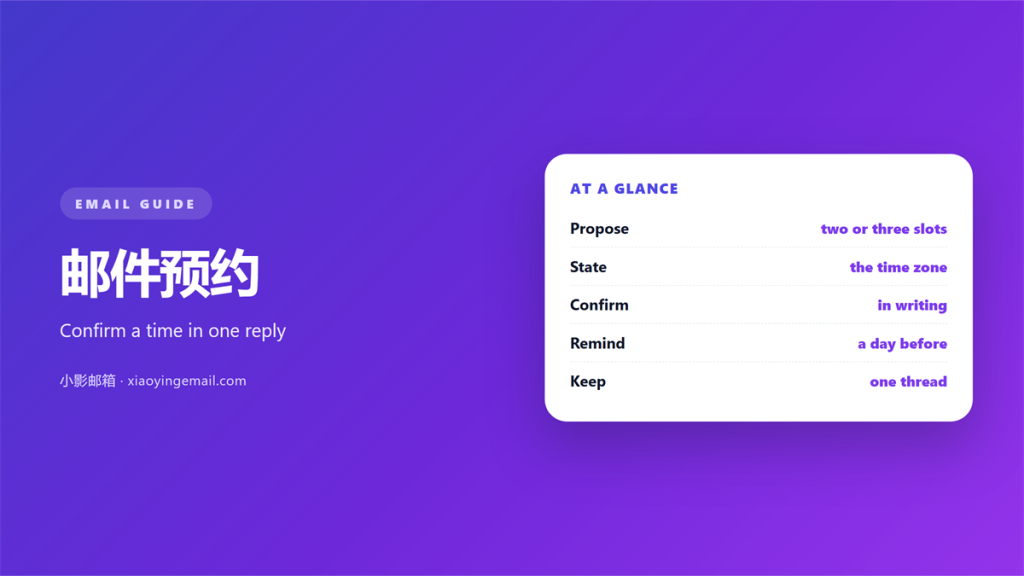
- 邮件预约 works when one clear time is offered.
- A single thread beats five scattered replies.
- Always repeat the date and the time zone.
- A short reminder cuts missed meetings.
- Confirm in writing to protect both sides.
What 邮件预约 means
邮件预约 is simply the act of agreeing on a time by email.
One person proposes a slot and the other person accepts it.
If the first slot does not fit, the reply suggests a different hour.
The whole exchange stays inside one thread, so no extra tool is required.
Most people already book meetings this way without giving it a name.
The trouble starts when the thread grows and more people join in.
Soon nobody is entirely sure which time survived the long chain of replies.
A clear subject line prevents that drift before it starts.
Keep the final date in the subject and repeat it in the first line.
Write the hour, the zone and the expected length of the meeting.
Then ask for a plain yes or a plain no, nothing softer.
That small habit turns a messy chat into a firm 邮件预约.
Where 邮件预约 happens
A booking can start in many places, yet most of them lead back to the inbox.
A phone call often ends with a vague promise to send the details later.
That follow up message is where 邮件预约 really begins.
Calendar tools help a lot, but they are never strictly required.
A plain message can do the same job when both sides read it carefully.
A clear 邮件预约 names the day, the hour and the zone in one line.
The weak point is the handover between a spoken deal and a written one.
A time agreed by voice can be lost the moment somebody starts typing.
So put the agreed time at the top, not buried under friendly small talk.
- Subject: put the date and the time in it.
- Body: repeat the time in plain words.
- Zone: name it and never simply assume it.
- Reply: ask for a short, clear yes.
Those four habits remove most confusion between two busy people.
They also make the 邮件预约 easy to find again months later.
When 邮件预约 goes wrong
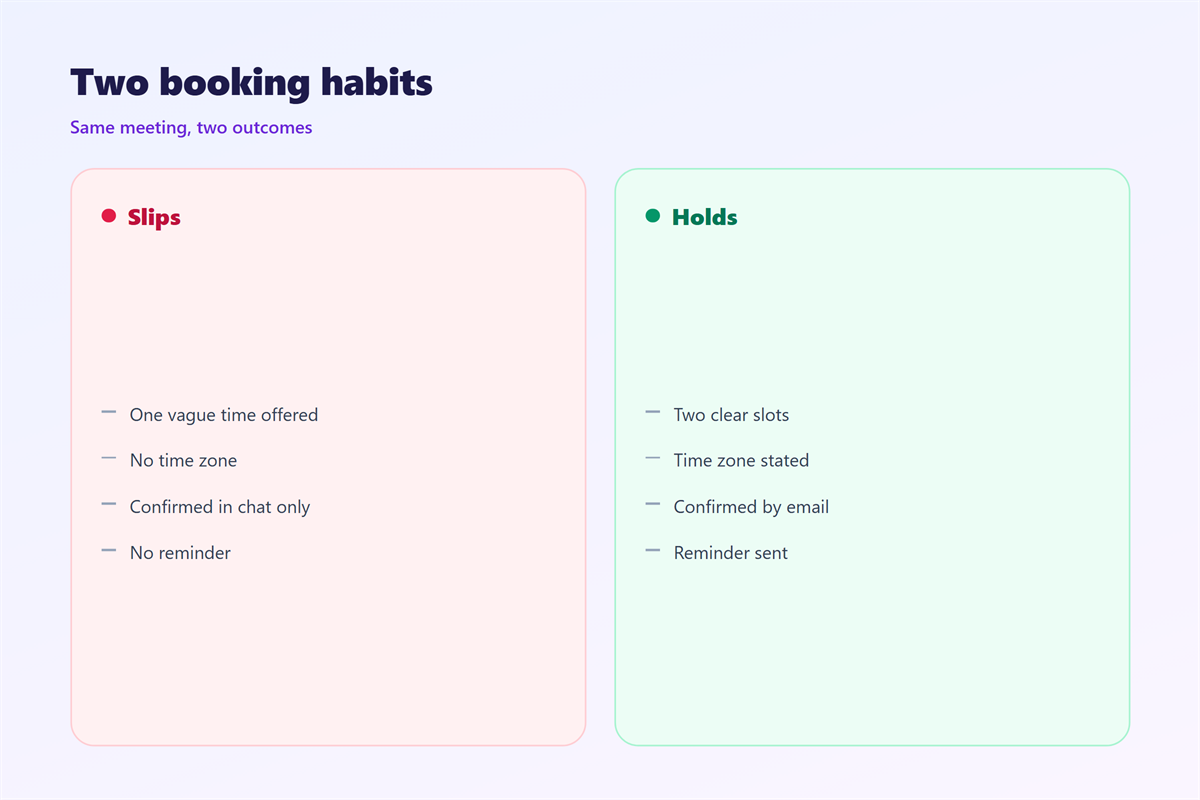
Two kinds of failure spoil a booking and both waste real time.
The first failure is an unclear message that leaves room to guess.
A vague offer such as next week sounds friendly but says almost nothing.
The second failure is quieter, because the reply arrives and is then forgotten.
A late change is the hardest kind of 邮件预约 to manage well.
A missed slot can waste a whole afternoon for two or three people.
Time zone errors stay a classic cause of missed calls every year.
Nine in the morning sounds exact until you ask in whose city.
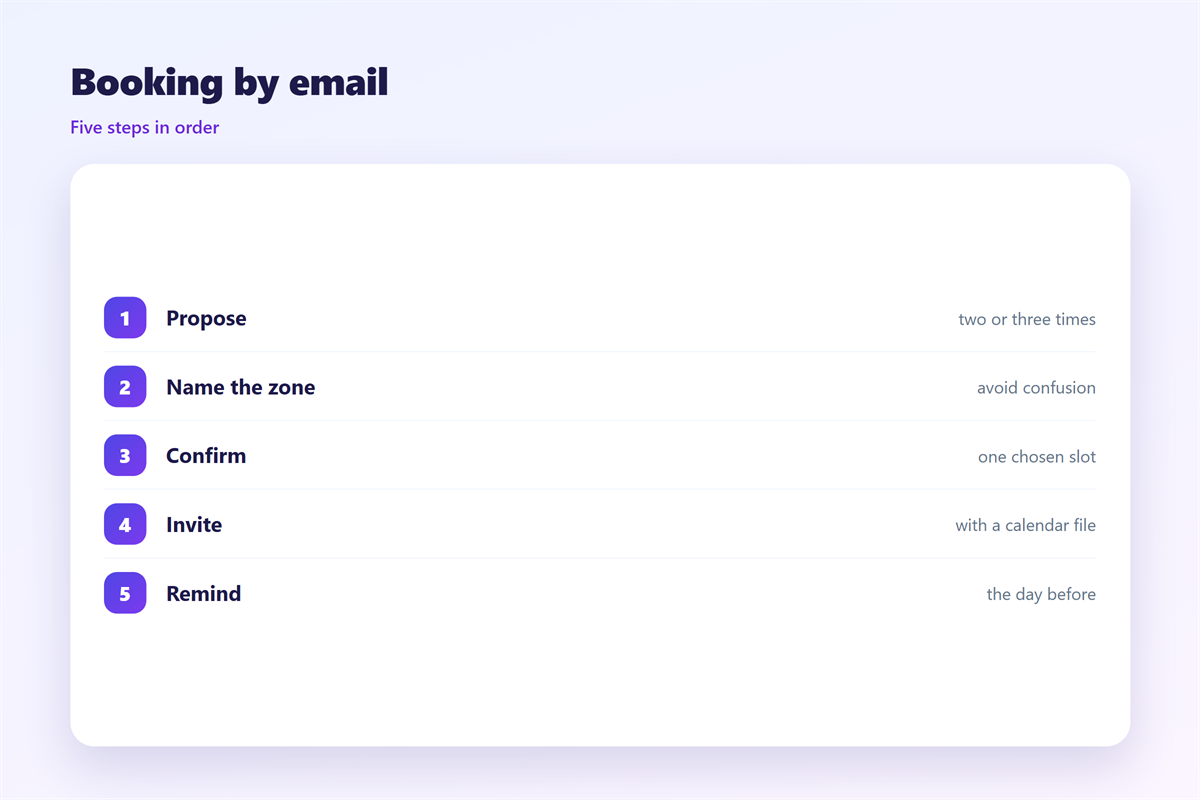
Always write the zone right next to the hour and the day.
That single habit removes a surprising number of quiet mistakes.
Another cause of confusion is a crowded thread with many voices.
New replies push the actual offer further and further out of sight.
A fresh subject line solves that problem in a second.
Start a new message with the final time in the subject.
Then the 邮件预约 stands alone and is simple for anyone to find.
Testing your 邮件预约
You can test the whole process in only a few minutes.
Send a booking request to a colleague and watch how the reply returns.
Does the answer repeat both the time and the zone clearly?
If it does not, your wording is too loose and needs a small fix.
Tighten the template until a busy person can answer in one line.
Then check any calendar link and click it yourself.
Confirm that the slot appears on the correct day and hour.
Keep the 邮件预约 short and specific from the very first line.
A broken link can defeat an otherwise perfect 邮件预约.
Run the same test once a quarter to catch quiet changes.
Small updates to tools can break a flow that once worked well.
A two minute check today can save a missed meeting next month.
Releasing a slot from 邮件预约
Sometimes a confirmed time has to change, and that is completely normal.
Handle the change early and put it in writing straight away.
Send a short note well before the meeting is due to start.
Apologise once, then offer two new times that both fit you.
Do not explain at great length, because a brief reason is enough.
Ask the other side to pick one, which keeps the 邮件预约 alive.
Our notes on 邮件日历邀请 explain when meetings go missing. The proof of a decision is described under 邮件确认. Reminders are covered in 邮件提醒, and reusable wording sits under 邮件模板.
Keep every change inside the original thread for a clean record.
That record settles any later doubt about what was agreed.
If the other side goes quiet, send one polite reminder.
Then stop and wait, because a second nudge can feel like pressure.
Two clear reminders are usually plenty for any booking.
FAQ
Is a reply enough to confirm 邮件预约?
Usually yes. A written yes from the other side is a clear record. Save it where you can find it.
Should I repeat the time zone?
Always repeat it. People travel and forget. One short line removes the doubt.
What if the other side never answers?
Send one reminder after a day. If silence continues, treat the slot as open. Offer it to someone else.
Do I need a calendar tool?
No. A clear message is enough for most bookings. Tools help when many people share one diary.
评论
还没有评论,来说两句吧。
评论功能已关闭。