 小影邮箱
邮件补充说明怎么写?A Short Addendum

Key Takeaways
- 邮件补充说明 adds a small fact you missed earlier.
- Label it clearly so the reader knows what changed.
- Keep it short and never bury the main point.
- Send it only when the detail truly matters.
- A tidy addendum looks careful, not careless.
What 邮件补充说明 means
邮件补充说明 is a short note that adds to an earlier message.
It usually carries one fact, one file, or one correction.
The phrase simply means a supplement to the main text.
People often mix it up with a casual afterthought.
An addendum has a job. An afterthought does not.
It may arrive right after the first note.
Or it may follow later, once new details appear.
Either way, it stays brief and pointed.
Learned well, a 邮件补充说明 keeps a thread honest.
It never tries to restart the whole conversation.
The name itself explains the purpose.
You are adding, not replacing the first message.
Keep it focused on the one thing that changed.
Why 邮件补充说明 matters
Small facts often surface after you press send.
A number is wrong. A date moves. A file is missing.
Without a fix, the reader keeps an old plan.
A 邮件补充说明 corrects that gap in seconds.
It protects the work and the reader’s trust.
Silence, by contrast, invites a costly guess.
A reader who guesses may act on the wrong detail.
One clear note prevents that quiet mistake.
Trust grows when the facts stay current.
A quick fix shows you pay attention.
Readers value honesty more than a perfect first draft.
When a detail slips through
Most slips are tiny and easy to forgive.
An omitted line item rarely ruins a project.
Yet a wrong deadline can cost a whole day.
Send the addendum when the cost of the slip is real.
When to send a 邮件补充说明
Send one when a fact changes the reader’s plan.
Send one when you left out a key instruction.
Send one when a file failed to attach.
Skip it for a typo the reader will never notice.
Skip it when the point is already clear.
Skip it when a quick chat would settle things faster.
Timing matters as much as the wording itself.
Send it while the topic is still fresh.
A quick note also shows the project is moving.
Cases that fit and cases that do not
A corrected figure always deserves a short note.
A moved meeting time also earns one.
A forgotten pleasantry does not need a second send.
Let the stakes decide, not your own nerves.
How to write a 邮件补充说明
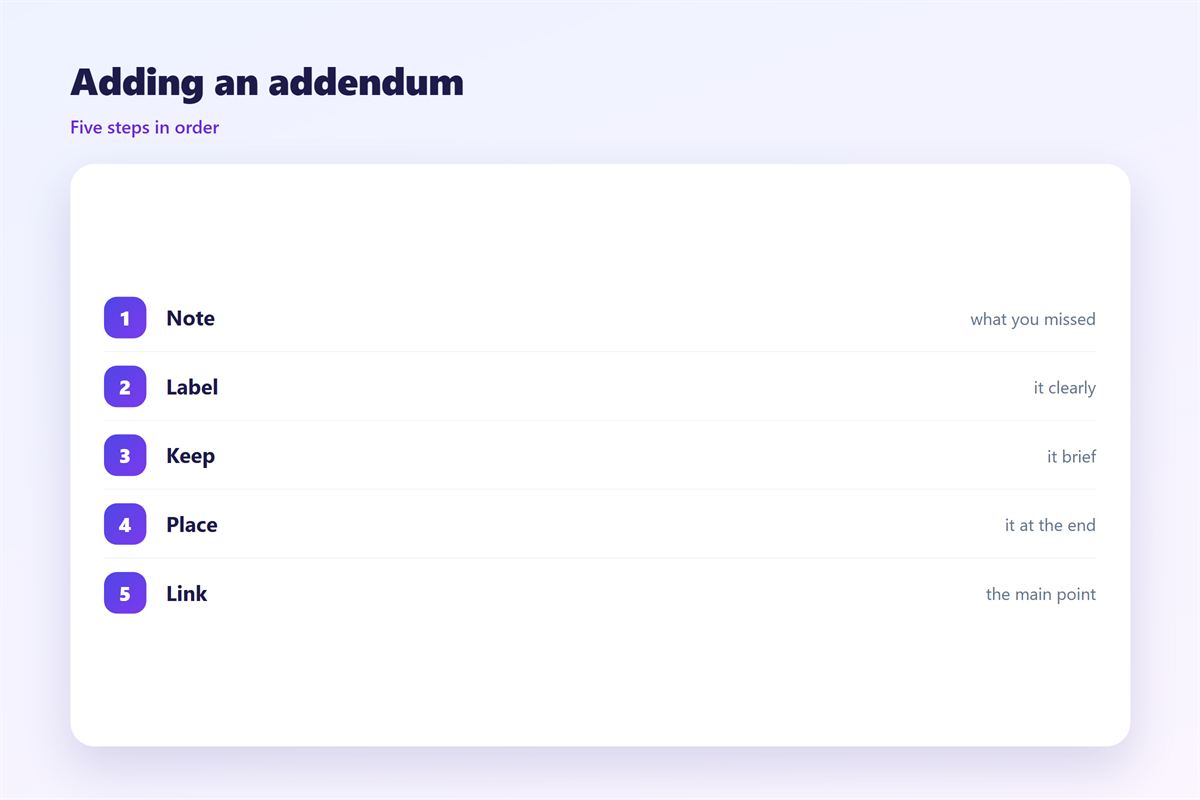
Open with a clear and honest label.
Name the point you are adding or fixing.
Give the new fact in one plain line.
Then stop. Do not rewrite the whole message.
Close with a short thank you and your name.
That is all a 邮件补充说明 needs.
Plain words beat clever phrasing here.
Keep the tone as calm as the first note.
A short label that works
Try a simple line such as a quick addition to my notes.
Another option is one correction to point three.
Both tell the reader what to expect at once.
A clear label saves a second of confusion.
Where a 邮件补充说明 belongs
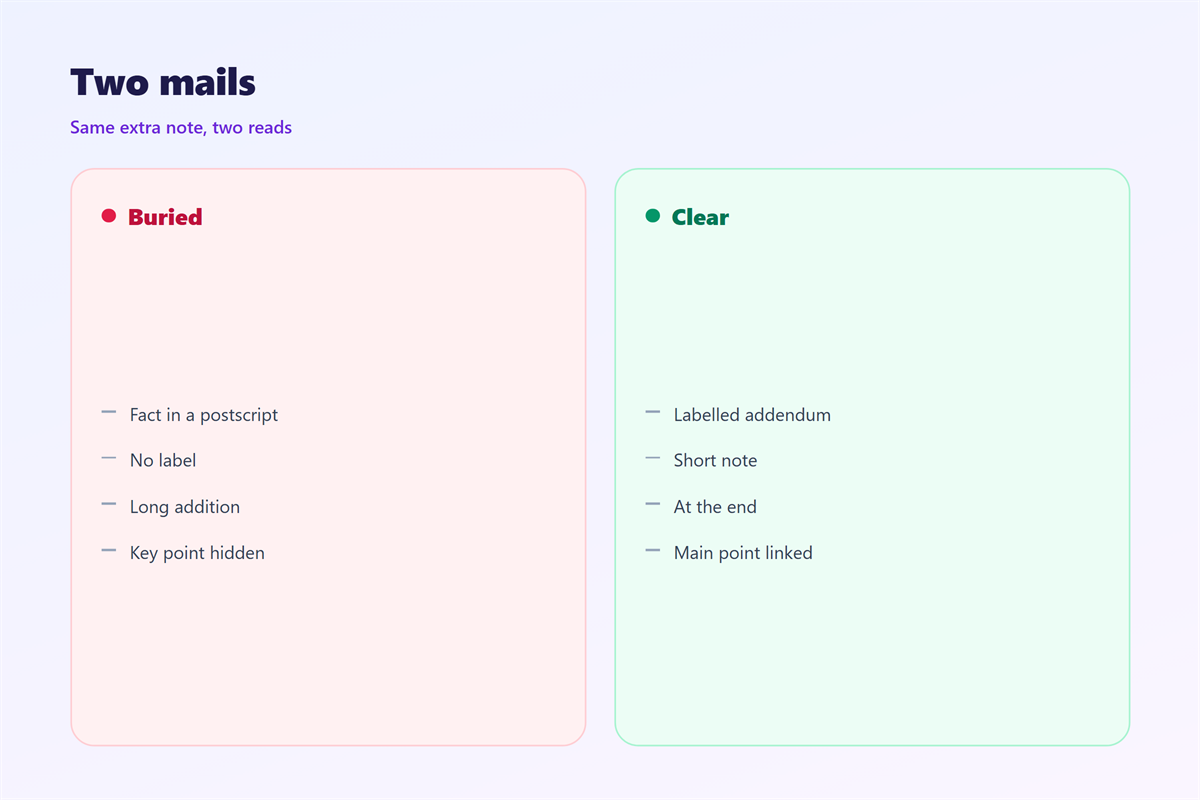
Place the note where the eye will find it.
A short line near the top works best.
The very bottom can hide it from a busy reader.
So avoid burying a key fact in the footer.
Treat a 邮件补充说明 with the same care as the main text.
A well-placed note gets read at once.
Some teams add a short heading for clarity.
That small label helps the eye land.
Mistakes that weaken a 邮件补充说明
Some notes grow into a second full message.
Others bury the correction in a long story.
Some repeat the whole thread for no reason.
All three waste the reader’s time.
Keep the addendum small and direct.
Say the new fact and then let go.
Never use an addendum to hide bad news.
State the issue in the main line first.
Never let an addendum replace a proper reply.
Signs your addendum is too long
If it takes three paragraphs, it is too long.
If it needs an apology for the apology, trim it.
If the reader must scroll, start over.
Aim for four lines or fewer every time.
Building a 邮件补充说明 habit
Review each message once before you send it.
Catch the missing number and the missing file.
When you must add later, do it at once.
Prompt fixes keep trust high.
Late fixes look careless and thin.
Then your 邮件补充说明 stays a small, rare tool.
Keep a simple checklist beside your drafts.
Run it before every important send.
Small repairs are cheaper than a large apology.
Keeping 邮件补充说明 clear and consistent
Consistency turns a small habit into a steady one.
The structure of a full message is covered in 邮件正文.
The short line after the sign-off appears in 邮件附言.
How to catch small slips is explained in 邮件校对.
The timing of a later message appears in 邮件跟进.
Match the same neat style across every note.
Readers trust a 邮件补充说明 that always looks tidy.
Agree on one format with your whole team.
A shared style removes doubt and delay.
FAQ
Is 邮件补充说明 the same as a postscript?
No. It stands alone, while a postscript trails a sign-off.
How soon should I send one?
As soon as you notice the gap, ideally within the day.
Can a 邮件补充说明 fix a big mistake?
It helps, but a phone call serves better for a large error.
Should I apologize inside it?
Briefly. One calm line is enough.
References
- Chicago Manual of Style: Editing and citation
- Microsoft Support: Outlook message tools
- HubSpot: Writing a clean follow-up email
评论
还没有评论,来说两句吧。
评论功能已关闭。