 小影邮箱
邮件灰名单是什么?Why First Delivery Is Delayed
Key Takeaways
- 邮件灰名单 delays a first-time sender instead of rejecting them.
- The server answers with a temporary code, so a real mail server simply retries.
- Spam bots usually do not retry, which is the whole point of the filter.
- Typical delays run from a few minutes to about an hour.
- Once a sender is recorded, later messages pass without delay.
What 邮件灰名单 does
邮件灰名单 sits between a plain rejection and full acceptance. When an unknown sender delivers a first message, the server replies with a temporary error and waits to see whether the sender comes back. I enabled it on a small mail server for a month, and the noise dropped noticeably within days.
The idea is simple. Legitimate servers queue the message and retry, because that behaviour is written into the protocol. However, most bulk spam tools fire once and move on.
In other words, 邮件灰名单 does not test the message. It tests the sender’s patience, and patience is a surprisingly good way to separate machines built for bulk blasting from servers built for real mail.
This design also explains why the filter ages so well. It needs no content rules, no keyword lists and no machine learning. Instead, it leans on a property of the protocol itself, which is why administrators still deploy 邮件灰名单 two decades after it was first introduced.
How a 邮件灰名单 rejection works
The rejection is temporary by design. It carries a 4xx status code, which tells the sending server that the message was not accepted but could be later.
The first attempt
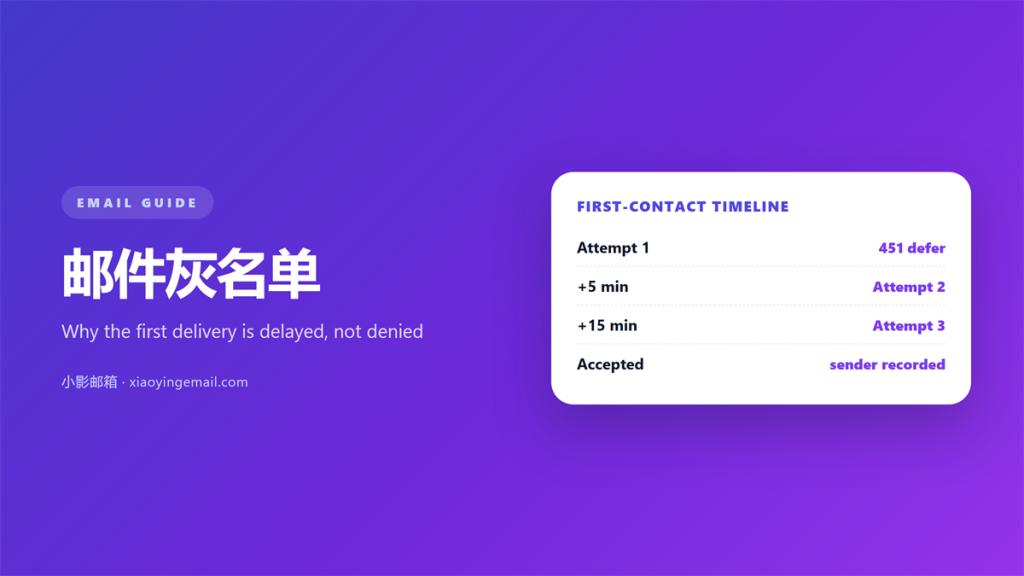
On the first attempt, the server records the sender address, the recipient and the connecting IP, then refuses with a temporary code. Notably, it stores the triplet rather than the message itself.
The retry that succeeds
When the same triplet appears again after the configured delay, the server recognises it and accepts the message. Consequently, real mail flows normally from the second attempt onward.
| Stage | Server reply | What happens next |
|---|---|---|
| Attempt 1 | Temporary failure | Sender pauses and queues |
| Attempt 2 | Accepted | Sender is recorded as trusted |
| Later mail | Accepted | No further delay |
| Spam bot | No retry | Message is never delivered |
What 邮件灰名单 delays cost
The delay is usually short, but it is not zero. In my logs, the first retry arrived around five minutes, and a slow sender took closer to fifteen.
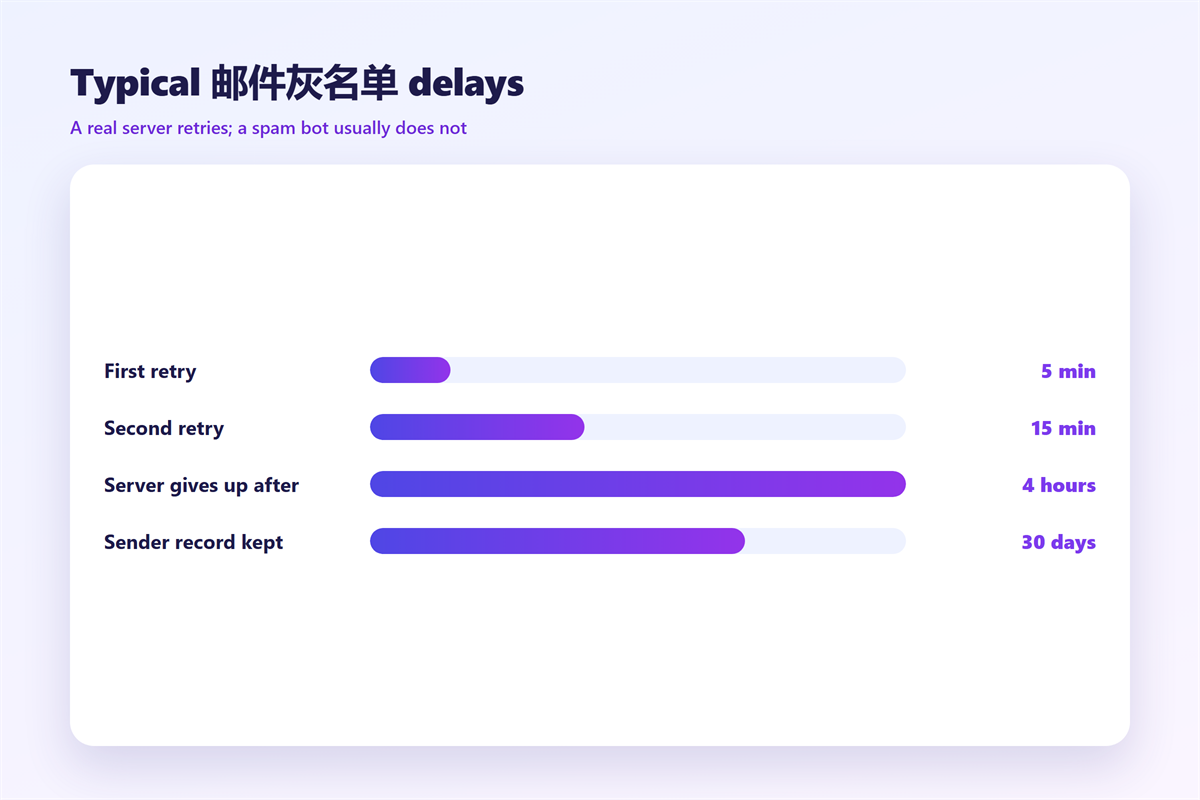
For ordinary correspondence this is invisible. For time-sensitive mail such as a sign-in code, however, a five-minute delay feels like a failure, which is why the mechanism needs tuning rather than blind adoption.
Therefore, most administrators keep an exemption list. Anything a user is actively waiting for should bypass 邮件灰名单 entirely, because the cost of a blocked code is much higher than the cost of one spam message.
邮件灰名单 versus blacklisting
These two filters are often confused, yet they behave in opposite ways. Blacklisting denies a message outright, while greylisting only postpones it.
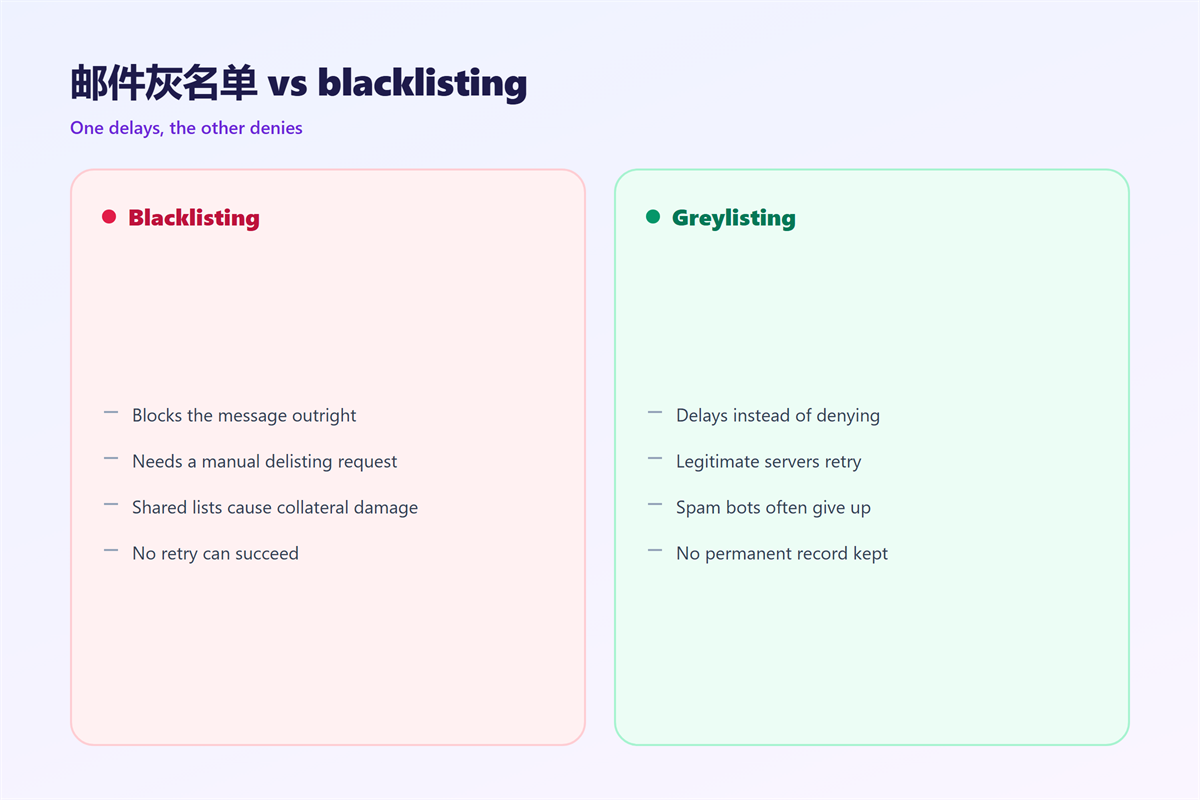
Therefore, 邮件灰名单 is the gentler tool. It also ages out old records automatically, so a sender that behaves well is never permanently marked.
When a message does fail for good, the reason is different, and the codes explained in 邮件退信 help you tell a temporary delay from a permanent refusal.
When 邮件灰名单 causes real problems
Greylisting is not free. The main cost is delay, and delay breaks two things in particular: automated notifications and anything a user is waiting for in real time.
- Verification codes that expire in minutes.
- Password reset links with short lifetimes.
- Senders that retry on a long schedule of several hours.
- Providers that route retries through a different IP.
Additionally, some large senders rotate through a pool of addresses, so the retry arrives from a different IP and fails the triplet check again. In that case, an allowlist entry is the practical fix, as described in 邮件白名单.
Meanwhile, the same delay can look like a fault to the recipient. Our notes on 邮件延迟 explain how to tell this apart from a genuine outage, and that distinction saves a lot of pointless troubleshooting.
There is a quieter cost as well. Users who never see the delay still notice the symptom, and a support ticket about a missing code costs more time than the spam that 邮件灰名单 blocked. Weigh that trade-off honestly before you enable it.
Turning 邮件灰名单 on safely
If you manage a server, greylisting is worth trying with three safeguards. First, set a short initial delay of about five minutes. Second, keep a generous record window of thirty days or more. Third, exempt your known senders before you enable it.
Furthermore, document the exemptions. A greylist that blocks your own payment provider is a self-inflicted outage, and the first symptom will be unexplained missing mail.
I would also test it against a real inbox first. Send a message from an external account and watch the clock, because that single experiment reveals whether the 邮件灰名单 delay is tolerable for your users.
FAQ
Is greylisting the same as a blocklist?
No. A blocklist refuses permanently, while a greylist accepts the message once the sender proves it retries. The intent and the outcome both differ.
How long are senders remembered?
It depends on configuration. Thirty days is a common window, after which 邮件灰名单 treats the sender as unknown again.
Why did my message arrive twice?
Sometimes a sender gives up too early and re-sends manually. The server then accepts both, so the duplicate comes from the sender rather than the filter.
Should small servers enable it?
Often yes, because the spam reduction is real and the configuration is light. However, keep 邮件灰名单 off for any address that receives login codes.
评论
还没有评论,来说两句吧。